


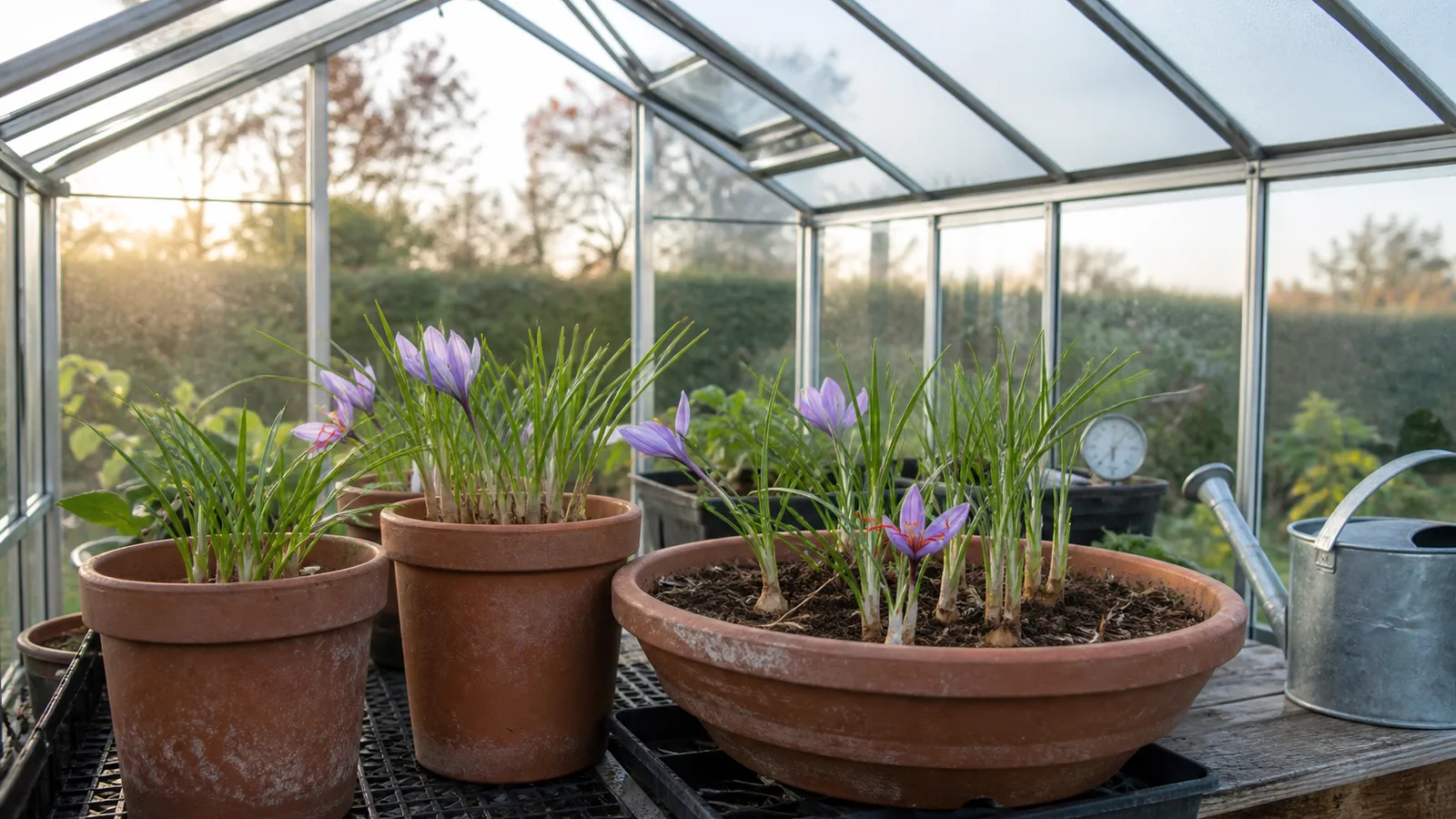
Growing saffron at home is possible in a garden bed, raised bed, deep container, high tunnel, or carefully managed greenhouse. The plant is not difficult because it needs constant attention; it is difficult when its seasonal rhythm is ignored. Healthy Crocus sativus corms need a dry dormancy, good drainage, an autumn flowering period, and enough winter and spring leaf growth to replenish the next generation of corms.
A greenhouse can make those conditions easier to manage in a very wet, very cold, or very hot climate. It can also create new problems. Warm, stagnant air and damp growing media encourage rot, while cooling, ventilation, benches, sensors, and labor add real cost. The useful question is not simply whether greenhouse saffron is “better,” but whether the structure solves a problem your local climate actually presents.
Can I grow saffron at home? Yes, if you can provide healthy corms, drainage, seasonal temperature changes, and patience. Is saffron hard to grow? A small container trial is manageable; producing a dependable commercial crop is much more demanding.
Can saffron be grown in a greenhouse?
Yes. Growing saffron in a greenhouse has been tested in soil beds, containers, crates, and controlled soilless systems. A greenhouse or high tunnel can shelter the crop from excessive rain, buffer temperature swings, and give a grower more control over irrigation. In hot regions, active cooling may make cultivation possible when open-field conditions are unsuitable.
That does not mean a basic plastic greenhouse can produce flowers at any temperature or in every month. Saffron is an autumn-flowering perennial with a yearly cycle. Advanced controlled-environment work can shift flowering by managing corm storage, temperature, light, and humidity, but “year-round cultivation” is not a default benefit of putting corms on greenhouse shelves. Each corm still has to complete the biological stages that support flowering and daughter-corm growth.
Greenhouse or container: choose the smallest system that works
For a home grower, a greenhouse is optional. The University of Vermont’s home-gardener saffron guidance describes successful production in garden beds, raised beds, containers, and lined crates. A deep pot in a sunny, protected position may be more sensible than a heated structure if the local summer is dry and the soil can drain freely.
- Use an outdoor bed where summers are dry enough, winters suit the plant, and standing water is not a problem.
- Use a raised bed or container where native soil is heavy, rodents are a concern, or you want easier control of drainage.
- Use an unheated high tunnel where protection from prolonged rain or severe winter exposure is the main need.
- Use a controlled greenhouse only when temperature, humidity, or production research justifies the equipment and energy.
How to grow saffron at home or in a greenhouse
1. Start with true saffron corms
Buy Crocus sativus from a reputable plant supplier. Saffron is propagated by corms, not seed. Garden catalogues often call them “saffron bulbs,” but a corm is a solid underground stem; the distinction matters when you plan how it multiplies. Corms sold under the regional name kesar should still carry the botanical name; how to grow kesar is the same cultivation question, not a different crop.
Choose firm corms without soft patches, mold, or major damage. Larger, mature corms generally have better flowering potential than undersized stock, but weight alone does not guarantee a crop. Origin, health, storage, planting density, and the growing environment all influence the result. The former recommendation to select corms by an unverified 40–55% moisture range is not a safe home inspection method.
2. Prepare a deep, freely draining root zone
Use a light to moderate soil or potting medium with organic matter and quick drainage. A container should have generous drainage holes and enough depth to place the corms properly while leaving room for roots. A saucer that remains full of water defeats the purpose.
Drainage is not a minor preference. The UVM guide warns that corms can rot after prolonged standing water. In a greenhouse, check both the growing medium and what is underneath a raised bed; a well-filled bed can still fail if water collects below it.
3. Plant at the right season, depth, and density
For the northern-hemisphere home-garden schedule described by UVM, corms are planted in August or early September rather than stored until spring. Local timing should be adjusted to the region and the supplier’s instructions, especially in a fully controlled system.
UVM’s home guidance uses a depth of about 6 inches (15 cm), with 6–12 corms per square foot, usually 3–4 inches apart. Other extension programmes and greenhouse studies use different depths and densities. That variation is evidence that there is no universal layout for every climate, corm size, or production goal.
At home, leave enough space to inspect the plants and divide daughter corms later. In commercial planning, record planted-bed area separately from aisles, benches, work space, and the greenhouse’s total footprint.
4. Manage temperature as a cycle, not one fixed number
A saffron greenhouse needs monitoring, shade or screening where appropriate, ventilation, and possibly heating or cooling. The former article’s single 23–25°C target did not identify the growth stage and should not be treated as a year-round setting. Flower initiation, flowering, leaf growth, and dormancy do not all call for the same conditions.
A recent controlled-greenhouse study in a hot, arid Saudi climate used cooling and examined how density and planting depth affected flowers, stigmas, and daughter corms. Its conditions are valuable research evidence, not a thermostat recipe that can be copied into an unrelated home greenhouse. Start with local extension guidance and corm-supplier information, then log the actual day/night environment.
5. Understand saffron humidity requirements
There is no single “optimal humidity for saffron cultivation” that applies to every system and every stage. The Saudi greenhouse study reported daytime relative humidity around 70–80% under its pad-and-fan operation. A separate contained soilless experiment controlled relative humidity at 60%. These are different research systems, not competing universal rules.
For a home soil or container setup, the practical safeguards are more important than chasing one percentage: provide air movement, prevent condensation from sitting on plants, avoid saturated media, and inspect corms for rot. Record humidity alongside temperature and watering because the variables interact. The old advice to hold 75–85% humidity while withholding water so corms absorb moisture from the air blurred two separate parts of plant management and has been removed.
6. Water the growing medium, not a calendar
Water after planting when the chosen local method calls for it, then allow excess water to drain. Outdoor UVM guidance notes that natural rainfall may be enough after planting in its climate. A greenhouse blocks rainfall, so the grower has to replace only the moisture the root zone needs.
Do not adopt late October, December, and February as three universal irrigation dates. Greenhouse material, pot volume, temperature, ventilation, plant stage, and local climate change the drying rate. Check moisture below the surface and keep a log. During summer dormancy, the corms need much drier conditions than actively growing leaves.
7. Check for flowers frequently and harvest cleanly
Flowering is brief, so inspect the plants every morning once buds appear. Pick clean flowers promptly, then separate the three red stigmas from the petals and yellow stamens. Use clean hands or tools and keep harvested flowers out of direct sun while you work.
Drying determines whether the spice stores safely and retains a useful aroma. A small home harvest can be dried with a controlled dehydrator or another documented method, then cooled and sealed in a clean, airtight container away from light and moisture. Do not package threads that still feel damp.
8. Keep the leaves after flowering
The plant is not finished when the red stigmas are picked. Its narrow leaves continue growing through winter and spring and help build daughter corms. Leave them in place until they yellow and die back naturally. Cutting green leaves for a tidier bench weakens the next cycle.
When the plant enters summer dormancy, reduce moisture and decide whether the corms will stay in the bed, be divided, or be moved in their containers. Disinfecting tools and clearing diseased plant material is sensible hygiene; “disinfect the greenhouse” is too vague to justify applying an unspecified chemical.
What is a realistic greenhouse saffron yield per square meter?
No honest grower can promise one yield from floor area alone. Corm size and health, number of flowering corms, density, climate control, planting depth, disease, harvest timing, drying, and crop year all affect the dry stigma weight.
In a two-year University of Vermont high-tunnel study, first-year dry stigma yield averaged about 0.88–1.39 g per square meter at a planting density of 100 corms per square meter, with crates outperforming in-ground beds in that trial. Those numbers are a documented comparison, not a sales forecast for another greenhouse.
A newer controlled-greenhouse experiment tested 67, 100, and 200 corms per square meter. Higher density increased flower and stigma yield per unit area but reduced performance per individual plant, and planting depth affected daughter-corm development. This is why the most crowded shelf is not automatically the best long-term system.
How many saffron corms are needed per hectare?
Density has to be chosen before a hectare figure means anything. The experimental densities above equal 670,000, 1,000,000, or 2,000,000 corms per hectare of planted bed. They are not recommendations, and a working greenhouse hectare includes aisles and service areas. The old claim that a 150 m² greenhouse simply “needs six tons” of corms hid the assumed corm weight, density, planted area, and production goal, so it could not support a purchase decision.
Advantages of greenhouse saffron cultivation
- Protection from excessive rain and some weather extremes.
- More control over irrigation, ventilation, temperature, and crop records.
- Use of containers or benches where native soil is unsuitable.
- Easier daily inspection and flower collection in a compact trial.
- A way to test saffron in climates where open-field production would be unreliable.
None of these advantages guarantees higher-quality spice. Quality also depends on plant material, harvest timing, stigma handling, drying, and storage. A greenhouse reduces some exposures; it does not make a crop automatically hygienic or pest-free.
Disadvantages and costs to plan for
Greenhouse saffron farming only makes financial sense after the system, labor, crop quality, and market have been tested locally.
- Structure, cooling, heating, ventilation, sensors, irrigation, and energy costs.
- Dense plantings can spread rot or other problems quickly if inspection is poor.
- Flower picking and stigma separation remain delicate manual work.
- Benches and aisles reduce the area that actually holds corms.
- Daughter corms need space and a plan after flowering.
- A failed temperature or ventilation system can affect the whole crop at once.
- The local market and achievable dried-spice quality have to be tested, not assumed.
Start with a home trial before planning saffron farming
For a first season, grow a small, labelled group of corms in one or two deep containers. Record their source, size range, planting date, depth, spacing, temperature, humidity, watering, flower count, and dry stigma weight. Keep a second container only if you have a useful comparison to test.
That modest trial will answer more than a generic profit estimate. It will show whether your environment supports flowering, whether the media drains, when local leaves emerge, and how much labor each gram requires. If the plants complete a healthy cycle and produce sound daughter corms, you then have evidence for scaling the system. Greenhouse cultivation is gaining attention because control can be useful, but careful growing saffron at home begins with the plant’s needs, not the size of the building.

![Exporting Saffron to Turkey + Price Guide [Complete 0 to 100]](https://img.rowhanisaffron.com/20260827003933/saffron-export-turkey-quality-inspection.webp)



