


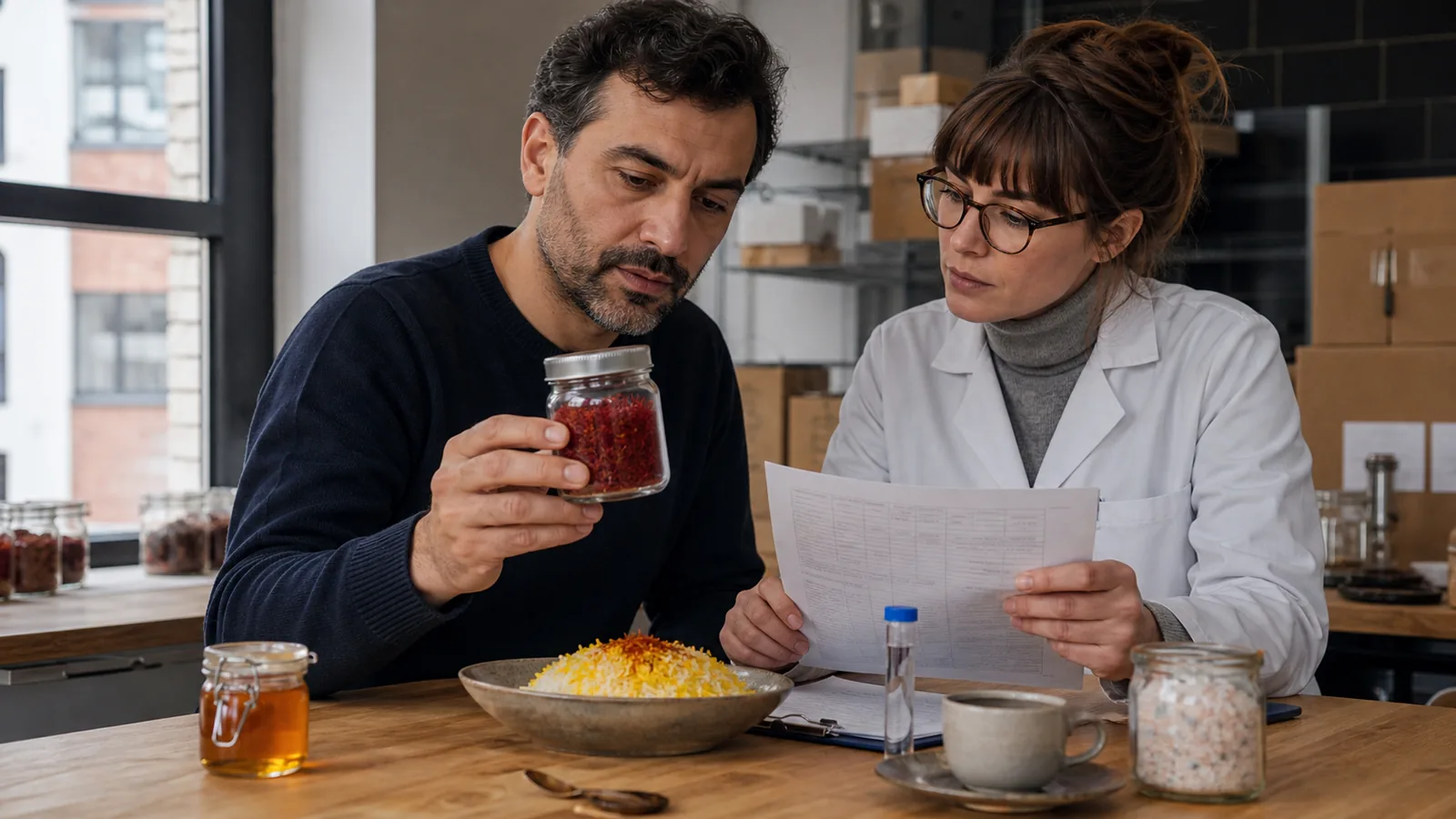
German prosperity of small businesses with Iranian saffron is less a story about one fashionable spice than about what happens after a raw ingredient crosses a border. In 2016, the Berlin company Miasa showed how Iranian saffron could support a small European food business through careful sourcing, quality control, product development and sales to several kinds of customer.
The original account contained several damaged names and phrases. The founder was Michael Sabet, not “Michael Fix,” and the company was Miasa GmbH, not “Myasa.” Those corrections matter because the business still has a public history and the 2016 claims can be checked against contemporary material.
How Iranian saffron became a German business
Sabet, an Iranian-German executive, founded Miasa in Berlin in 2010 after working in banking and business development. In the period account, he described leaving that career six years earlier and building a company around saffron imported from Iran. He said the business was doubling its revenue each year at the time. That is a historical growth claim, not a statement about the company’s finances today.
The idea began with a packet of saffron brought back from Iran. Sabet, who has an Iranian father and a German mother, became interested in the ingredient, returned to learn more about its production and studied Persian as part of that process. He described the decision as a new adventure that opened a different professional world.
The phrase saffron in German can also mean the name of the spice: it is Safran. In this story, though, it means something more specific—how saffron from Iran moved through a German importer and into food manufacturing, hospitality and retail.
Not simply a packet of threads
Miasa sold high-quality saffron as a raw ingredient for industrial users, but it also developed finished products. The period range included about 20 items, from saffron sea salt to honey, rice and coffee. The company sold through its own website and selected luxury stores in Berlin, while also supplying larger professional customers.
This two-part model is important. Bulk saffron provided a commercial foundation; branded foods allowed a small company to add work, presentation and margin around the same raw material. A 2015 Miasa interview described the arrangement as a hybrid business: raw-material sales supported the company while branded, value-added products developed the consumer side.
Contemporary company material also listed saffron rice, honey, balsamic vinegar, espresso, liqueur and pasta. The exact range has changed over time, so these products should be read as evidence of the company’s approach rather than as a current catalogue.
Different markets wanted different products
The 2016 report did not describe Europe and the Persian Gulf as one market. In parts of Europe, growing interest in fine food, cooking programmes and West Asian cuisine helped specialist saffron products find buyers. Sweden was singled out because saffron has a familiar place in Christmas baking. Gulf customers, by contrast, were described as more interested in prepared and packaged products such as saffron rice.
That contrast helps explain why exporting the same packet everywhere is rarely enough. A useful saffron product must fit the cooking habits, retail format, price expectations and labelling rules of the market where it will be sold. The underlying spice may be identical; the product surrounding it may need to change.
Why Miasa kept sourcing from Iran
Sabet explored growing saffron in Germany’s Black Forest, according to the original account. The trial did not supply the volume needed for industrial sales. Saffron can grow in parts of Europe, but a small successful plot is not the same thing as a dependable commercial supply chain.
Iran already had the growers, harvest knowledge, drying experience and scale that the business required. The 2016 article described Iran as producing nearly 90% of the world’s saffron at the time. Because global production estimates vary by year and method, that figure belongs to the report’s period rather than being treated as a permanent current share.
The original page also contained a broken sentence claiming that “every 100 grams” of a saffron plant produced an incomplete quantity. That statement cannot be recovered reliably and has not been repeated. What is clear is that usable saffron consists of the dried stigmas of Crocus sativus, so large quantities of flowers and careful hand work are needed to produce a kilogram of finished spice.
Quality had to travel with the saffron
Importing Iranian saffron was only the beginning of Miasa’s work. In a detailed 2015 interview, Sabet said the company visited north-eastern Iran during harvest, identified lots with batch numbers and used laboratory checks both near the source and again in Germany. He also stressed the handling steps that happen before a laboratory receives a sample: clean separation of the threads, controlled drying, suitable moisture and protective packaging.
Those controls solve two problems at once. They help a buyer verify that the material meets an agreed specification, and they make it possible to trace a lot back through the supply chain if a complaint arises. Under Article 18 of the EU General Food Law, food businesses must be able to identify their suppliers and the businesses they supply. A brand story cannot replace those records.
For a modern saffron importer, the practical file for each lot should connect the purchase order, supplier, origin documentation, batch identity, test report, packing record and customers who received it. Attractive packaging comes after that chain is secure.
The 2016 opening in German-Iranian trade
The original report placed Miasa’s growth in the atmosphere following the easing of some sanctions on Iran. Sigmar Gabriel—Germany’s economy minister and vice-chancellor at the time, not its finance minister—visited Iran with a business delegation as German companies explored renewed trade ties.
Sabet said Germany had long maintained good relations with Iran and hoped the changed sanctions environment would support both exports and imports. The remark captures the optimism of that moment, but it is not current compliance guidance. Rules, restricted parties, banking access and shipment routes can change. Any business importing Iranian saffron today needs advice based on the parties and jurisdictions involved in the actual transaction.
What made the small-business model work
Miasa’s period story points to a sequence that is still more useful than a generic promise to sell “premium saffron”:
- Know the source. Direct harvest-season contact made it easier to understand variation between lots.
- Define the specification. Buyers need measurable requirements, not quality adjectives alone.
- Test and trace the batch. The lot supplied to a chef or manufacturer should connect back to the records received from the exporter.
- Serve more than one channel. Industrial raw material, hospitality packs and branded consumer products solve different needs.
- Develop products for the market. Saffron rice for one audience and saffron honey or coffee for another are deliberate choices, not decorative variations.
- Keep the history dated. Revenue growth, product ranges and market access reported in 2015 or 2016 should not be presented as current facts without new evidence.
Where the prosperity was created
The German prosperity in this case did not come from changing the origin of the saffron. It came from the work placed around Iranian saffron: selecting lots, testing them, keeping records, building products, explaining their use and reaching retailers, chefs and manufacturers.
That does not mean all value must be added outside Iran. It shows why exporters gain more durable relationships when they can provide consistent specifications, batch documentation and product ideas as well as the spice itself. The better those capabilities are at origin, the easier it becomes for both Iranian suppliers and overseas small businesses to build value without losing the identity of the ingredient.
What remains true—and what has changed
The names and growth figures on this page describe a particular business at a particular time. Miasa’s current website still presents the company as a Berlin-based saffron specialist working with chefs and small manufacturers, but it should not be used to infer that every product, sales channel or financial result from 2016 remains unchanged.
The lasting lesson is narrower and stronger. Iranian saffron can support a specialised German food business when provenance, handling and compliance are treated as part of the product. A beautiful jar may attract the first look. Repeat business depends on whether the saffron inside arrives with the flavour, consistency and documentation the customer was promised.
Sources reviewed: the October 2016 business report, Miasa’s contemporary 2015 founder interview and press material, the company’s current public history, and EU General Food Law traceability requirements. Historical company statements are attributed and dated rather than presented as independently audited current results.

![Exporting Saffron to Turkey + Price Guide [Complete 0 to 100]](https://img.rowhanisaffron.com/20260827003933/saffron-export-turkey-quality-inspection.webp)



