


Forecast for harvesting more than 9 tons of saffron in the village of Rokh in Iran referred to a historical forecast for the Rokh district of Torbat Heydarieh, not a verified result from one village. Mohammad Reza Abbaspour, then head of the county’s Agricultural Jihad office, expected roughly 9.99 tonnes of dry saffron from the district’s fields.
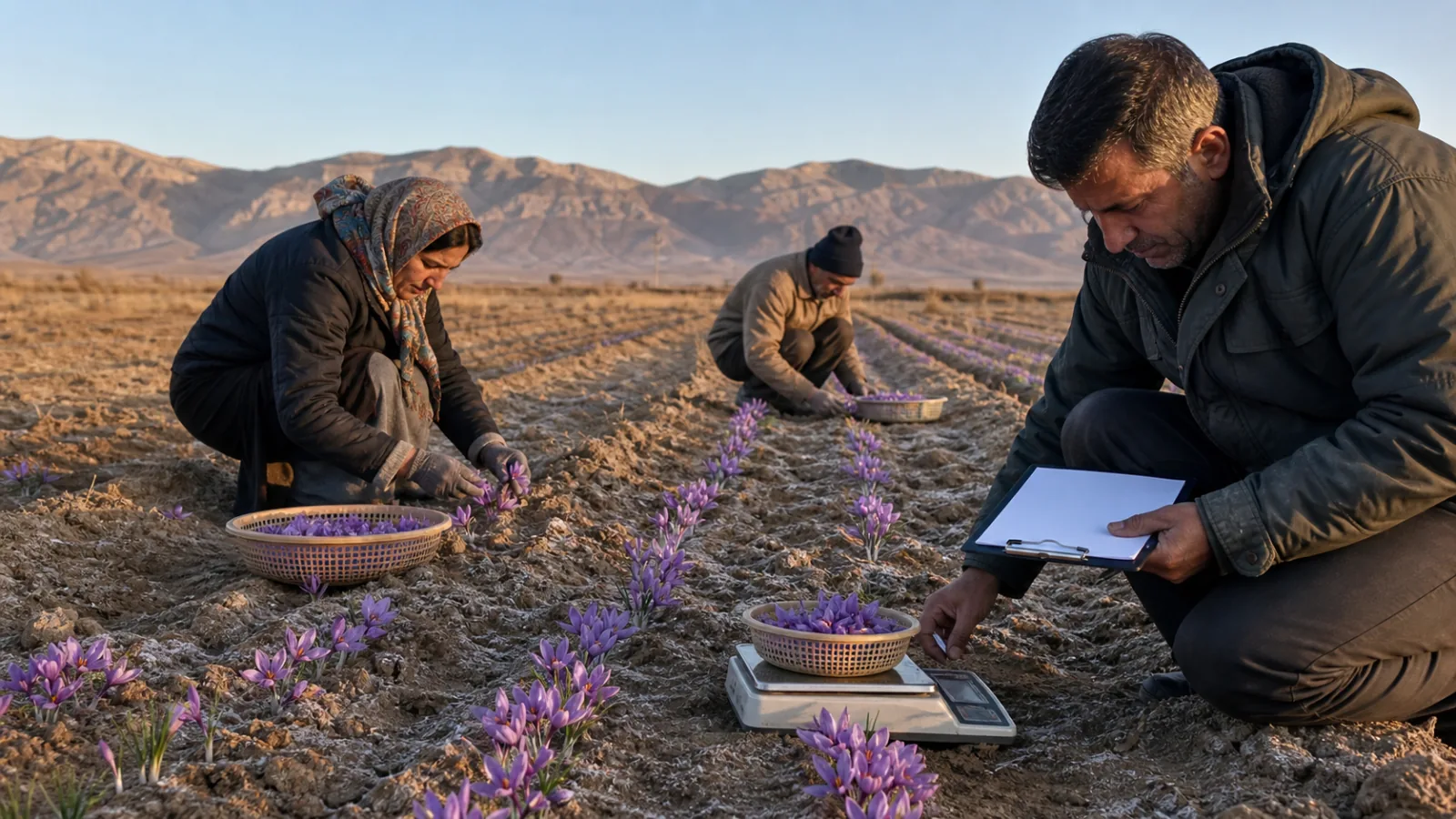
The forecast came with a warning: output was expected to be about 30% below the previous season after drought, reduced rainfall, summer heat and frost. That context matters more than the headline alone.
Rokh district, not a single village
The title’s “village of Rokh” is an old translation. Rokh is a district within Torbat Heydarieh County in Razavi Khorasan. The report said the county had 8,765 hectares of saffron and placed more than 2,000 hectares in Rokh.
Those two area figures have different boundaries. The nine-tonne forecast applies to Rokh’s share, while 8,765 hectares describes the wider county. Combining the district’s production with the county’s area would produce a misleading yield.
Flower weight and dry saffron are not interchangeable
Abbaspour estimated 500 to 600 kilograms of fresh saffron flowers per hectare and roughly 4.5 to 5 kilograms of dry saffron per hectare. The old English wording was damaged, but the two ranges describe separate stages of the harvest.
A field’s flowers include petals, stamens, stigmas and considerable moisture. Dry saffron is the much smaller, processed stigma portion. Any useful yield record therefore needs to state whether it measures fresh flowers or dry spice, and whether the denominator is planted area or productive bearing area.
At more than 2,000 hectares, a dry yield around the reported range is consistent with a forecast exceeding nine tonnes. It still does not prove that the crop reached the estimate. A forecast should be replaced by a final weighed total only when that result is available.
Why the forecast was lower
The official attributed the expected 30% decline to several stresses acting in sequence: drought, less precipitation, unusually high summer heat and frost during the current autumn period. Each can affect a different part of the saffron cycle.
Water stress can weaken corm growth and flower initiation. Excessive soil heat can affect corm condition, while frost at emergence or flowering can damage flowers and disrupt daily picking. A district average can also hide fields that experienced very different conditions.
The old report did not publish weather-station data, field samples or the previous year’s final weight. Its cause-and-effect statement should therefore be read as the local official’s assessment, not as a controlled attribution of exactly how much each stress cost.
Planting and harvest calendar
The account placed saffron-corm planting from early August through September and harvesting from late October to the end of November. These are approximate Gregorian windows translated from a local seasonal report, and altitude and autumn temperatures can shift flowering between fields.
Planting dates alone do not determine success. Corm health and size, soil drainage, planting depth, temperature, irrigation timing and stand age all influence emergence and yield. Our guide to saffron cultivation explains how those decisions fit together.
During flowering, harvest crews need to inspect fields every day, pick before heat and trampling damage the flowers, and move them promptly to a clean separation and drying area.
How the fields were irrigated
The original article said saffron was grown using “rainfed, dripping and traditional” methods. In context, the first term appears more likely to mean sprinkler irrigation. Because the underlying wording was not supplied, it is safest to record the reported categories as sprinkler or rain-dependent, drip and traditional surface methods rather than declare one translation certain.
Method names do not show actual consumption. A drip system can still be poorly scheduled, and a traditional system can vary greatly by soil and field design. Water delivered, source, salinity and timing are the figures needed for a meaningful comparison.
Production share claims need a date
The report described Torbat Heydarieh as a saffron-production hub and said Razavi Khorasan produced more than 80% of Iran’s saffron, while Iran produced about 90% of the world’s supply. Those were historical share claims tied to the reporting period, not permanent ratios.
An official IANA account of saffron warehousing and trading in Torbat Heydarieh supports the county’s established production role. It does not confirm that the same national or global percentages apply today.
What a final harvest report should contain
To turn the forecast into an auditable result, a follow-up would need the dry weight from Rokh alone, its bearing hectares, sampling and moisture basis, and the comparable previous-season figures. It should also separate new plantings from mature fields and report quality grades rather than tonnes only.
The most useful conclusion is not that Rokh was guaranteed more than nine tonnes. It is that a large saffron district entered harvest with a plausible production estimate and a serious climate-related decline to explain. Preserving both parts gives farmers and buyers a much more honest picture of the season.

![Exporting Saffron to Turkey + Price Guide [Complete 0 to 100]](https://img.rowhanisaffron.com/20260827003933/saffron-export-turkey-quality-inspection.webp)



