


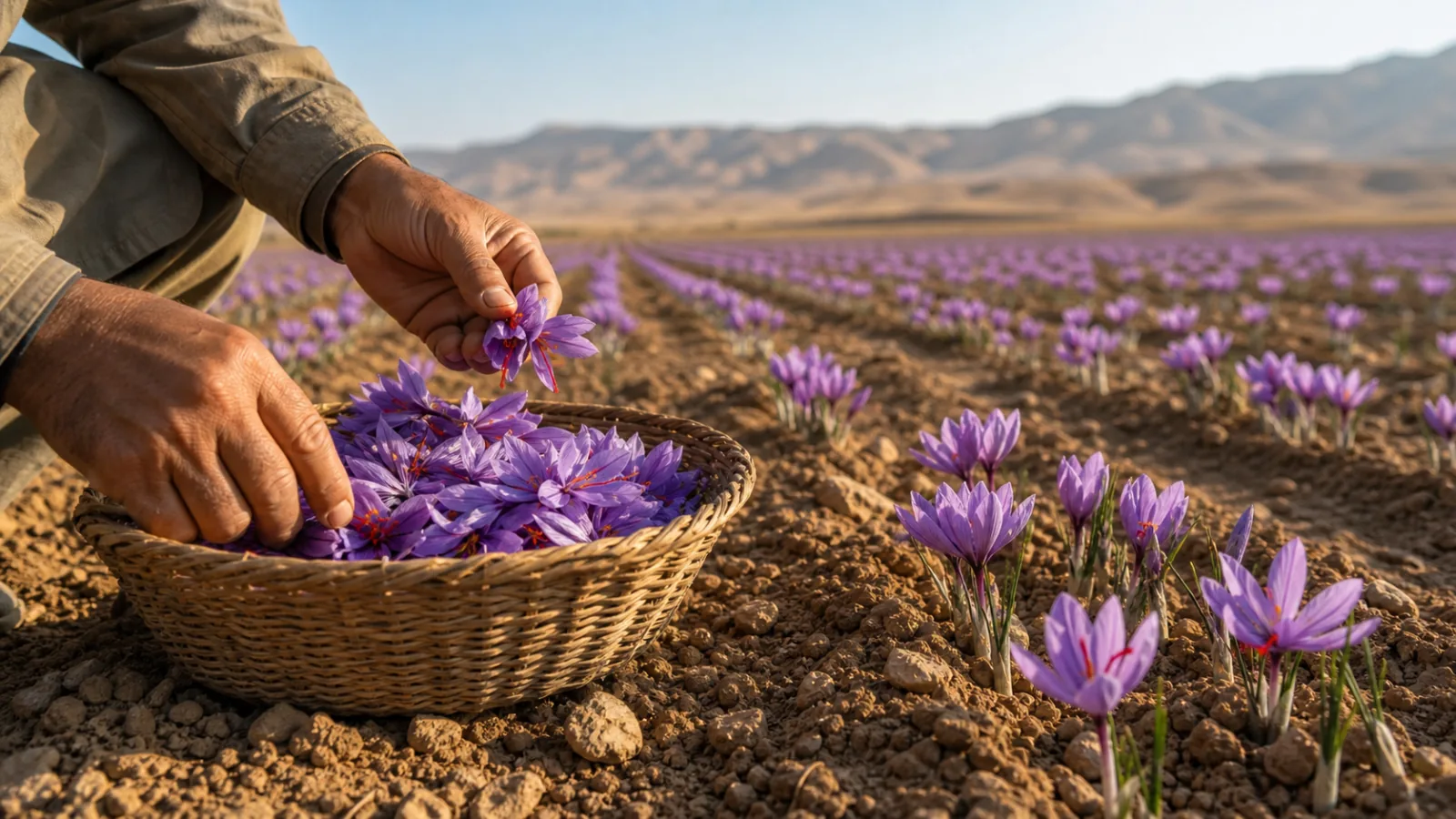
Fars Province has a well-established saffron sector, with production concentrated in cooler, drier districts such as Estahban, Bavanat, Abadeh, Eghlid and Sepidan. A provincial agriculture report published before this article first appeared described Fars as Iran’s fifth-ranking saffron province at the time. That historical position matters, but it should not be confused with a permanent national ranking: planted area, mature fields and harvests change from season to season.
The same report said about 60 hectares had been assigned to the expansion of saffron cultivation that year, 15 percent more than the previous year. It also referred to more than 400 hectares already under the crop and an ambition to pass 1,000 hectares in the future. Those figures record the programme as it was announced; they are not presented here as current acreage.
Why saffron can suit parts of Fars Province
Saffron is not suited to every warm or dry location. The plant grows from a corm, flowers in autumn and develops much of its foliage through the cooler part of the year. It generally favours a climate with hot, dry summers, cooler winters and soil that drains freely. Several upland districts of Fars offer that broad pattern, although suitability still varies between individual fields.
Research carried out at Shiraz University’s Bajgah Agricultural Experiment Station describes saffron production under Fars Province’s semi-arid conditions. Another eight-year experiment in the Bajgah region found that annual rainfall alone was not enough to predict the yield of rain-fed saffron; the timing and distribution of rain also mattered. That is an important caution for growers. A low-water crop is not a no-management crop.
Before planting, a farmer still needs to assess drainage, soil texture, salinity, irrigation-water quality, winter cold, autumn temperature and the availability of labour during the short flowering period. The site should be judged on local measurements, not on the province’s reputation as a whole. Our broader guide to saffron growing conditions explains how these requirements fit together.
The Fars expansion figures in their historical context
Mehrzad Kherad, identified in the original report as an official with the Fars Agricultural Jihad Organization, said the province had increased the area devoted to saffron development by 60 hectares. He named Estahban, Bavanat, Abadeh, Eghlid and Sepidan among the producing counties and said farmers had received training and cultivation facilities.
The translated report also referred to 174 hectares identified across the years written as “92, 93 and 94.” In the Iranian context these appear to refer to years in the Solar Hijri calendar, but the surviving wording does not make clear whether 174 hectares was a cumulative figure, a target or an area prepared in one phase. It is safer to retain the number with that limitation than to manufacture precision the source does not provide.
A later Iranian submission to the Codex Committee on Spices and Culinary Herbs gives a useful independent benchmark. Using Ministry of Agriculture-Jahad statistics for 2014–2015, it recorded 529 hectares of saffron in Fars, production of 1.587 tonnes and an average yield of 3.2 kilograms per hectare. In that table, Razavi Khorasan and South Khorasan remained far ahead in total area and output. Fars was nevertheless part of the country’s significant second tier of producing provinces.
What determines whether expansion succeeds
Adding hectares is only the first step. The crop occupies the same ground for several years, so early decisions about corm health, planting density and drainage shape more than one harvest. A poorly selected site can lock a grower into weak flowering, disease pressure or expensive corrections.
Four practical issues deserve particular attention in Fars:
- Field selection: heavy waterlogging and saline conditions can damage corms and reduce performance. Soil and water tests should come before a commercial planting decision.
- Irrigation timing: local rainfall is variable. Irrigation should respond to crop stage, soil moisture and the season rather than follow a province-wide calendar without adjustment.
- Harvest labour: flowers open over a compressed period and are best collected promptly. Expanding the field without a labour plan can sacrifice quality at the point when the crop is most valuable.
- Post-harvest handling: clean separation, controlled drying, protection from moisture and light, and lot records determine whether the harvested stigmas become a consistent saleable spice.
Training mentioned in the original programme was therefore more than an administrative detail. New growers need practical instruction before planting and again at harvest, when delays or rough handling can undo months of field work.
Water use needs a field-level plan
Saffron is often promoted in Iran as an option for dry areas because its active season avoids part of the hottest summer period. That does not mean all expansion automatically saves water. The relevant questions are how much irrigation the field actually receives, where that water comes from, what crop it replaces and whether the resulting yield makes efficient use of the resource.
Studies in semi-arid Fars have examined irrigation intervals, soil salinity and planting methods because these conditions interact. A schedule that works on one soil may cause unnecessary deep drainage or stress on another. Rain-fed production is possible in some settings, but the Bajgah research shows why growers cannot base a harvest forecast on annual rainfall totals alone.
From flowers to a dependable Fars product
A larger planted area benefits growers only when the saffron reaches buyers in good condition. Flowers must be picked, transported and separated cleanly. Stigmas then need even drying and storage that protects their aroma, colour and purity. Mixing lots of different quality can erase the value created by careful field work.
Traceability can also give Fars producers a clearer identity in a market dominated by Khorasan. Recording the farm, harvest date, processing method, test results and packer makes a regional claim verifiable. It is a more durable form of differentiation than relying on a broad claim that the province is “one of the largest.”
How to read the original growth target today
The announced goal of moving from more than 400 hectares toward 1,000 hectares captured genuine interest in saffron as a higher-value crop for suitable parts of Fars. It did not guarantee that every proposed hectare would be planted, remain productive or earn the same return.
The sound conclusion is narrower and more useful: Fars had already developed a meaningful saffron sector, and several of its cooler semi-arid districts had conditions worth evaluating. Future growth should be measured by healthy fields, consistent yield, responsible water use and saleable quality—not by acreage alone.
Historical production figures are drawn from the original provincial report cited by this article and the Iranian discussion paper submitted to the Codex Committee on Spices and Culinary Herbs. Agronomic context includes the eight-year Bajgah rainfall and saffron study indexed by FAO AGRIS.

![Exporting Saffron to Turkey + Price Guide [Complete 0 to 100]](https://img.rowhanisaffron.com/20260827003933/saffron-export-turkey-quality-inspection.webp)



