


The first integrated saffron chain in Semnan province was licensed in 2020, according to an announcement from the provincial Agricultural Jihad Organization. The plan linked field work near Bastam with processing and packaging in Shahroud Industrial Town.
This is a historical report about the project at the licensing stage. Its investment figures and equipment plans describe that 2020 announcement and should not be treated as a current operating statement.
What an integrated saffron chain was meant to cover
Rahmatullah Kashi, then director of agricultural industries for the provincial organization, said the licence brought the main stages of the saffron business into one coordinated chain. He listed planting, crop maintenance, harvesting, processing, packaging, purchasing and sales.
The idea was broader than a single packing workshop. Field operations and mechanisation services would support production, while a separate industrial unit would handle saffron flowers and finished saffron products after harvest.
Field work near Bastam and processing in Shahroud
The project divided its work between two locations. Planting, crop care, harvesting and associated machinery services were planned for the area behind Bastam. Processing and packaging were assigned to a facility in Shahroud Industrial Town.
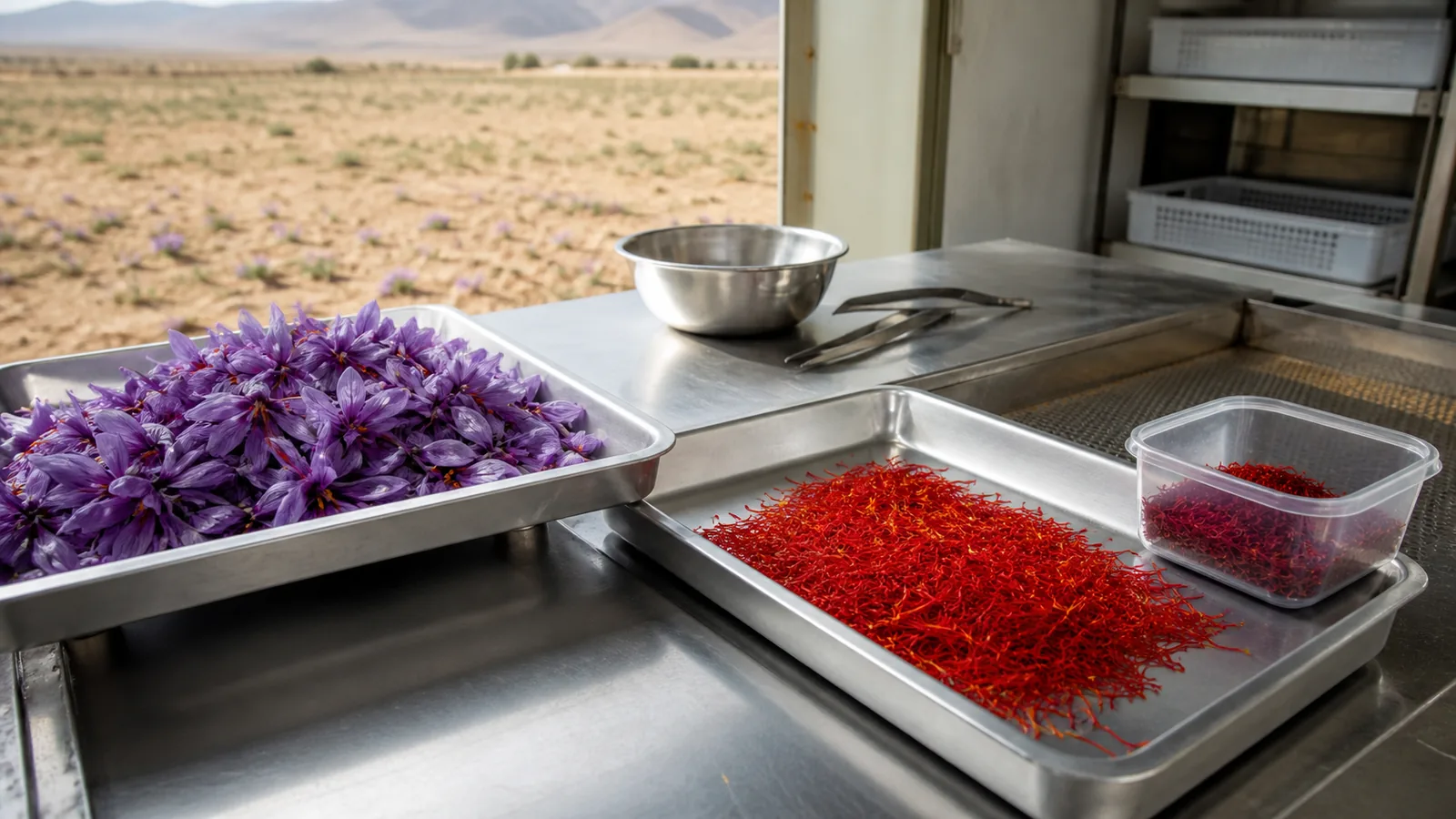
That separation reflected the practical stages of saffron production. Flowers have to be collected close to the farms, while sorting, cleaning, drying and packing need controlled handling and suitable equipment.
Investment announced for the Semnan saffron chain
Kashi put the chain’s fixed investment at 30 billion rials. Of that wider plan, machinery for the saffron-processing section was valued at 10 billion rials and was expected to come from domestic manufacturers.
A further 2.17 billion rials was associated with the mechanisation equipment listed in the announcement. Because these are nominal figures from 2020, comparing them directly with present-day project costs would be misleading.
Machinery named in the original plan
The translated equipment list referred to an ITM 485 tractor, a seven-branch roller or chisel implement, a rotary implement, a saffron field machine, a three-tonne sprayer and a 700-litre mounted sprayer.
Some equipment names in the original English rendering are imprecise, so they are best understood as a project inventory rather than technical specifications for selecting machinery.
Why coordination matters after saffron is picked
Saffron quality can be affected at several points between flower collection and final packaging. Flowers must be handled promptly, the stigmas separated cleanly, and the spice dried and stored under controlled conditions.
An integrated chain can make responsibility across those steps clearer. It can also connect growers with processing capacity and a route to market, instead of leaving each stage to operate independently.
What the announcement did not establish
The issuance of a licence showed that the Semnan project had formal approval to proceed. It did not, by itself, prove that every unit had been completed, that all equipment had been installed or that the chain later reached its intended production capacity.
For that reason, the most accurate reading is straightforward: in June 2020, Semnan province announced its first licensed integrated saffron chain, with field operations near Bastam, industrial processing in Shahroud and a stated fixed investment of 30 billion rials.

![Exporting Saffron to Turkey + Price Guide [Complete 0 to 100]](https://img.rowhanisaffron.com/20260827003933/saffron-export-turkey-quality-inspection.webp)



