


The economy of 160,000 rural households dependent on saffron production was the central warning in an earlier statement by a member of Iran’s National Saffron Council. The exact total needs a date and method, but the underlying issue is clear: weaknesses between field and market can reach far beyond a single harvest.
What the 160,000-household statement claimed
The source identifies the speaker only as Hosseini and describes him as a member of the National Saffron Council. He said the livelihoods of 160,000 rural households in Iran depended on saffron production. The report did not state the year, provinces covered, meaning of “dependent,” or whether the count included growers, seasonal workers, processors and traders.
That missing definition prevents the figure from being treated as a current census. A household earning a small seasonal share from saffron is different from one relying on it for most annual income. Both matter, but policy decisions need to know which group is being counted.
Official FAO material on Iran’s qanat-based saffron farming system in Gonabad describes saffron as important to livelihoods and employment under severe water scarcity. It supports the broader social significance of the crop, not the specific 160,000-household total.
Dependence should be measured, not assumed
A useful household study separates gross saffron revenue from net income after corms, water, labour, drying and marketing. It also records income from other crops, livestock, wages and remittances. This shows whether saffron diversifies a household’s risk or concentrates it.
A study of 355 households in 13 villages of Roshtkhar found that 43.9 percent of the surveyed households earned more annual revenue from saffron than from their other sources. That local result illustrates how dependence can be measured. It cannot be extrapolated to all Iranian saffron households without a representative national sample.
The 5,000-toman and two-dollar comparison is historical
Hosseini said Iranian consumers paid about 5,000 tomans for one gram of saffron, while the same gram was worth about two US dollars in world markets. The comparison lacks a date, exchange rate, grade, package size and trade level. A retail gram in a consumer pack cannot be compared fairly with bulk export value without adjusting for those differences.
Both numbers are retained as part of the original argument, not as current prices. A present comparison would use dated domestic and export transactions for the same quality, volume, delivery point and payment terms. It would also show packaging, testing, freight, finance and distributor costs between producer and consumer.
Quality protects income only when it is verifiable
Hosseini argued that the Ministry of Agriculture Jihad should not be indifferent to quality production. He warned that the Iranian saffron brand could disappear when product was repackaged in other countries.
Quality is not secured by a national claim alone. Grower and plot identity, harvest date, drying method, moisture control, clean handling, storage and laboratory results need to remain connected to each lot. If lots are mixed before those records are captured, careful work at the farm can no longer be distinguished from weaker material.
Origin and quality are related but not interchangeable. “Iranian” identifies provenance; it does not by itself establish a grade. A durable brand needs both truthful origin and repeatable product evidence.
What “complementary industries” means in practice
The source lists a lack of suitable complementary industries among saffron’s problems. For growers, that broad phrase becomes concrete after flowers are picked: collection points, clean stigma-separation spaces, controlled drying, suitable packaging, laboratories, storage, transport and facilities that can keep lots separate.
A missing or distant service raises cost and delay. It can force a household to sell flowers or poorly documented product quickly, giving more value and control to the next buyer. Investment is useful when it solves a measured bottleneck, not simply when a building or machine is labelled as saffron infrastructure.
Low yield per unit area has several possible causes
Hosseini also cited low production performance per unit area. Yield can be weakened by small or unhealthy corms, unsuitable density, field age, poor drainage, irrigation timing, weeds, disease, weather, late harvest and processing losses. A provincial average cannot reveal which cause matters on a particular farm.
Records should separate fresh flower weight from dry stigma output and compare fields of similar age. Counting only harvested kilograms may also hide rejected quality. Extension support is strongest when it diagnoses the limiting stage rather than prescribing the same input to every household.
Improper processing transfers risk to the household
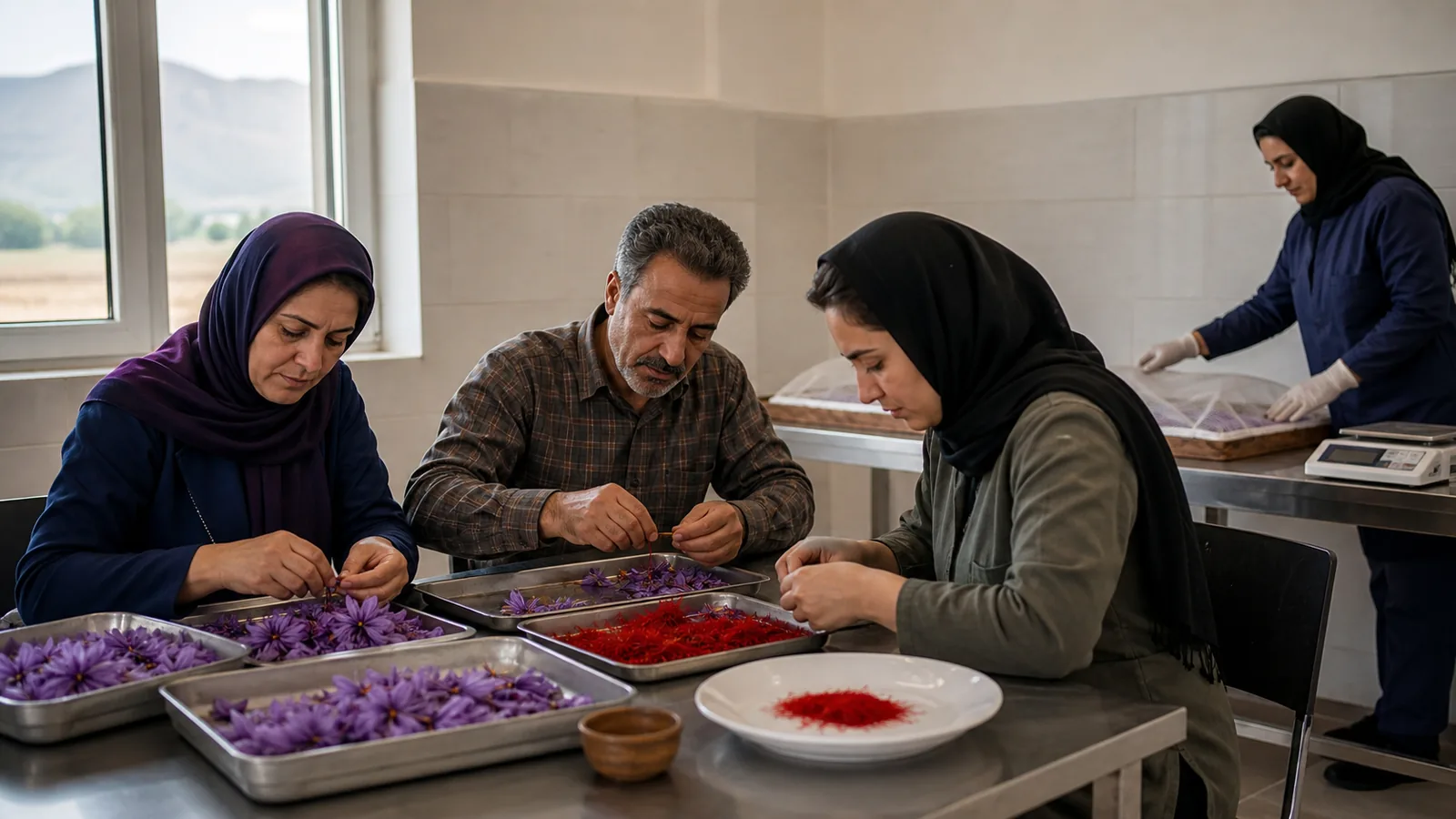
The original statement named improper processing as another concern. Saffron flowers are perishable, and the short flowering window creates pressure to separate and dry stigmas quickly. Household labour may carry much of this work, often alongside field harvest and other responsibilities.
A practical improvement programme needs clean work surfaces, trained handling, consistent drying controls, protected storage and a way to verify the finished lot. It should also count labour time honestly. A process that raises sale value but demands unpaid overnight work may not improve household welfare as much as the price suggests.
Managing the chain from production to market
Hosseini said the Ministry should manage the sector so that problems from production through the saffron market would not remain a concern for producers and exporters. No agency can remove all price, weather or buyer risk, but the chain can make risk more visible and fairly allocated.
Growers need clear quality specifications before harvest, transparent weighing and grading, written payment terms and a route for disputes. Processors need reliable raw material and traceability. Exporters need compliant, consistent lots. When information moves in both directions, farm decisions can reflect what the market actually accepts.
Recent peer-reviewed research on Iran’s saffron supply chain likewise identifies packaging, branding, marketing and access to markets as important constraints. Its analysis supports coordinated supply-chain work, not a promise that one intervention will raise every household’s income.
The proposed Saffron Crisis Headquarters
The National Saffron Council member proposed a body translated as the “Saffron Crisis Headquarters.” He connected it with plans to produce 500 tonnes of saffron, modest production growth, and the need to protect product quality and health.
The phrase reflects concern about coordination, but the source gives no mandate, membership, budget or reporting structure. A new committee is useful only if it has defined decisions to make, data it can audit, and accountability for results. Production targets should also be matched with demand, processing capacity, water, quality and household return.
Why a 500-tonne target is not enough
A higher national total can coexist with lower prices or greater household risk. If output rises faster than quality-assured processing and market access, growers may carry the surplus while intermediaries select the strongest lots.
A balanced plan would publish productive area, dry yield, accepted quality, grower prices, payment time, export destinations and inventories. Household indicators belong beside them: net income, labour days, debt, crop diversity and the share of income coming from saffron. Tonnes alone cannot show whether rural livelihoods improved.
The pistachio warning should remain a warning
Hosseini warned that continuing management mistakes could repeat problems experienced by the Iranian pistachio market. The source does not specify whether he meant contamination, export restrictions, water pressure, lost market share, branding or price.
It would be unsafe to invent the comparison. Its value is as a precaution: a strong production reputation can be damaged when quality control, market requirements or resource limits are handled too late. Any detailed saffron-pistachio analogy should name the exact event and evidence.
What a current household-dependence study should report
- Survey year, provinces, sampling method and number of households
- Who counts as a saffron household and what “dependent” means
- Gross revenue, paid costs, unpaid family labour and net saffron income
- Share of household income from saffron and from other sources
- Farm size, field age, dry yield and accepted quality
- Who performs harvest and processing work, including women and seasonal workers
- Buyer type, written terms, payment delay and price basis
- Access to drying, testing, storage, insurance and credit
- Changes over several seasons rather than one favourable year
How to protect the households behind the number
The original 160,000 figure made the scale of responsibility visible. Whether a later national survey confirms that exact total or not, saffron policy reaches families whose income depends on a short harvest, careful processing and markets they do not fully control.
The strongest response is not a larger slogan. It is reliable household and lot-level evidence, practical quality infrastructure, transparent transactions and production plans tied to demand. Those measures protect Iranian identity while giving rural households a better chance of retaining the value they create.

![Exporting Saffron to Turkey + Price Guide [Complete 0 to 100]](https://img.rowhanisaffron.com/20260827003933/saffron-export-turkey-quality-inspection.webp)



