


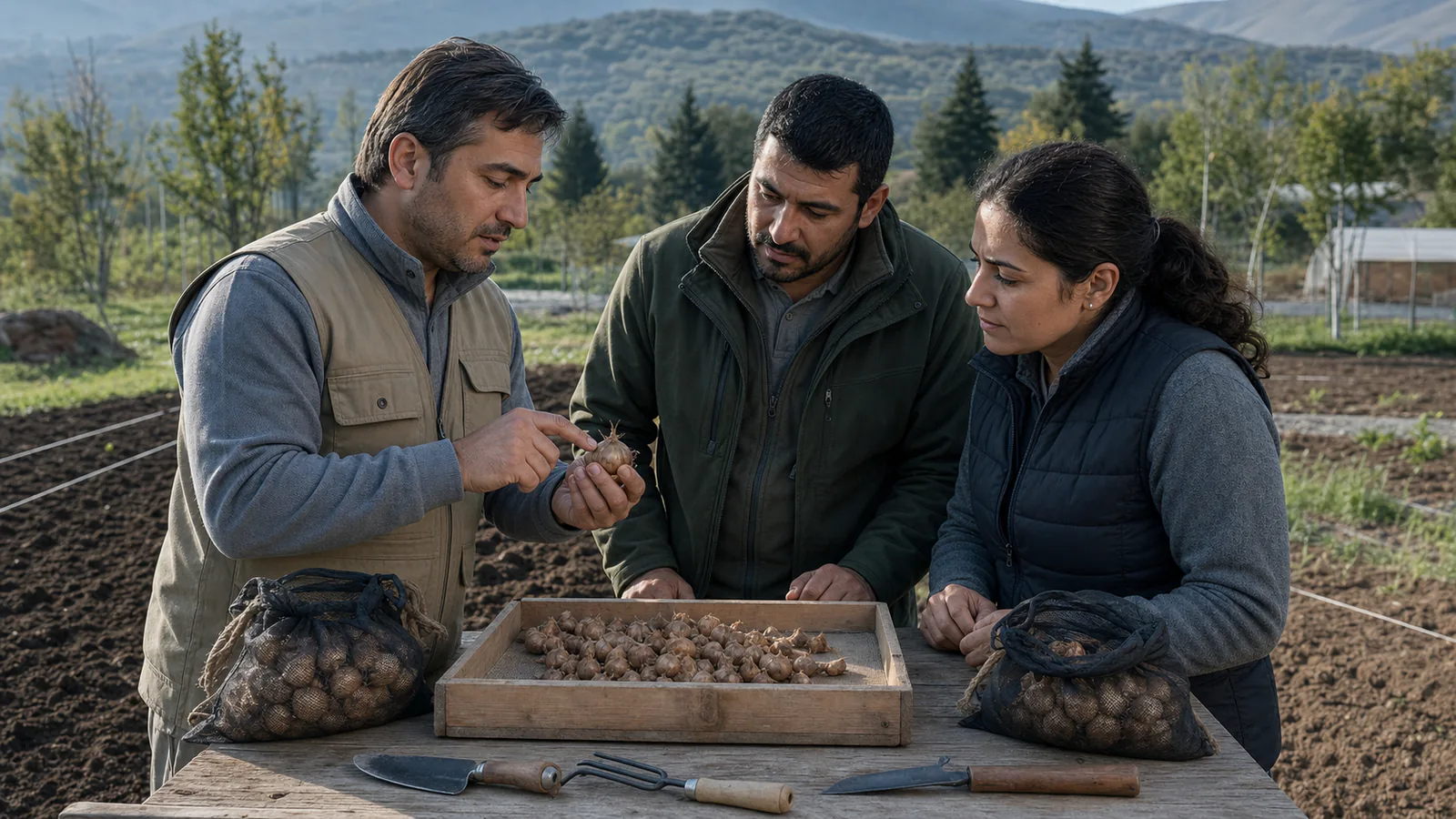
Two historical local programmes distributed saffron planting corms in very different parts of Iran. Amlash, in Gilan Province, reported distributing 1.5 tonnes among a group of about 30 growers. Sarein, in Ardabil Province, reported a 200-kilogram programme, including 110 kilograms allocated through local relief and welfare bodies for people under their support.
Both articles called the planting material “seeds” or “onions.” Botanically, saffron is propagated from corms. More importantly, both initiatives were small introductions whose success depended on training, field suitability and follow-up. The delivery weights are useful baselines, but they are not harvest results.
The Amlash saffron-corm programme
Massoud Amir Bandeh, then director of Amlash Agricultural Jihad, announced the distribution of 1.5 tonnes of saffron planting material. The article said corms were distributed to growers using small plots of roughly 200–300 square metres in the Kajid and Malakut areas to develop and promote local cultivation.
The surviving translation is unclear about whether every recipient received a plot in that range or whether the figure described an initial demonstration format. It does not list recipients, exact parcel areas, corm grades or distribution dates. Those missing details prevent a precise planting-density calculation.
Thirty growers and about 1.5 hectares
The Amlash report said 30 people were cultivating saffron on a combined 1.5 hectares. That means an average of 0.05 hectare—or 500 square metres—per person if land were divided evenly. The stated 200–300-square-metre plot range does not match that simple average, which may mean the figures refer to different stages, uneven parcels or only part of the programme.
It would be unsafe to “fix” the discrepancy by choosing one number. The useful conclusion is that this was a small-grower initiative. A parcel register showing each grower, area, corm weight, planting date and field age would resolve the ambiguity.
The reported Amlash yield was 2 kilograms per hectare
Amir Bandeh gave an average saffron yield of two kilograms per hectare for the city. The article does not state the harvest year, number of fields, age of the plots, whether the figure refers to dried stigmas or how the average was calculated. It therefore remains an attributed local figure, not a guaranteed result.
Applying two kilograms to the full 1.5 hectares would suggest three kilograms only if all land was harvested, comparable and represented by the average in the same period. The report does not establish those conditions, so no total-production claim is made here.
The Sarein programme distributed 200 kilograms
In Sarein, Agricultural Jihad director Mohammad Ebrahim Mohammadi announced that 200 kilograms of saffron corms had been distributed among farmers. The source did not state the number of recipients, total planting area, corm grade or planting density.
This programme was smaller by delivery weight than Amlash’s, but weight alone cannot compare ambition or likely output. A kilogram of large, healthy corms differs from a kilogram of small or mixed material, and the field area that weight can plant depends on corm size and spacing.
One hundred ten kilograms went through support bodies
Mohammadi said 110 kilograms were given to Sarein’s relief committee and welfare department for distribution among people under their support. That is 55% of the reported 200-kilogram total. The source does not identify how the remaining 90 kilograms were allocated, so it should not be assigned to a recipient group by assumption.
The social-support element is a distinctive part of the Sarein programme. It connected an agricultural input with a livelihoods objective. Yet the article gives no participant count, land-tenure information, complementary inputs, start-up costs or later income results. Distribution should not be reported as employment created until those outcomes are measured.
Training was part of the Sarein design
The Sarein account said recipients would receive instruction from agricultural engineers before beginning. The stated subjects were planting, field maintenance and harvest. That sequence is more useful than delivering corms without support because field preparation, planting material, timing and careful harvest all influence what follows.
A complete training record would add soil and drainage assessment, corm inspection, planting density, irrigation scheduling, weed and disease monitoring, flower collection, stigma separation, drying, lot identification and safe storage. The article does not show which of these were taught or whether participants completed the programme.
Corm quality can change the result
The two distribution weights do not describe corm quality. A three-year study in Scientia Horticulturae found that mother-corm weight affected flowering, stigma production and replacement-corm output. That does not predict Amlash or Sarein yields; their corm size distributions are missing. It shows why weight delivered is not enough for evaluation.
Useful programme records should include lot origin, health inspection, count or size classes and weight. Otherwise, two growers receiving equal kilograms may not receive equal numbers of viable flowering-size corms.
Water savings were a goal, not a measured result
The Sarein official described saffron as low in water consumption and said expansion could save agricultural water. The Amlash report similarly called the perennial crop resistant to difficult conditions, including shortage of water. Neither article provided field rainfall, irrigation volume, soil-water data or a comparison crop.
Saffron can fit water-constrained systems, but it still has stage- and site-specific requirements. A two-year lysimeter study at Shiraz University measured different crop coefficients across the growing season. The correct lesson is to schedule and measure water locally—not to assume a newly distributed corm needs none.
Amlash and Sarein require different field evidence
Amlash lies in Gilan, around 75 kilometres from Rasht and near Langrud and Rudsar. Its green highlands and tourist setting were part of the original article’s geographic context. Sarein is roughly 30 kilometres west of Ardabil and is known for its hot springs; the source placed it among the villages of Kanzak, Kahriz, Alidashi, Bileh Darreh, Varinab and Kalkhoran.
Scenery does not establish agronomic suitability. Humidity, winter temperature, soil drainage, rainfall timing and field elevation can differ substantially between the two locations. Each programme needs local survival, disease, flowering and yield measurements rather than borrowing results from the other.
Profitability and jobs need complete accounts
The Sarein article promoted saffron as profitable and capable of creating work. Amlash described 30 growers, but the damaged wording turned participation into “30 people employed.” These are not equivalent. Grower count is preserved as participation, not converted into 30 full-time jobs.
A real economic result requires the cost of corms, land preparation, irrigation, weeding, replacement, harvest labour, drying, packaging, testing and sale. It also needs lot-specific revenue and the value of family labour. A support programme may have important social goals even before profit, but those goals still require outcome reporting.
The biological-control reference in Amlash
The Amlash article also said expanding biological control to reduce agricultural pests was a wider goal for the city’s agriculture. It did not identify a saffron pest, control organism, treated area or result. The statement is retained as policy context but is not turned into a recommendation for a specific treatment.
Any current pest decision should begin with correct identification and advice suited to the field and applicable rules. “Biological” does not automatically mean effective for every pest or harmless in every use.
What a distribution programme should measure
To move from input delivery to evidence, future records should capture:
- recipient, parcel, area and land-access status;
- corm origin, lot, size distribution, condition and weight;
- planting date, depth, spacing and field age;
- rainfall and applied irrigation by growth stage;
- survival, flowering and dried-stigma yield by parcel;
- training attendance and extension visits;
- labour, processing costs, grade and sale result.
This framework would reveal whether a programme merely distributed corms or helped growers establish a repeatable crop.
What the archived reports leave unresolved
For Amlash, the key missing records are the programme year, recipient list, exact relationship between the 200–300-square-metre plots and 1.5-hectare total, corm grades, harvest sample and current cultivated area. For Sarein, recipient and area totals, the destination of the remaining 90 kilograms, training completion and follow-up outcomes are absent.
Neither post demonstrates whether the original fields remained productive. Their page publication and modification dates are also inconsistent, so relative phrases cannot supply a reliable programme year.
The practical lesson from Amlash and Sarein
The historical baseline is clear enough to preserve: Amlash reported 1.5 tonnes for a 30-grower, 1.5-hectare initiative and cited a two-kilogram-per-hectare yield; Sarein reported 200 kilograms, with 110 kilograms directed through relief and welfare bodies and training planned before cultivation.
The strongest idea in the two reports is not that corm distribution guarantees profit. It is that planting material, training and follow-up belong together. Our review of the larger Ardabil saffron-corm programme reaches the same conclusion: delivery weight is a starting point, while parcel-level evidence shows whether cultivation actually succeeds.

![Exporting Saffron to Turkey + Price Guide [Complete 0 to 100]](https://img.rowhanisaffron.com/20260827003933/saffron-export-turkey-quality-inspection.webp)



