


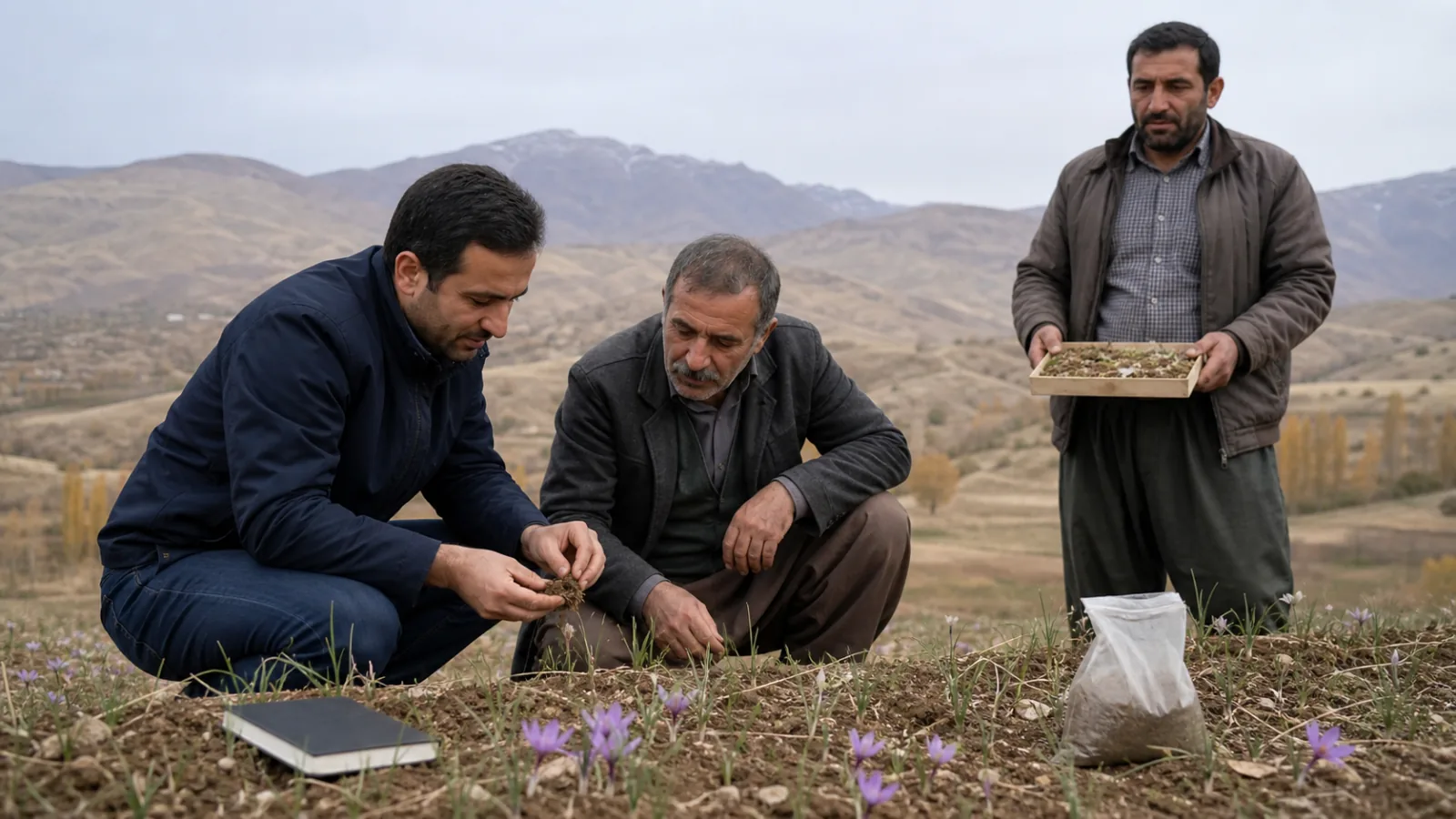
Cultivation of Saffron and Herbs in Iran City of Sonqor was presented in 2019 as one part of a local agricultural-development plan. The governor called saffron and medicinal plants promising options for changing the crop pattern in Sonqor and Koliaei County, Kermanshah Province. The proposal linked farmer training, university research, Agricultural Jihad advice and local processing, but did not report planted area or harvest results.
Which crops were identified for Sonqor, Kermanshah?
For readers searching for crops grown in Sonqor Kermanshah Iran, this particular report identifies saffron and medicinal herbs as development crops. It is not a complete inventory of everything cultivated in the county, and it does not name the individual medicinal-plant species.
That distinction matters. “Medicinal herbs” is a broad category, not a crop plan. Each proposed species needs its own assessment of climate, soil, planting material, labour, harvest method, processing and market.
Saffron is the dried stigma of Crocus sativus. It is often discussed alongside medicinal and aromatic plants in agricultural programmes, but it should not be confused with an undefined mixture of saffron herbs.
What Governor Masoumi Zadeh proposed
The article quoted Masoumi Zadeh, governor of Sonqor and Koliaei. He described saffron and medicinal-plant cultivation as a promising agricultural model for adjusting the county’s crop pattern.
His proposal was collaborative. The local Agricultural Jihad organisation and the Faculty of Agriculture would use scientific capacity, train local farmers and support the development of processing industries. The intended result was sustainable employment.
Those were programme aims. The report did not provide farm budgets, employment counts, trial yields, processing capacity or buyer contracts showing that the intended result had already been achieved.
The city development plan
Masoumi Zadeh also referred to a broader development plan for the county. Its purpose was to identify local capacities and address weaknesses across different sectors.
In agriculture, students from the faculty were expected to diagnose problems at different stages and suggest practical solutions. A Regional Agricultural Development Office linked to the university had been established to provide consultation to farmers and applicants through Agricultural Jihad, alongside scientific and research services.
The useful idea is a feedback loop: observe the farm, define the problem, test an option, measure the result and return that evidence to growers. A report or seminar alone cannot establish whether a crop works in a particular village.
What scientific crop selection should examine
A county-level recommendation is only the beginning. Before a farmer changes crops, advisers should examine:
- field elevation, winter conditions, spring frost and autumn temperatures;
- soil depth, texture, drainage, salinity and previous disease problems;
- rainfall, reliable irrigation and pumping cost;
- the source, identity and health of planting material;
- labour during the crop’s short critical harvest period;
- post-harvest space, drying, storage and lot identification; and
- a realistic buyer specification and farm-gate price.
Saffron and a medicinal herb may share a policy category while needing entirely different planting, harvest and processing systems. The university office should evaluate them separately.
Saffron cultivation in Iran is local, not uniform
Broad searches for Iran saffron farming, Iran saffron production or saffron cultivation in Iran can make one national method appear sufficient. In practice, a Sonqor field should be judged by its own conditions and compared with the farm’s current crop.
Saffron is a perennial corm crop with summer dormancy and autumn flowering. It may fit some dry or cool upland systems, but it still depends on healthy corms, suitable drainage, moisture at the right stages and concentrated harvest labour.
Our guide to saffron corms explains why source, condition, size and storage history should be recorded before planting.
Training indigenous farmers should start with their fields
The report specifically called for training local farmers. Useful training respects what growers already know about their land while making the new crop’s risks visible.
A small demonstration plot can show emergence, flowering time, weed pressure, irrigation needs and harvesting effort. Growers should receive their own records rather than only a regional average. Unsuccessful trials should be documented as carefully as successful ones.
Training also needs a post-harvest component. Saffron flowers must be collected and handled promptly. Stigmas need clean separation, controlled drying and protected storage. A farmer who produces good flowers can still lose value after harvest.
Processing industries must be sized to real supply
Masoumi Zadeh linked cultivation to “conversion and processing industries.” For saffron, that can include receiving, stigma separation where required, drying, sorting, testing, packing and storage. Medicinal plants may need different equipment.
A shared facility can help small growers, but it should not be built around an assumed future crop. Its design needs committed supply, harvest timing, product form, buyer requirements and a plan for keeping lots traceable.
ISO 21983:2019 gives current guidance for saffron harvesting, flower transport, stigma separation, drying and storage before packing. ISO 3632-1:2025 specifies requirements for dried saffron in filament, cut-filament and powder forms.
What sustainable employment would look like
Sustainable employment is more than the number of people who attend training or work for a few harvest days. The crop needs to return enough over several seasons to cover planting material, field operations, labour, handling and market costs.
A later Sonqor assessment should report trial area, productive area, dry yield, field age, water, labour hours, rejected material, tested quality, sale price and the number of growers who continue. Processing jobs should be counted separately from seasonal farm labour.
A practical role for the university office
The Regional Agricultural Development Office can be most useful as a shared record of local evidence. It can map trials, standardise basic measurements, connect growers to specialists and show which recommendations worked under which conditions.
Cultivation of Saffron and Herbs in Iran City of Sonqor was therefore a proposal for coordinated rural development, not a production report. Its strongest idea was the connection between farmers, agricultural advisers, students and research. The programme’s success depends on turning that connection into measured field results and saleable products.

![Exporting Saffron to Turkey + Price Guide [Complete 0 to 100]](https://img.rowhanisaffron.com/20260827003933/saffron-export-turkey-quality-inspection.webp)



