


Can you grow saffron in a greenhouse? Yes, but “greenhouse saffron” can describe several very different systems. Some growers use protected beds with soil or substrate; others force selected corms to flower on stacked trays, then move them into a rooting and leaf-growth phase so replacement corms can develop.
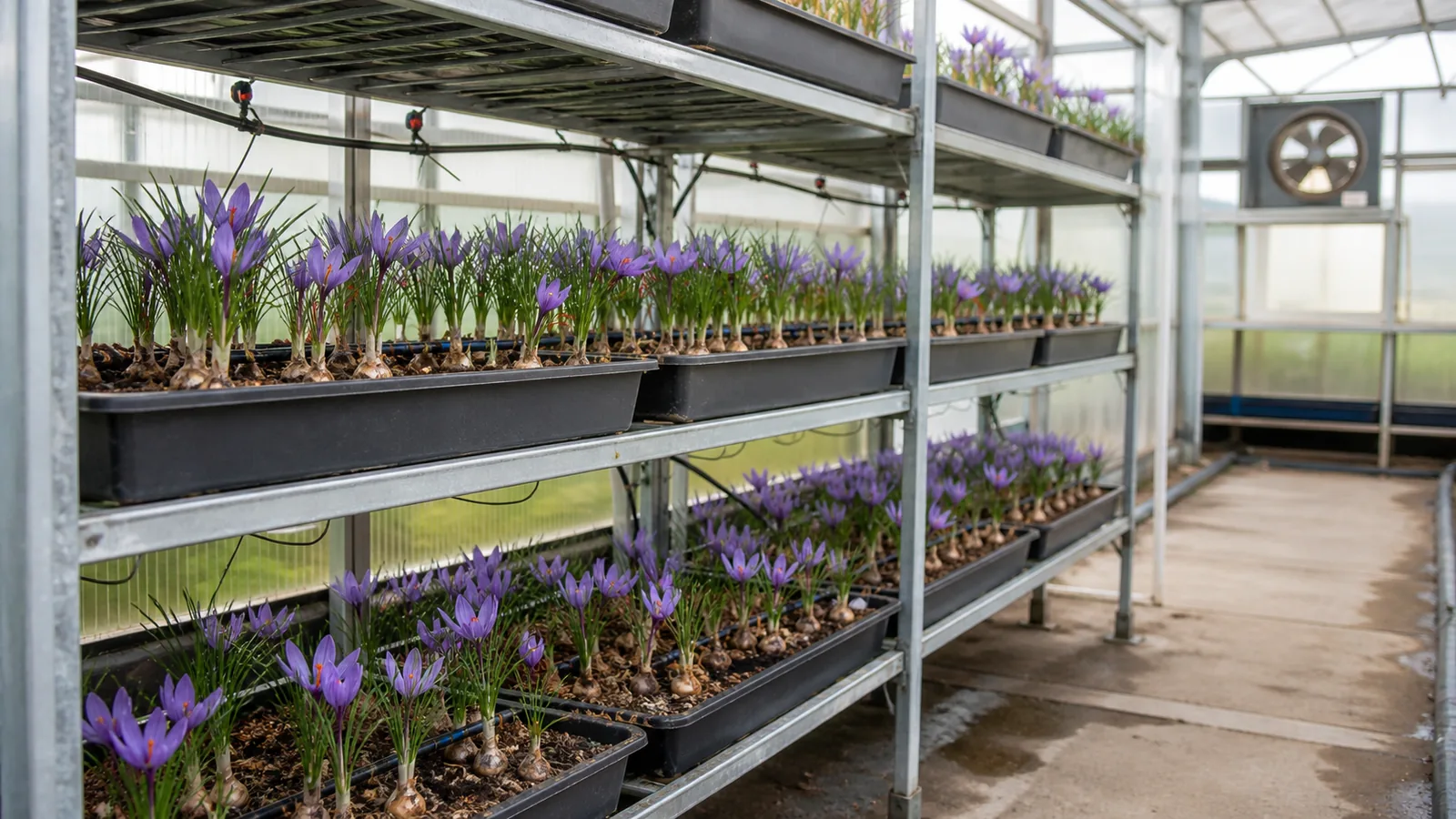
That distinction matters in Iran, where field production has a long agronomic history. Greenhouse saffron cultivation can concentrate flower handling into a smaller covered space, but a roof and a misting system do not remove the need to manage corm quality, temperature, humidity, light, nutrition, sanitation and the crop’s full annual cycle.
What greenhouse saffron cultivation means
Saffron comes from Crocus sativus corms. The flowers produce the red stigmas sold as saffron, while the leaves that follow flowering help build replacement corms for the next cycle. An indoor system therefore has two jobs: produce flowers now and maintain viable planting material for later.
The term “greenhouse” is often used loosely for three arrangements:
- Protected soil beds, where the crop remains in soil but gains some weather control.
- Soilless trays using a substrate and measured nutrient solution.
- Hydroponic or aeroponic-style racks, where corms are held at high density and their root zone is irrigated without a conventional field bed.
These are not interchangeable. A flowering-room trial, a complete corm-production cycle and a commercial greenhouse each have different costs and performance measures.
How saffron farming in a greenhouse works
1. Select sound, adequately sized corms
Corm size and condition strongly influence whether a plant flowers in its first controlled cycle. Remove soft, mouldy, cut or insect-damaged material before it enters a shared room. Uniform lots are easier to manage because they tend to reach each growth stage together.
2. Manage dormancy and flower induction
Saffron does not flower simply because it is put on a shelf. Temperature history during dormancy affects floral development and the timing of emergence. A peer-reviewed controlled-environment study used selected corms, a warm preconditioning period and then cooler forcing conditions; its exact programme belonged to that trial, not to every Iranian cultivar or greenhouse.
3. Arrange trays for airflow and access
Multi-level racks use vertical space and can make individual flowers easier to reach. Trays still need enough clearance for inspection, air movement and harvest. Packing corms tightly may increase the number per square metre of floor, but it also makes local humidity and disease problems harder to see.
4. Provide controlled moisture without saturation
Some soilless systems deliver water indirectly through drip, ebb-and-drain or mist. That is not the same as “no water.” Roots need an appropriate moisture and oxygen balance, and the nutrient solution has to be managed rather than guessed. Water use should be measured across the whole cycle, including cleaning and the stage when leaves and replacement corms grow.
5. Harvest and dry the stigmas promptly
Flowers are picked as they open, then the red stigmas are separated and dried under controlled conditions. Shelves can reduce walking and bending, but they do not automate this delicate work by themselves. Hygiene depends on clean surfaces, careful handling, suitable drying and protected storage.
What research shows, and what it does not
A 2022 peer-reviewed study on a multilevel hydroponic saffron system tested field-grown corms in a controlled greenhouse and cleanroom over two cycles. It shows that contained, high-density production is technically possible and that flowering responds to corm selection and environmental management.
It does not prove that every saffron greenhouse will out-yield an Iranian field, use almost no water, avoid disease or produce more colouring compounds. Those outcomes depend on the starting corms, cultivar, preconditioning, environment, crop phase, measurement method and operator skill.
Quality also needs laboratory measurement. Aroma, bitterness and colouring strength cannot be judged reliably from flower count or visual redness alone. A claim that greenhouse saffron is always better—or always worse—than field saffron is too broad without comparable samples and test methods.
The Iranian report behind this page
The original report quoted agricultural-biotechnology specialist Mahmoud Momeni describing a covered Iranian system with multiple cultivation levels and indirect spraying. He said the shelves made harvesting easier and compared a covered space of about 50 to 60 square metres with a field requirement of roughly 1,000 to 1,500 square metres.
Those figures are retained here as the source report’s comparison, not as a universal land-equivalence or profit forecast. The report also argued that selected larger replacement corms could produce more flowering shoots, and said shelf costs, corm purchases, labour, fertiliser and crop protection had to be included.
Its strongest claims—that output and staining material would be higher, disease lower and the product automatically hygienic—need controlled side-by-side evidence before they can guide an investment. A clean indoor room can reduce some exposure routes, but it can also spread a problem quickly through dense, shared equipment.
Greenhouse saffron versus an Iranian field
Iranian saffron farming is already adapted to dry landscapes. The FAO’s description of the qanat-based saffron system in Gonabad shows how cultivation is connected to local water management, livelihoods and accumulated field knowledge.
A greenhouse changes that production system rather than merely shrinking it. It may offer better scheduling, easier flower access and more control over temperature. In return, it adds structures, racks, sensors, energy, sanitation, nutrient management and technical failure points.
Field and greenhouse methods can also be combined. A grower may use controlled space for flower forcing and return corms to soil or another suitable growing system for leaf and daughter-corm development. The movement, timing and biosecurity of that transition must be part of the plan.
Costs to calculate before building
- Verified corm source, size distribution, replacement rate and storage losses
- Building, insulation, racks, trays and food-safe work surfaces
- Heating, cooling, ventilation, humidity control and backup power
- Irrigation hardware, water treatment, nutrients, drainage and cleaning
- Monitoring equipment and labour for daily inspection
- Flower picking, stigma separation, drying, packaging and quality testing
- Space and inputs for leaf growth and replacement-corm production
- Local market price, realistic grade, sales channel and rejected-product risk
Floor-area comparisons alone are misleading because vertical racks concentrate plants but also concentrate capital and operating costs. A pilot should record saleable dry saffron per starting corm, per square metre of growing surface, per square metre of building, per labour hour and per unit of energy and water.
Questions a pilot must answer
- What percentage of the corms flowers, and how many flowers does each flowering corm produce?
- What is the dry stigma weight after a consistent drying protocol?
- How many healthy replacement corms remain at the end of the complete cycle?
- Which temperature, humidity and light records correspond with failures or delays?
- How much labour is actually saved during harvest, and how much is added elsewhere?
- Does independent quality testing support the grade and price assumed in the business plan?
For a complementary caution on the economics, see this discussion of why saffron cultivation may not be profitable in a greenhouse. The useful conclusion is not that every project should stop; it is that the technical trial and the business case must be tested together.
Greenhouse saffron cultivation in Iran is therefore possible, and serious research supports controlled flowering and soilless production. It is not a shortcut that makes location, water, soil biology or farm experience irrelevant. The strongest project is the one that measures an entire corm-to-corm cycle before treating a successful flowering room as a successful saffron farm.

![Exporting Saffron to Turkey + Price Guide [Complete 0 to 100]](https://img.rowhanisaffron.com/20260827003933/saffron-export-turkey-quality-inspection.webp)



