


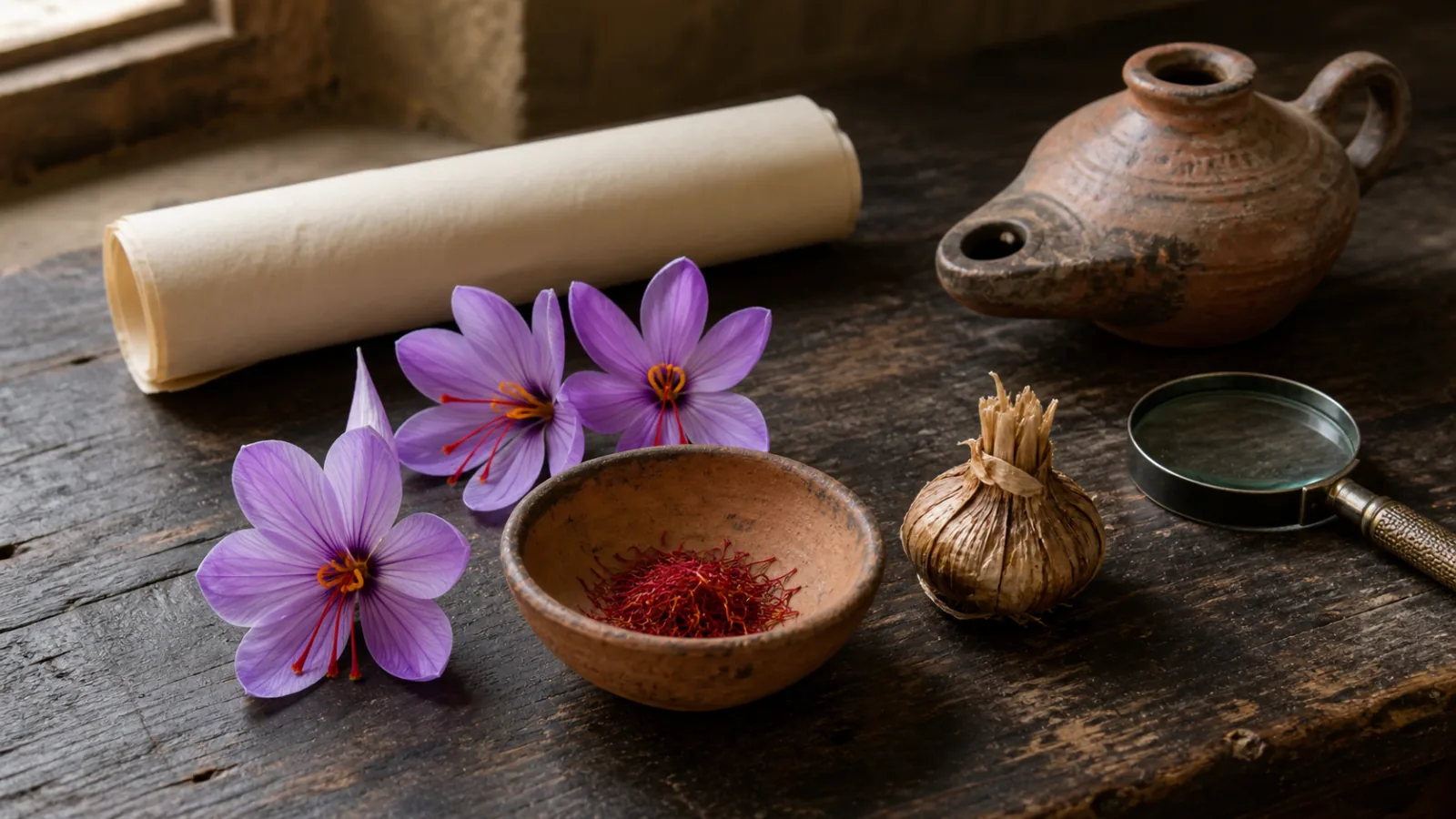
A brief history of saffron begins with a distinction that older accounts often blur. The spice has a botanical origin, which modern genetics can investigate, and a cultural history shaped by many societies. Evidence now points strongly to an early Greek origin for the cultivated saffron crocus. Iran, meanwhile, became one of saffron’s great centres of cultivation, craft and trade. One fact does not cancel the other.
Saffron is made from the dried red stigmas of Crocus sativus, a member of the iris family, Iridaceae. The plant is a sterile triploid, so it does not reproduce normally through seed. People keep it in cultivation by dividing and replanting corms. That dependence on human propagation helps explain both saffron’s long journey and the close relationship among cultivated plants across distant regions.
Where did saffron originate?
Iran, Greece, Anatolia and parts of Central Asia have all appeared in older origin theories. Archaeology could show that crocuses and saffron mattered to early cultures, but it could not identify the cultivated plant’s parent with certainty. Genetic work has made the picture clearer.
A 2019 genome-wide study placed 99.3% of the tested saffron alleles in the wild species Crocus cartwrightianus. The closest sampled populations grew around Athens, and the researchers concluded that C. sativus arose in Attica from two different C. cartwrightianus genotypes. Independent chromosome research reached the same broad result: cultivated saffron is an autotriploid derived from heterogeneous forms of that wild Greek crocus.
This is the best-supported answer to “where did saffron originate?” today. It is evidence about the crop’s biological emergence, not proof that one later nation invented every use of the spice. Once people carried viable corms beyond the Aegean, saffron could become embedded in several cultural traditions at the same time.
Bronze Age evidence from the Aegean
The famous frescoes at Akrotiri on the island of Thera, now Santorini, provide some of saffron’s most vivid early evidence. Painted in the second millennium BCE, scenes in the building known as Xeste 3 show crocus flowers, people gathering them and figures bringing the harvest into a ritual setting.
Images cannot tell us exactly how every flower was used. Scholars have interpreted the scenes in religious, social and medicinal contexts, and some details remain debated. What they do show is that the crocus was recognisable, deliberately collected and culturally important in the Bronze Age Aegean. That visual record sits comfortably beside the newer genetic evidence for an early Greek origin.
Saffron in ancient Iran
Saffron also has a deep Iranian history. Persian sources associate it with fragrance, colour, food, medicine, writing and ceremony. Accounts describe saffron-coloured preparations, scented compounds and its use during celebrations and formal welcomes. It became more than an agricultural product: its colour and aroma carried ideas of wealth, hospitality and distinction.
The old version of this page attributed many very specific practices and trade routes to unnamed traditions. Some may preserve genuine historical memories, but details such as a single people introducing saffron to the Greeks, Romans, Chinese and Arabs cannot be stated as settled fact without dated evidence. The safer historical conclusion is substantial enough: Iran cultivated saffron for centuries, developed varied uses for it and helped sustain its movement through regional trade.
Qom and other parts of central and eastern Iran are repeatedly mentioned in historical discussions of cultivation. Over time, Khorasan became the country’s dominant growing region. Readers interested in the crop’s present geography can continue with our guide to where saffron is grown today.
Colour, fragrance and the written page
Saffron’s history is easy to understand when we look at what the stigmas provide. Their compounds produce a powerful golden colour, a recognisable aroma and a bitter, complex taste. Before modern synthetic dyes, a material capable of colouring food, fabric, cosmetics or a manuscript could be exceptionally valuable.
Persian and Arabic accounts describe saffron solutions in calligraphy, illumination and ceremonial writing. That does not mean every yellow or orange manuscript page was coloured with saffron; artists also had access to mineral and plant pigments. Identifying saffron in a particular object requires material analysis or a reliable contemporary record. History is stronger when a plausible use is not turned into a universal claim.
How saffron travelled west
Trade, migration and conquest moved saffron corms and dried stigmas around the Mediterranean. Cultivation became established in Islamic Spain, and European production later appeared in regions including Italy, France, Switzerland and England. The English town of Saffron Walden still carries the crop in its name, a reminder that saffron was once commercially important there.
The route was not a single straight line from one country to another. Dried saffron was light, valuable and comparatively easy to transport, while establishing a new crop required living corms, suitable conditions and growers who knew how to manage them. Trade in the spice and transfer of the plant therefore followed different rhythms.
India, China and the wider Asian story
Saffron appears in long-standing medical, culinary and religious traditions across Asia. Kashmir developed one of the best-known growing cultures outside Iran, while written records show the spice reaching consumers much farther east. Precise arrival dates vary by source, and later texts do not always prove that local cultivation began at the same moment as local use.
That distinction matters. A court or pharmacy could buy imported dried saffron long before farmers in the surrounding region planted the crocus. When a history says a society “knew saffron,” it may refer to trade, medicine, cooking, ritual or farming; those are related but separate claims.
Where the name “saffron” comes from
The English word arrived through Old French and medieval Latin forms related to Arabic za‘farān. The deeper origin of the Arabic term is not certain. Older Iranian names, including forms often transliterated as korkom or kurkum, belong to a broader and complicated family of words for yellow colourants and aromatic plants.
Etymology can reveal contact between languages, but it is not a botanical map. A word may travel with a traded product, replace an older local name or come to describe several materials. The language trail supports saffron’s intercultural history; by itself, it cannot settle where Crocus sativus first arose.
A short saffron timeline
- Bronze Age: Aegean art depicts crocus gathering and ritual presentation on Thera.
- Ancient and late antique periods: saffron is recorded across Mediterranean and West Asian food, fragrance, dye and medicinal traditions.
- Medieval period: cultivation and commerce expand through Islamic Spain and other parts of Europe, North Africa and Asia.
- Early modern Europe: specialist growing districts develop, including the English area that became known as Saffron Walden.
- Modern era: Iran becomes the leading centre of commercial production, while smaller regional industries preserve distinctive growing traditions.
- 2019 onward: genome and chromosome studies provide strong evidence that cultivated saffron arose from Greek Crocus cartwrightianus.
No single person “discovered” saffron. Its story belongs to generations of growers who maintained a sterile plant by hand, traders who carried the spice and its corms, and cooks, artists and healers who found uses for its colour and aroma. Modern science has clarified the plant’s ancestry, while the historical record shows how widely its meaning was shared.
Research used for this history
- Nemati and colleagues’ 2019 genome-wide study identifies Crocus cartwrightianus from Attica as the progenitor of cultivated saffron.
- Schmidt and colleagues’ chromosome study independently supports saffron’s autotriploid origin from heterogeneous C. cartwrightianus forms.
- The 2022 review of ancient artworks and crocus genetics compares the biological evidence with material from Greece, Iran and Mesopotamia.

![Exporting Saffron to Turkey + Price Guide [Complete 0 to 100]](https://img.rowhanisaffron.com/20260827003933/saffron-export-turkey-quality-inspection.webp)



