


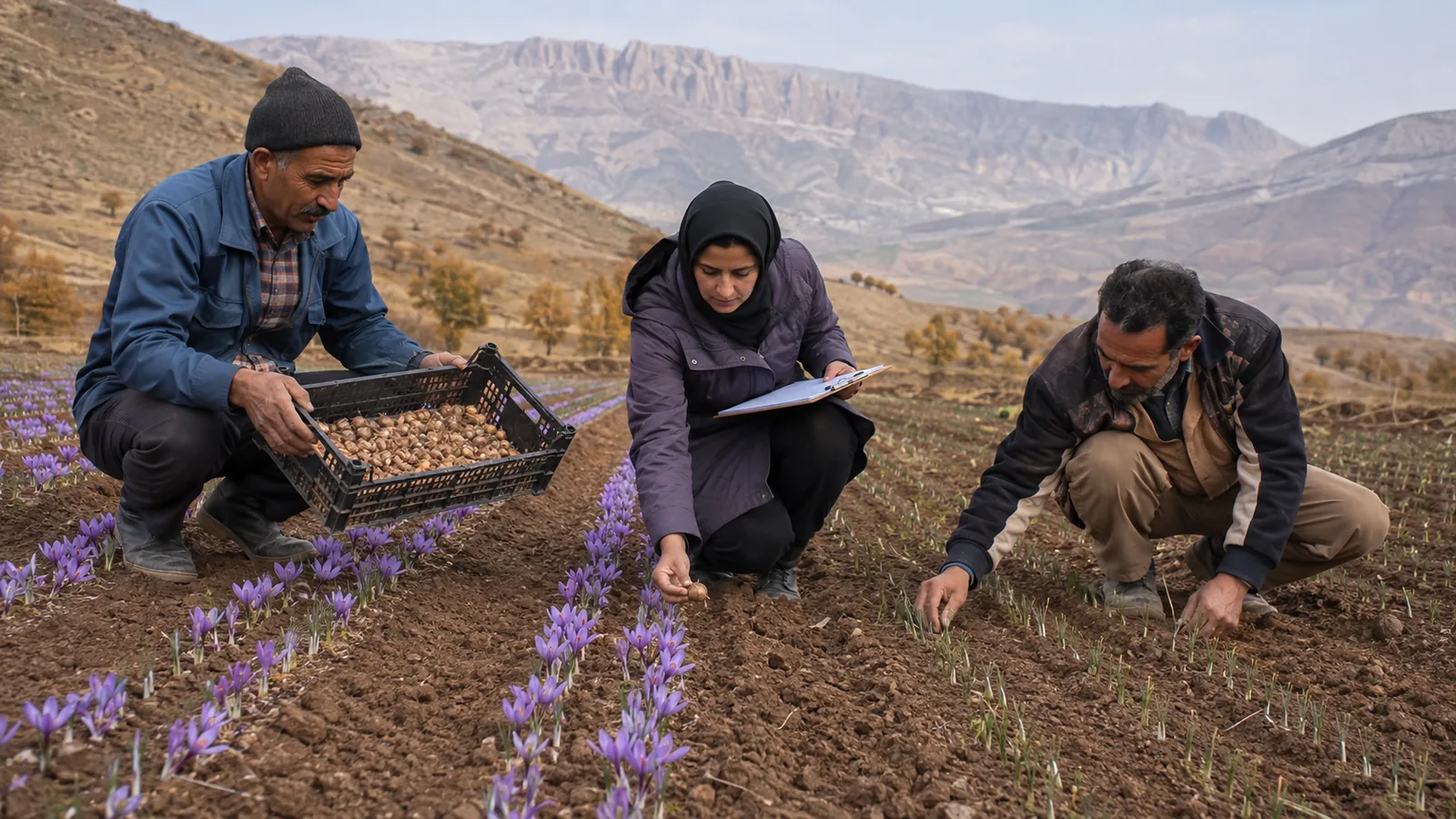
A provincial report said 380 hectares of Lorestan farmland had been allocated to saffron cultivation in that crop year. The figure marked a growing local sector, but the same account also mixed area, yield, quality and income claims that need to be separated before they can guide a farm decision.
What the 380-hectare figure represented
Alireza Ahmadvand, identified as horticulture director of the Lorestan Jihad Agricultural Organization, said more than 380 hectares of farms were dedicated to saffron that year. This was a dated planted-area statement, not a current total.
The report did not say how much of the area was newly planted or already bearing. That distinction matters because young saffron fields generally produce less than established fields and should not be used in the same yield calculation.
The crop develops over several seasons
The English copy says saffron “seeds” produce for seven years. Saffron is propagated with corms, not botanical seed in ordinary commercial cultivation, so corm is the correct term here.
Ahmadvand said output was low during the first two years and reached its peak from the third year. Seven years should be read as the working life stated in that report, not a guarantee: field health, corm crowding, soil, water and management affect how long a planting remains productive.
The reported Lorestan yields varied
The fuller version of Ahmadvand’s statement reported about five kilograms per hectare in some parts of Lorestan and an average of three kilograms per hectare across the province. These figures belong to that reporting period and should not be transferred to a new field without local records.
A separate official agricultural report on Lorestan saffron recorded 381 hectares and 1,047 kilograms for its own period. It also described different yields as fields aged. The near-matching area does not make the two reports interchangeable; each needs its own date and definitions.
The quality claim was not a laboratory result
Ahmadvand described saffron from some parts of Lorestan as unique in quality within the country. That is an attributed official opinion. The short report did not publish sampling methods or measured crocin, picrocrocin, safranal, moisture and foreign-matter results.
Origin alone cannot prove the grade of every lot. A reliable quality claim needs a representative sample, an identified test method and traceability back to the grower, harvest and processing conditions.
The ten-times-income comparison needs context
The report said income from saffron was more than 10 times that of dryland wheat. It did not state the prices, yields, establishment costs, labour, field age or whether it compared gross revenue or net income.
Saffron and dryland wheat also have different cash-flow and labour patterns. Corms and field preparation create early costs, while the flower harvest demands concentrated hand work. A current farm budget is safer than repeating a historical ratio as a promise of profit.
Free corms were a promotion measure
Ahmadvand said saffron corms would be provided free to farmers in the province for the first time. The statement described a particular support measure; it does not establish that free corms remain available today.
Free planting material is useful only if it is healthy, suitable and traceable. Training, field selection and follow-up are just as important. The fuller account also referred to numerous training centres created to promote saffron cultivation.
Lorestan’s landscape is not uniform
The original page locates Lorestan in western Iran between roughly 46°51′ and 50°03′ east longitude and 32°37′ and 34°22′ north latitude, with an area of about 28,294 square kilometres.
It borders Isfahan to the east, Khuzestan to the south, and Kermanshah and Ilam to the west, with a small boundary adjoining Chaharmahal and Bakhtiari in the southeast. Those coordinates describe a large province, not a single saffron-growing environment.
Field suitability still has to be tested
Across that area, elevation, winter temperature, drainage, soil texture, salinity and available irrigation can vary. A grower needs evidence from the actual parcel before treating saffron as a suitable replacement crop.
A small trial can record flowering, corm survival, dry yield, labour hours and quality over several seasons. Expansion should follow those records, not a provincial average or a free-corm offer by itself.
Processing and markets determine lasting value
Flowers must be collected promptly, moved cleanly, separated and dried under control. Storage, grading and lot records then protect the spice and make quality claims testable. A larger planted area without enough harvest labour and processing capacity can lose value quickly.
The official Lorestan account also noted weak branding and traditional packaging at the time. Those gaps matter because a farmer benefits from a high-value crop only when the product reaches a dependable buyer in a form that retains its identity and quality.
How to read the Lorestan allocation today
The 380-hectare report documents a stage in Lorestan’s saffron development: a sizeable provincial area, uneven yields, promotional training and the first free-corm initiative. It does not establish the current area, current yield or the profitability of a new planting.
Current decisions should use dated local records for planted and bearing area, dry output, field age, tested quality, water, labour, processing and prices. That keeps the historical report useful without turning its strongest claims into guarantees.

![Exporting Saffron to Turkey + Price Guide [Complete 0 to 100]](https://img.rowhanisaffron.com/20260827003933/saffron-export-turkey-quality-inspection.webp)



