


The claim that 95 percentage of saffron products are exported in bulk comes from a 2019 industry discussion, not a current customs measure. It remains useful because it captures a long-running concern: Iran grows most of the world’s saffron, yet part of the value created by consumer packaging, branding and distribution can accrue elsewhere. The percentage itself needs care, however. “Bulk” can mean anything from a large food-service container to every package above a particular weight, so figures from different sources are not automatically comparable.
What the 95% bulk-export claim originally meant
At a specialist round-table in Khorasan Razavi, Hossein Zeynli, then identified as a medicinal-plants official at Iran’s Ministry of Agriculture, argued that saffron policy should give greater weight to quality, updated production knowledge and processing technology. He was reported as saying that 90% to 95% of Iranian saffron left the country in bulk, while only about 5% was sold in one-gram packs.
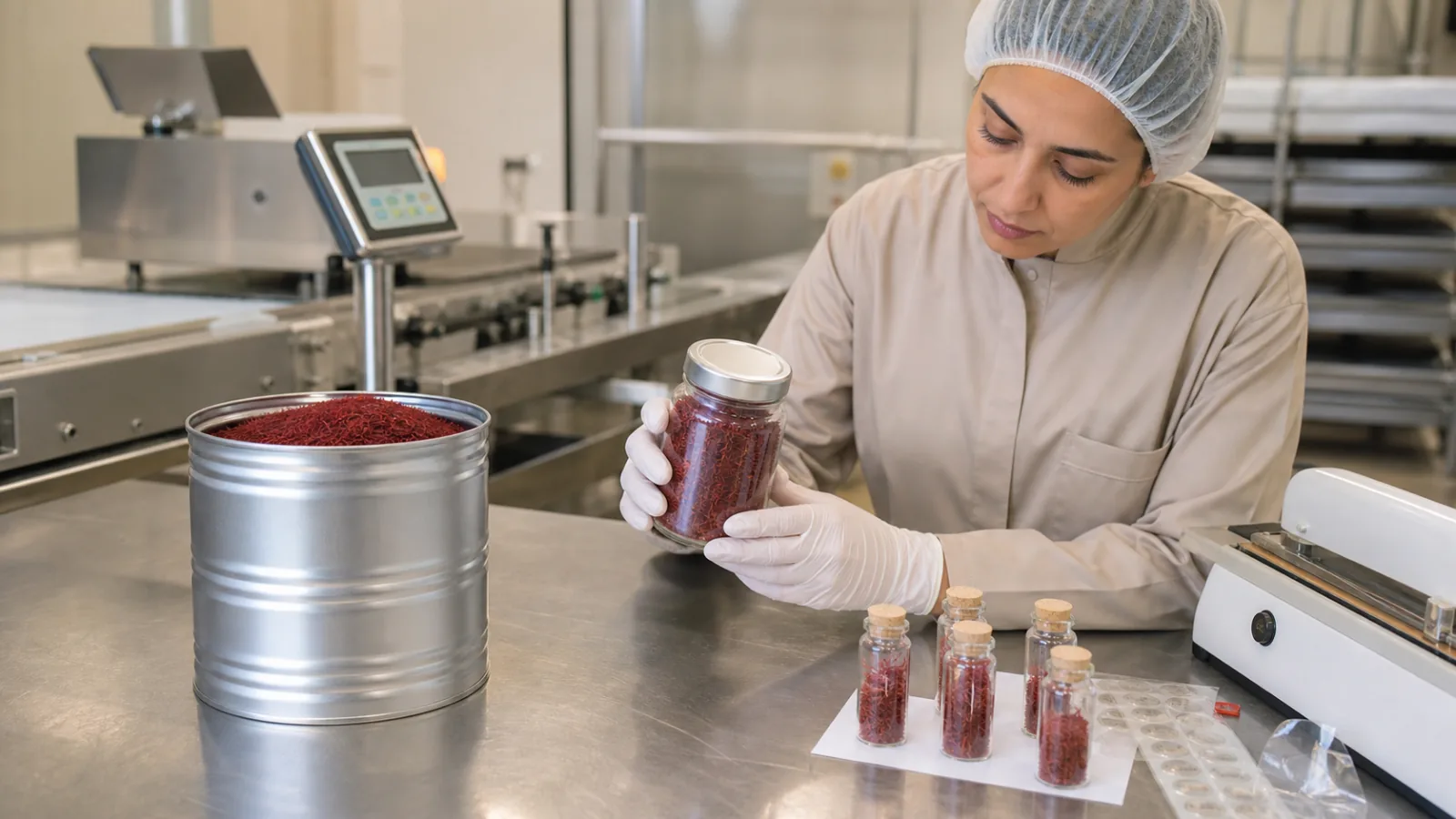
That comparison is narrower than it first appears. One-gram packs are only one retail format. Saffron is also sold in other consumer sizes, food-service packs and sealed commercial containers for importers that package it under their own labels. Without a stated year, customs code, package-weight threshold and calculation method, the 95% figure should be read as an attributed historical estimate rather than a precise description of today’s trade.
The same discussion put Iranian saffron turnover at roughly $400 million, divided into an estimated $350 million abroad and $50 million in the domestic market. It also referred to a much larger global turnover figure. Those numbers did not use a published common methodology, so they should not be treated as directly comparable market shares. Export value at the border, retail sales and the value of saffron-containing products measure different things.
Bulk saffron is not automatically a poor export
A large, sealed package can be the right product for a spice company, food manufacturer or distributor. The buyer may need to blend lots, perform its own quality checks, comply with local labelling rules or divide the saffron into formats suited to its market. For such customers, forcing every shipment into one-gram packs would add cost without adding useful value.
The commercial problem begins when saffron is sold as an interchangeable raw material with little proof of origin, weak quality documentation and no durable relationship between the exporter and the final market. In that situation, another business can capture the margin from sorting, certification, packaging, storytelling and customer trust. The practical goal is therefore not “no bulk exports.” It is to give Iranian growers and exporters a stronger choice of channels and enough evidence to defend the value of each lot.
Quality evidence matters more than package size alone
Zeynli’s emphasis on quality was well placed. A buyer needs to know that a shipment is clean, correctly identified, traceable and consistent with the agreed grade. The international Codex standard for dried or dehydrated saffron describes requirements covering matters such as moisture, foreign matter, defects and chemical characteristics. A contract may add buyer-specific laboratory limits, packaging conditions and documentation.
This distinction also clarifies the role of a commodity exchange. Exchange contracts can improve price discovery, lot definition and transaction transparency. They are one route to standardisation, but not the only one. Farm practices, laboratory testing, Codex or ISO specifications, traceability systems, buyer contracts and destination-market rules all shape whether saffron is accepted and what a buyer will pay.
The Khorasan production context behind the debate
The 2019 meeting described Khorasan Razavi as Iran’s saffron hub. Seyyed Hashemi Najibi, identified in the report as a provincial horticulture official, cited about 86,000 hectares under saffron and annual production of roughly 300 to 310 tonnes. He also said cultivated area was expanding by around 2,000 to 2,500 hectares a year as water scarcity encouraged some farmers to consider saffron.
Those figures imply a rough provincial average near 3.5 kilograms per hectare, which is consistent with the meeting’s badly translated yield reference. It is only a broad calculation: yields vary with field age, climate, irrigation, corm health, harvest timing and whether newly planted land is included. The original warning that not every soil is suitable for saffron remains important. Expansion without agronomic care can increase acreage while weakening yield or quality.
Representatives of the Khorasan Razavi Rural Cooperative Union and local producers also raised price volatility, production security, intermediaries and transparency. Their comments point to the same value-chain problem now being addressed through work on traceability, standards and innovation. The FAO’s current saffron value-chain work in Iran likewise focuses on quality integrity rather than packaging alone.
How an exporter should choose a saffron format
A sensible packaging decision starts with the customer and destination rules. Before choosing bulk, commercial or retail-ready packs, an exporter should establish:
- who will use or resell the saffron, and in what quantity;
- which grade, laboratory evidence and traceability records the buyer requires;
- whether the destination requires particular food labels, languages or importer details;
- how the container protects the threads from moisture, light, contamination and tampering;
- whether smaller packs add enough margin to cover their materials, labour, compliance and logistics;
- which part of the customer relationship and brand value remains with the Iranian supplier.
Recent trade data should also be kept separate from market-size estimates. For example, the WITS presentation of UN Comtrade data for HS 091020 records Iran’s reported saffron exports by weight, value and destination. It does not identify every retail pack, nor does it measure the final shelf value after re-export and repackaging.
What should replace the bulk-export argument
The strongest response to the 95% claim is better measurement and more commercial choice. Reports should state what counts as bulk, the period covered and whether the denominator is shipment weight, customs value or number of packages. Producers need cultivation guidance and dependable testing; exporters need packaging options, market knowledge and direct customer relationships; buyers need credible, traceable specifications.
Iran’s production scale remains a major advantage, but origin alone does not guarantee recognition in the final market. Clear quality evidence and formats chosen for real buyers allow more of saffron’s value to remain visible from farm to shelf—whether a particular shipment leaves in a one-gram pack or a carefully controlled commercial container.

![Exporting Saffron to Turkey + Price Guide [Complete 0 to 100]](https://img.rowhanisaffron.com/20260827003933/saffron-export-turkey-quality-inspection.webp)



