


Meybod saffron cultivation covered 9 hectares in the historical local report, including an apparent 6 hectares around Sadrabad in the Nodoushan area. Officials promoted the crop as an alternative to more water-demanding cultivation, but growers faced higher corm prices, plant-health controls, and intermediaries. A 300-hectare report from Darmiyan adds useful evidence on yield, field nutrition, rodent damage, and permits.
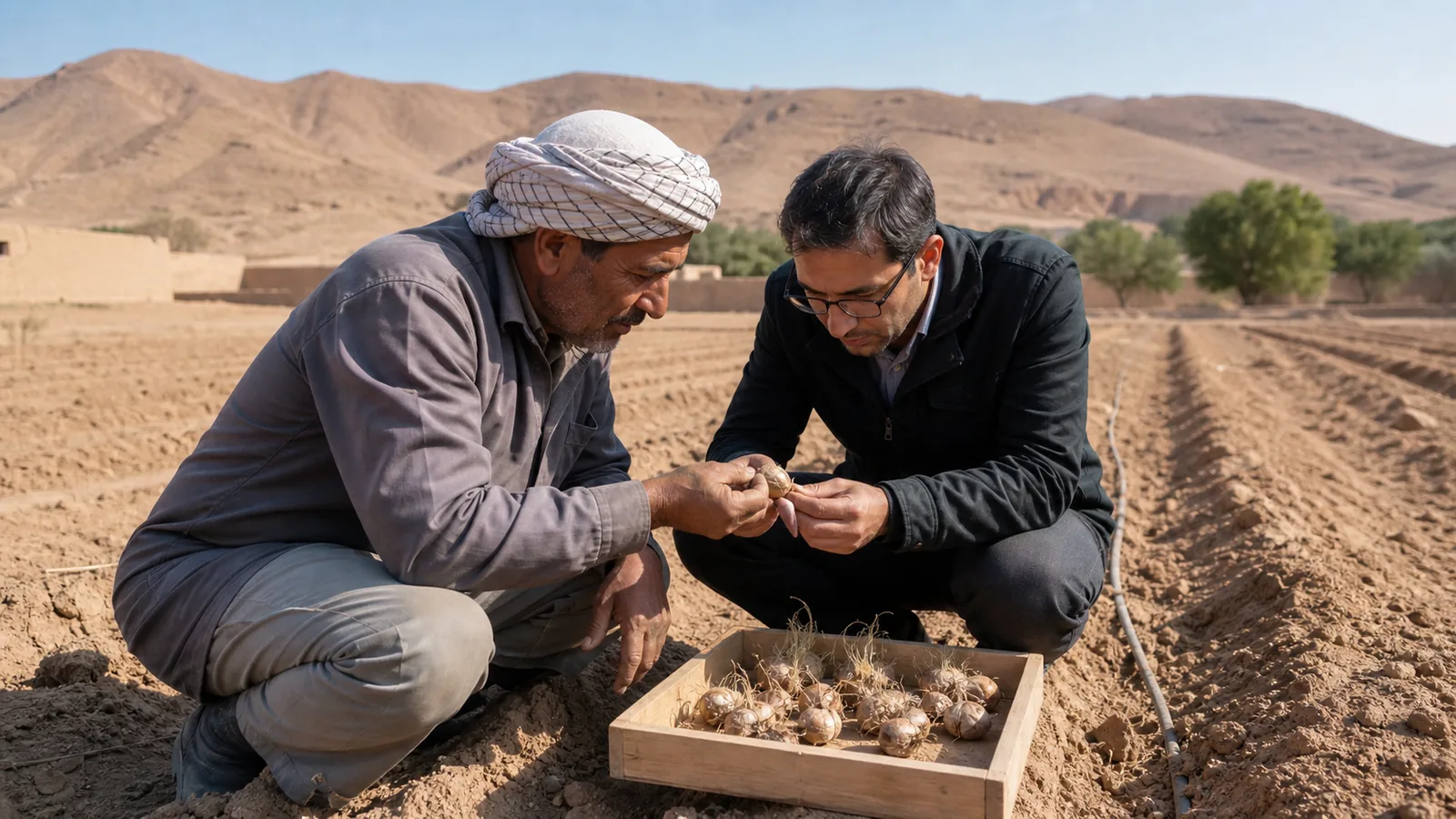
The two accounts cover different provinces and reporting periods. Meybod is in Yazd Province; Darmiyan is in South Khorasan. Their figures should not be added together, and their old schedules, prices, support, and permit routes should not be assumed current.
Why 9 hectares were allocated to saffron in Meybod
Sadr Pourkoosari, then director of Meybod’s agricultural office, said 9 hectares had been allocated to saffron. He presented it as a possible replacement for crops such as alfalfa, watermelon, and melon where water availability made those crops difficult to sustain.
The official identified Sadrabad in the Nodoushan area as particularly suitable. The machine-translated article appears to say that 6 of the 9 hectares were there and that the crop quality was good, but the sentence is incomplete. The 6-hectare location should therefore remain an attributed reading rather than a more precise boundary or quality classification.
The report expected that season’s harvest to exceed the previous year’s because of what it described as favorable local weather. It supplies neither year’s output, mature productive area, grade, nor rainfall data, so the size of the expected increase cannot be calculated.
The local planting and harvest calendar
Pourkoosari placed local planting from September into early October and harvest in the first half of November. He also described a five-year field cycle, production beginning in the third year, and irrigation only two or three times annually.
Those statements record how the official summarized the local program; they are not universal cultivation rules. The number and timing of irrigations, first meaningful flower yield, and useful life of a planting can change with corm size and health, planting date and depth, soil, temperature, field history, and water conditions. The old report provides none of those details.
It also says labor was needed only at harvest. That is too broad if read literally: establishment, irrigation, weed and pest management, flower separation, drying, and post-harvest handling can all require work. The article preserves harvest as the labor-intensive period without claiming it is the only time labor is needed.
Corm cost, plant health, and intermediaries
Meybod growers were said to face a 30% year-on-year increase in the price of saffron corms. The report gives no baseline price, currency amount, corm grade, or crop year beyond its publication context, so the percentage is historical rather than a current buying guide.
Bringing corms from other cities also raised quarantine and plant-health concerns. This is a meaningful constraint because moving planting material can move pests or disease as well. The source does not identify a specific organism or inspection protocol, so no diagnosis or treatment is invented.
Pourkoosari also mentioned brokers and intermediaries as a market problem. The report does not quantify their margin or show a transaction, which means it supports the existence of a local concern but not a universal claim about every corm seller.
Darmiyan: 300 hectares and about one tonne
Hashem Vali-Pourmotlagh, then head of the South Khorasan Agricultural Jihad Organization, reported 300 hectares of saffron in Darmiyan and an average yield of 3.7 kilograms per hectare. Multiplying the figures gives about 1,110 kilograms, or 1.11 tonnes, which is reasonably consistent with the article’s rounded statement that about one tonne was harvested.
The source calls 3.7 kg/ha a good yield. Because it does not give field age, grade, sampling method, water use, or the spread between farms, that remains the official’s regional assessment rather than a universal benchmark.
For scale only, the site’s report on Khorasan Razavi saffron cultivation covers a much larger provincial total. Darmiyan is in South Khorasan, so the regions must not be confused or their acreage combined.
Nutrition and rodent guidance in the Darmiyan report
Vali-Pourmotlagh said local advisers recommended vermicompost at the start of flowering and foliar micronutrients in March and April as ways to improve yield. These are attributed historical recommendations, not a one-size-fits-all fertilizer prescription. A grower would still need local advice, soil or tissue evidence where appropriate, product instructions, and a field-specific rate.
He also identified rodents—translated in the old article as “blind mice”—as an important cause of lower yield. The report provides no species identification, damage count, or control method. Correct identification should come before control; this article does not substitute a pesticide or trapping recommendation for missing field evidence.
Historical permit requirement before moving corms
The Darmiyan official told farmers to obtain permits from the agricultural authority and the Engineering System Organization before buying saffron corms and transferring them to fields. That requirement is important to preserve because it connects planting material with plant-health oversight.
Rules and office procedures can change. Anyone planning a current purchase or transfer should confirm the applicable permits with the responsible local authorities rather than relying on this historical report.
What the combined record shows
Meybod’s 9 hectares document a small expansion effort shaped by water limits, corm sourcing, and local climate. Darmiyan’s 300 hectares show what a more established area was reporting about yield and management. Together they make a coherent point: choosing saffron is not the end of a water or farm-planning decision.
A current update would need productive hectares, corm origin and grade, irrigation volumes, final dried harvest, quality results, pest records, input costs, sale prices, and current permit requirements. Without those data, the historical figures should remain clearly dated observations rather than present-day promises.

![Exporting Saffron to Turkey + Price Guide [Complete 0 to 100]](https://img.rowhanisaffron.com/20260827003933/saffron-export-turkey-quality-inspection.webp)



