


The Torbat-e Heydariyeh saffron harvest fell by an estimated 30–40% in the historical season covered by this report. The city had about 8,700 hectares under saffron, but severe winter cold followed by sharply reduced spring rain cut yield from its earlier average of 4–4.2 kilograms per hectare.
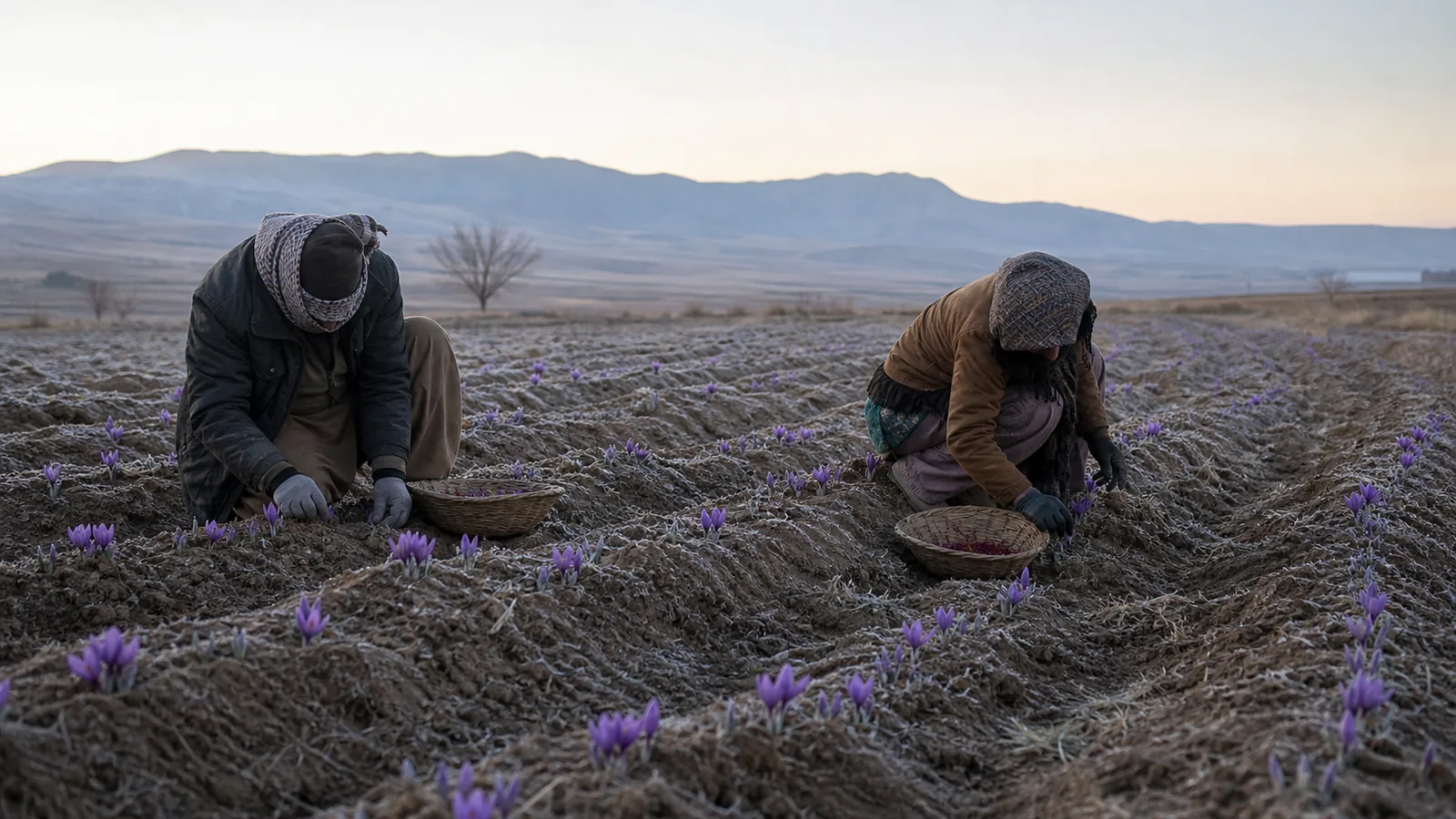
The local decline mattered beyond one county. Torbat-e Heydariyeh sat inside a Khorasan production region that an agricultural official credited with 80% of Iran’s saffron and about 82,000 cultivated hectares at the time. It was also a trading centre where crops from surrounding districts were brought for sale.
Every acreage, yield, price, and purchase rule below belongs to those dated official interviews. They are useful as a record of that season, not as current production data or a standing offer to farmers.
How much the Torbat-e Heydariyeh saffron harvest declined
Mohammad Reza Abbaspour, then director of the city’s agricultural authority, said earlier fields averaged 4–4.2 kilograms of dried saffron per hectare. A 30–40% reduction would put the affected season’s implied average near 2.4–2.9 kilograms per hectare, although the source did not publish a final measured total for the whole city.
Abbaspour attributed the loss to two weather shocks: severe cold during the preceding December and February, followed by a sharp reduction in April rainfall. Saffron is dormant for part of the year, but corm health, root development, temperature, and available moisture before flowering still influence the next crop. The report links the conditions with the decline; it does not provide a controlled field study that isolates how much each event contributed.
A second Khorasan interview, from a different reporting period, said some farms had also experienced cold but suggested production could improve on the prior year. The two observations should be read as separate seasonal snapshots, not as forecasts for the same harvest.
Harvest labour and neighbouring cities
The local report estimated that one hectare of saffron required about 200–220 labour-days across field work and harvest. This means the combined work of people over days, not 200 permanent jobs for each hectare.
Roughly 30% of the seasonal harvest workforce was reported to come from nearby cities, especially Torbat-e Jam, Bakharz, and Qaen. Workers helped pick flowers and separate or spread them for stigma removal and drying. Their role explains why a poor Torbat-e Heydariyeh harvest affected household income beyond the city’s own growers.
Khorasan’s wider saffron production area
Mojtaba Mazrouei, then head of the Khorasan Razavi Agricultural Jihad Organization, reported about 82,000 hectares under saffron and said the Khorasan production region supplied roughly 80% of the country’s crop.
He named Torbat-e Heydariyeh, Zaveh, Kashmar, Gonabad, Khaf, Rashtkhar, Mashhad, and surrounding districts as principal production areas. Abbaspour’s local account also mentioned Mahvelat and said Zaveh had the largest planted area in that cluster, at about 12,000 hectares.
These historical totals should not be read as a current provincial census. They do establish the scale around Torbat-e Heydariyeh and why the city’s market served growers from several production districts. Our overview of saffron production in Iran provides broader national context.
Why Torbat-e Heydariyeh was also a trading hub
Abbaspour said saffron from Torbat-e Heydariyeh, Zaveh, Mahvelat, Rashtkhar, and Khaf commonly moved into Torbat-e Heydariyeh for buying and selling. In the reduced-harvest season, however, he described private demand and prices as weak.
Local authorities responded with an agreed-purchase program starting on November 1. The Rural Cooperative Centre and Zarrin Saffron Company of the East acted on behalf of Iran’s Central Organization of Rural Cooperatives. By the interview date, the program had reportedly purchased about 2,000 kilograms of dried saffron in the city.
The stated historical purchase prices were:
- ordinary Pushal, translated in the source as “straw”: about 4.4 million tomans per kilogram;
- premium Pushal: about 4.9 million tomans per kilogram; and
- Negin: about 5.4 million tomans per kilogram.
A related provincial briefing quoted a floor near 4.3 million tomans for Pushal and 5.4 million for Negin. The small difference in the Pushal figure may reflect grade, rounding, location, or timing. It is safer to preserve both reports than to invent one official price.
For present buying information rather than these historic support values, use the site’s current saffron price page.
How the support-purchase plan worked
Mazrouei described the provincial system as a price floor intended to prevent distressed sales and bring more stability to growers and traders. Saffron first underwent laboratory analysis. Once accepted, the farmer received 40% of the floor-price amount.
The remaining product was then offered through the commodity exchange, where it could sell above the floor. The balance owed to the farmer was to be paid within three months. That structure tried to combine immediate cash for the grower with a later organized sale.
The account does not specify every laboratory criterion, fee, storage cost, rejection rule, or settlement safeguard. Nor does it show that all farmers participated. It should be understood as the design of that historical support program, not a current payment guarantee.
Export activity during the same period
Abbaspour said the main export phase for the new crop had not yet begun when he was interviewed. One Torbat-e Heydariyeh company had nevertheless exported about 1.5 tons during the first six months of the year.
That company figure is not the city’s total exports and should not be compared directly with the 2,000 kilograms purchased through the support program. One measures shipments by a single business over six months; the other measures local program purchases by the interview date.
What the consolidated reports show
The Torbat-e Heydariyeh saffron harvest story connects field conditions with labour and market structure. Cold and low rainfall reduced yield. The effect spread to seasonal workers from Torbat-e Jam, Bakharz, and Qaen. Weak private buying then led cooperatives to purchase graded saffron under a floor-price arrangement.
The provincial report adds the missing scale: Torbat-e Heydariyeh was one part of an 82,000-hectare Khorasan production network credited with most of Iran’s crop. That context explains why local weather, grading, and purchase policy were important well beyond the boundaries of one city.

![Exporting Saffron to Turkey + Price Guide [Complete 0 to 100]](https://img.rowhanisaffron.com/20260827003933/saffron-export-turkey-quality-inspection.webp)



