


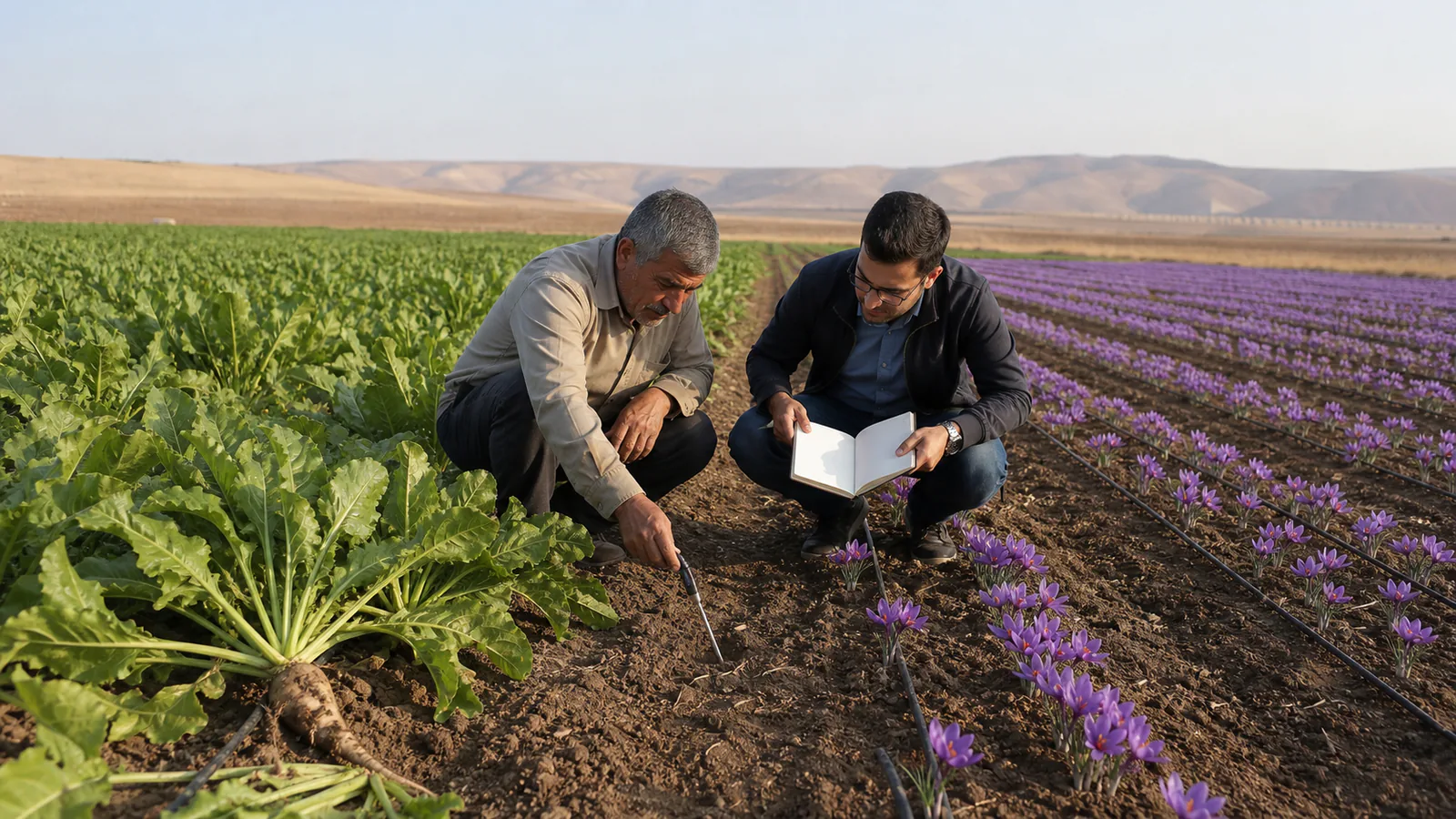
“Saffron takes the place of sugar beet Aslamabad gharb?” was the translated headline of a local crop-planning report from western Iran. The place is more commonly written in English as Eslamabad-e Gharb, in Kermanshah Province. The question was whether some irrigated land devoted to water-demanding sugar beet could produce greater value with saffron instead.
Karam Mohammadi, then governor of Eslamabad-e Gharb, supported exploring that change. His proposal was not evidence that every beet field should be converted. A sensible decision has to compare water, soil, labour, crop timing, processing links and the farmer’s route to market on the same piece of land.
What the original Eslamabad-e Gharb report said
In the archived ISNA interview reproduced by this post in 2016, Mohammadi described agriculture as one of the county’s major development opportunities. The report gave the area as roughly 84,000 hectares of rain-fed land and 12,000 hectares of irrigated land. Better productivity from that land, he argued, could support wider economic development.
He said the county accounted for 46% of Kermanshah Province’s sugar-beet production at the time. Beet was therefore not a marginal crop: it supported farms, haulage and sugar processing. His concern was its water use. He suggested replacing part of the beet area with saffron because the spice could offer more value from a smaller quantity of harvested product.
The article also identified wheat, barley and other cereals as important crops. It linked farm development to local processing and employment, citing a provincial employment allocation of 2,227 positions, of which 774 had reportedly been achieved when the interview took place. It mentioned 28 industrial units, some inactive, and referred to tile, poultry, spring-water, sugar and cake production among local activities. These are dated statements from the report, not a current inventory of the county’s economy.
Why saffron looked attractive as an alternative
Sugar beet needs substantial water over its growing season. The UN Food and Agriculture Organization gives an indicative crop-water range of 550–750 mm for sugar beet, while stressing that such figures are rough estimates and local calculations are better. A separate FAO agronomy reference gives a similar 500–800 mm range and notes that need varies with climate, planting date, density and management.
Saffron follows a different calendar. Its corms remain in the soil for several years, flowers are collected in autumn and the plant is dormant through much of the hot summer. Research on saffron water requirements describes high water productivity and lower irrigation needs than many conventional crops, but it does not call saffron a no-water crop. In dry Iranian conditions, timely irrigation still affects flowering, corm growth and future yield.
That difference helps explain Mohammadi’s proposal. It does not prove the economics. Saffron earns value through a tiny dried stigma yield, and the flowers must be picked and separated quickly. Land that saves water but cannot supply harvest labour, careful drying or a dependable buyer may not deliver the hoped-for return.
A field-by-field decision, not a slogan
Before replacing sugar beet with saffron, a grower or local programme should answer several practical questions.
Does the field suit a multi-year saffron cycle?
Saffron needs free-draining soil and a site where waterlogging can be avoided. The field will not return to an annual rotation immediately because the corms stay in place across seasons. Soil history, weeds, salinity, drainage and the health of planting corms all deserve inspection before the first furrow is opened.
How much irrigation is actually available?
Regional averages are not an irrigation schedule. Rainfall and evaporative demand vary from year to year, while soil texture changes how long moisture remains available. A study mapping saffron requirements across Kermanshah Province estimated different seasonal needs for each station and calculated a separate figure for Eslamabad-e Gharb after effective rainfall. That is precisely why a local water balance is more useful than the claim that saffron “needs little water.”
Who will harvest and process the flowers?
Flowering is brief and labour demand arrives quickly. Fresh flowers lose quality if they wait. A conversion plan therefore needs pickers, a clean place for stigma separation, controlled drying and suitable packaging. Those costs should be counted alongside corm purchase and field preparation.
What happens to the crop after drying?
A farmer needs a realistic buyer, not a theoretical retail price. The calculation should use expected farm-gate terms for a stated grade and include testing, packaging, commissions, storage and payment timing. Our guide to Iranian saffron standards explains why quality cannot be judged by colour or origin alone.
What would be lost if beet area shrank too quickly?
Crop substitution changes more than field water use. The original report itself placed Eslamabad-e Gharb within a local agricultural and industrial system. Sugar beet supplied factories and transport work. A sudden reduction could leave processing capacity underused even if the replacement crop earns more per kilogram.
Saffron creates a different chain of work: corm supply, seasonal picking, separation, drying, grading and sale. Those jobs may be valuable, but they do not appear automatically. A phased trial protects the farm and the local economy better than a county-wide instruction based on one season’s prices.
A practical trial before wider conversion
A small demonstration plot can answer the questions that a headline cannot. The trial should record:
- field area, soil condition and planting-corm cost;
- rainfall and every irrigation by date and volume;
- labour hours for field work, picking, separation and drying;
- fresh flowers and dry saffron produced;
- quality-test results and the grade actually sold;
- packaging, testing, transport and sales costs;
- the price and payment terms received by the farmer; and
- corm health and yield over more than one flowering season.
The same record should be kept for a comparable beet plot. Only then can the farm compare net income, irrigation use, labour and risk rather than comparing saffron’s retail reputation with beet’s bulk tonnage.
So, should saffron take the place of sugar beet?
On some suitable irrigated land in Eslamabad-e Gharb, saffron may be a useful part of a more diverse crop plan. The historical proposal had a rational starting point: water was constrained and the county wanted higher-value agriculture. Yet “part of the area” is the crucial phrase.
Saffron should earn its place through a local trial, a measured water budget and a believable market. Sugar beet should be judged with the same care, including its link to the local sugar industry. The strongest plan may be a gradual shift on selected fields rather than treating one crop as a universal replacement for the other.
Sources and historical scope
- The archived ISNA interview reproduced in the original version of this post, with statements attributed to Karam Mohammadi.
- FAO, Crop Water Needs, indicative seasonal values including sugar beet.
- FAO, Crop Yield Response to Water, sugar-beet agronomy and water requirements.
- Behdani and Fallahi, Saffron water requirements, 2020.

![Exporting Saffron to Turkey + Price Guide [Complete 0 to 100]](https://img.rowhanisaffron.com/20260827003933/saffron-export-turkey-quality-inspection.webp)



