


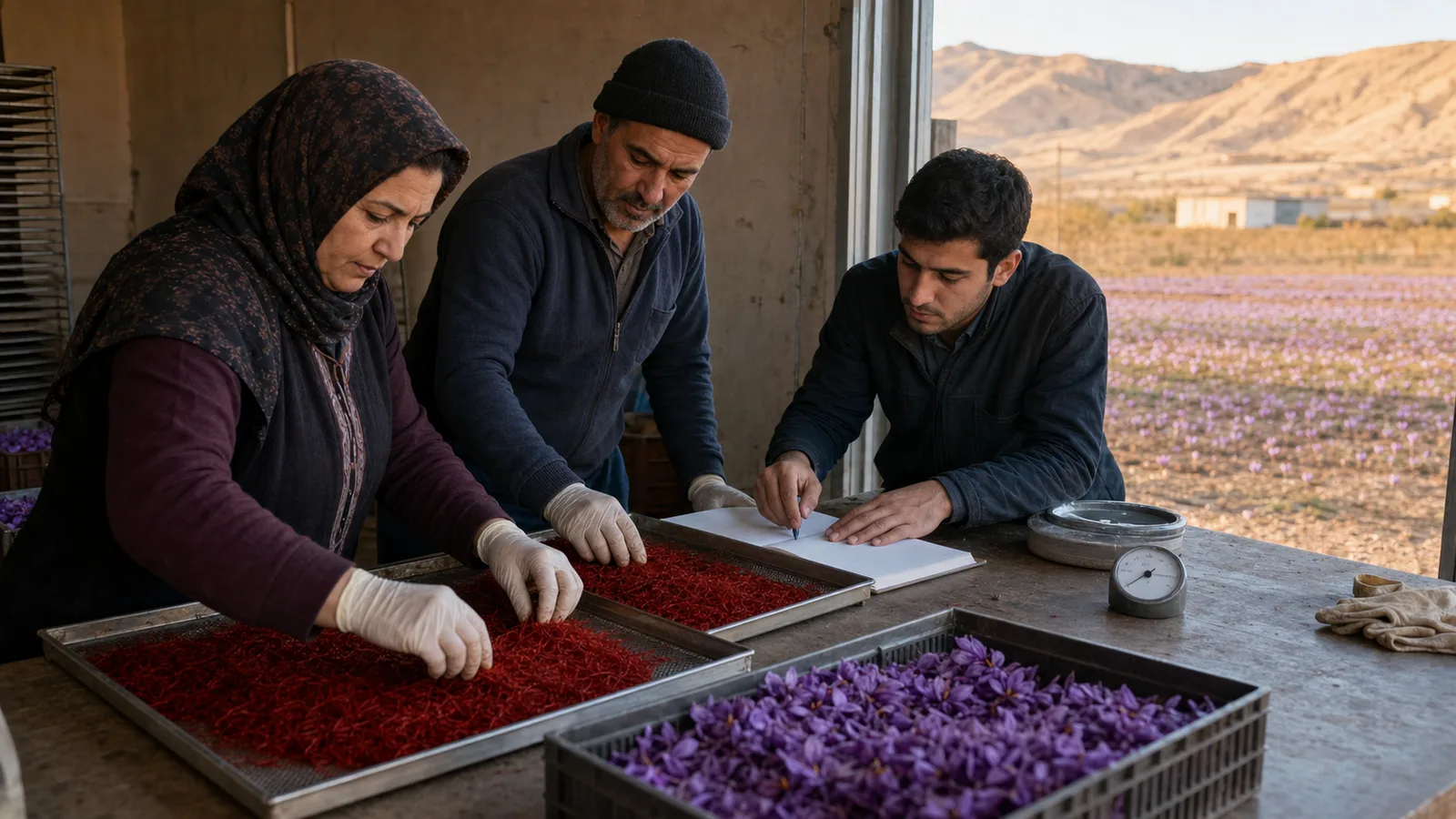
“Red Gold is not a luxury” was Gholamhossein Shafei’s way of describing saffron as a strategic crop rather than an ornamental extra. In a 2016 interview attributed to the Iranian Students News Agency (ISNA), the then chairman of the National Saffron Council argued that saffron policy affected rural income, water-scarce farming areas and Iran’s place in export markets. A high retail price did not make the crop expendable to the people whose livelihoods depended on it.
The original English article is fragmented and repeats part of the interview. This reconstruction keeps its complete meaning but does not turn the old proposals into current government policy. It also separates Shafei’s opinions from facts that can be checked today.
What “not a luxury” meant in the interview
Saffron can be a premium purchase for a household and still be a working agricultural product at its origin. Growers buy corms, prepare land, irrigate, control weeds, pick flowers in a narrow season, separate stigmas, dry them and find a buyer. For farming communities, the central issue is not the glamour attached to “red gold”; it is whether the crop produces a stable return.
That distinction is especially important in dry parts of Khorasan. The Food and Agriculture Organization describes the qanat-based saffron system in Gonabad as a source of livelihoods in an area with severe water shortages. Saffron needs less water than many alternative crops, but “less” does not mean none. A suitable site still requires dependable irrigation at the right stages, healthy soil and a plan for long-term corm and land management.
The inherited report contains one opening fragment: “Compared with other countries is much lower.” It never identifies what was being compared. Yield per hectare may have been the missing subject, but production value, efficiency or another measure is also possible. The responsible choice is to preserve the fragment’s existence without manufacturing a statistic or conclusion.
The stalled saffron master plan
Shafei presented implementation of a national “saffron master plan” as the answer to several structural problems. He said the plan had been approved years earlier but was not mandatory, and that budget constraints appeared to be blocking it. In his account, effective implementation could raise productivity and improve both the quality and quantity of Iranian saffron.
A master plan is useful only when it connects the whole chain. Increasing field output without improving drying, storage or sales can produce more saffron without creating more value. Branding without dependable batches can raise expectations that the supply chain cannot meet. Export promotion without market research can send the wrong grade, pack or message to the wrong buyer.
The old article does not publish the approved plan, its legal status, budget or performance measures. It therefore cannot show whether a particular project was funded or completed. What it does preserve is Shafei’s diagnosis: fragmented measures were not enough, and an agreed programme needed money and implementation authority.
Productivity should mean more than a larger harvest
Farm productivity is often reduced to dry saffron yield per hectare. That number matters, but it can hide losses elsewhere. More flowers do not help if they wait too long before separation, collect soil during transport, dry unevenly or enter storage with excess moisture.
A useful productivity programme would track the crop from field to sale:
- healthy, traceable corms and a planting density suited to the field;
- timely irrigation based on local soil and weather rather than a universal calendar;
- weed, pest and corm-disease monitoring;
- prompt, clean flower collection and transport;
- accurate stigma separation and controlled drying;
- lot identity, storage conditions and representative sampling;
- the share of sale value that reaches the grower, not only the final export total.
Shafei also said cultivation should be developed in drought and low-rainfall areas. That cannot be a blanket recommendation to plant every dry field. Saffron may have a relative water advantage, yet expansion still needs suitable temperature, drainage, irrigation access, clean planting material, labour and a buyer. Otherwise, additional area can spread disease or depress returns without improving rural resilience.
New competitors changed the export question
The interview warned that Iranian saffron faced new producing countries whose cultivation and market work were becoming more systematic and scientific. Iran could not prevent competitors from growing the crop. It could protect its position by making origin, quality and commercial reliability easier for buyers to recognise.
This is where branding entered Shafei’s argument. A national name or attractive box is not enough. A brand promise has to survive the whole transaction: the stated origin must be defensible, the grade must match the specification, the sample must represent the shipped lot, and the seller must deliver consistently.
The current international specification ISO 3632-1:2025 covers dried saffron in filaments, cut filaments and powder. ISO’s related guidance explains that conformity and the absence of added foreign matter are central to purity claims. A laboratory result is useful only when the sampling and chain of custody connect it to the actual consignment.
Why direct market access matters
Shafei said Iran had not done enough to establish Persian saffron in global markets. In the inherited translation, exporters could not get their product directly to the consumer; much of it passed through intermediaries and was then exported onward to other countries and end users.
Intermediaries are not automatically harmful. A capable importer, distributor or packer can provide finance, regulatory knowledge, warehousing, local sales and customer service. The problem arises when Iranian origin becomes invisible, quality information is lost or most of the value is created only after the product leaves the producer.
Direct access can take several forms. A producer group may sell to a foreign industrial user under a documented specification. An exporter may supply a named retailer. A brand may sell smaller packs in a target market while complying with its food, labelling and tax rules. Each route requires different pack sizes, certificates, margins and support. “Remove the middleman” is not a strategy unless someone is ready to perform the work that middleman did.
Readers comparing the scale and direction of Iranian supply can use our saffron production statistics article. Production share and export value should be read by year and source; neither is a permanent percentage.
Processing must begin with the market
The interview criticised the processing sector for overlooking the market. Shafei referred to international showcases where products made from two major Iranian crops—saffron and pomegranate—were being unveiled. His point was that other markets were turning raw agricultural identity into products and customer demand while Iran still sold too much value for others to finish.
Processing can mean careful cleaning and grading, consumer packing, food ingredients, extracts or finished foods. It is not automatically more profitable. A processor must know who will buy the product, which laws apply, how long it remains stable, what evidence supports each label claim and whether the extra margin exceeds development and compliance costs.
For saffron, market-led processing starts with questions rather than machinery. Does a restaurant buyer need whole threads and repeatable colour strength? Does a food manufacturer need an ingredient specification and microbiological limits? Does a retailer require tamper evidence, country-of-origin wording and a particular pack size? The answer determines the process.
A practical reading of the master-plan idea
The old interview points to a connected programme with several jobs:
- Farm support: local agronomy, corm health, water planning and realistic yield records.
- Post-harvest control: clean handling, prompt separation, measured drying and protected storage.
- Common quality language: agreed grades, representative tests and lot-level traceability.
- Market intelligence: target-country demand, buyer requirements, competing origins and price by comparable grade.
- Brand and origin: claims that can be verified from field or supplier through the final pack.
- Commercial access: finance, logistics, compliant packaging and contracts that return value to producers.
- Measurement: outcomes such as grower income, rejected lots, repeat buyers and value retained in Iran.
Funding matters because training, laboratories, extension work, data systems and export development cost money. Governance matters just as much. A plan with no named owner, milestones, published measures or feedback from growers can absorb a budget without changing the market.
Red gold is valuable because it supports real work
Shafei’s phrase was not a claim that saffron should be cheap, common or essential in every kitchen. It challenged the idea that policy could treat the crop as a decorative luxury. In dry farming regions, saffron connects land and scarce water to seasonal work, processing, trade and family income.
The 2016 report identified weaknesses that fit together: an approved but stalled master plan, uncertain productivity, new competitors, weak branding, indirect access to consumers and processing that was not led by the market. Solving only one would leave the others in place.
Red Gold is not a luxury when the phrase is viewed from the farm outward. Its lasting value comes from careful production, verifiable quality and a market that recognises Iranian origin while returning a fair share of the result to the people who grow and handle it.

![Exporting Saffron to Turkey + Price Guide [Complete 0 to 100]](https://img.rowhanisaffron.com/20260827003933/saffron-export-turkey-quality-inspection.webp)



