


North Khorasan saffron production was forecast to rise by 3 tons, from 15 tons to 18 tons, in the historical provincial report preserved here. The same report placed the cultivated area at 3,206 hectares and said Farouj produced about 75% of the province’s saffron. Read together with the three related reports consolidated into this article, the figures show rapid expansion followed by a practical warning: growing more flowers is only useful when a region also has enough people, hygienic cleaning facilities, and processing capacity to handle the harvest.
What the North Khorasan saffron production increase meant
Mohammad Ali Sharikian, then the horticulture director of the North Khorasan Agricultural Jihad Organization, expected the province’s autumn harvest to reach 18 tons. The previous harvest had been reported at 15 tons, so the forecast represented a 3-ton increase rather than a total production figure of three tons.
At that point, saffron covered 3,206 hectares across the province. More than 2,000 hectares were in Farouj, which Sharikian credited with roughly three-quarters of North Khorasan’s output. The crop had reached flowering, with picking expected to begin within the following month.
These are dated news figures, not a current production forecast. Their value is in showing how quickly the province’s saffron sector was developing and why Farouj became central to both its production gains and its processing problems.
How the province’s saffron area expanded
An earlier briefing from Sharikian recorded another stage of the same growth. It said 470 hectares had been added to North Khorasan’s saffron gardens in one year, taking expected production to about 15 tons.
The translated report also describes a longer progression: cultivated area grew from 344 hectares to about 2,750 hectares, with production later reported at 12.11 tons. Some wording and dates in the old translation are unclear, so these figures should be read as separate historical snapshots rather than a perfectly continuous annual series.
Sharikian put the province’s average yield at 6.2 kilograms of dried saffron per hectare. The source mistakenly renders that unit as kilograms per square metre in one sentence; the surrounding comparison and normal agricultural reporting make clear that the intended unit is kilograms per hectare. The same account placed Isfahan at 5.7 kilograms per hectare and ranked Kerman behind it.
For wider context, our overview of Iranian saffron production statistics explains why cultivated area, yield per hectare, and total output need to be kept separate. A province can add land without achieving the same proportional rise in dried saffron if weather, corm quality, labor, or post-harvest handling limits the result.
Farouj produced most of the crop
Farouj’s share explains why the city appears repeatedly in North Khorasan saffron reports. With more than 2,000 of the province’s 3,206 hectares and around 75% of its output, a problem in Farouj could affect the provincial harvest as a whole.
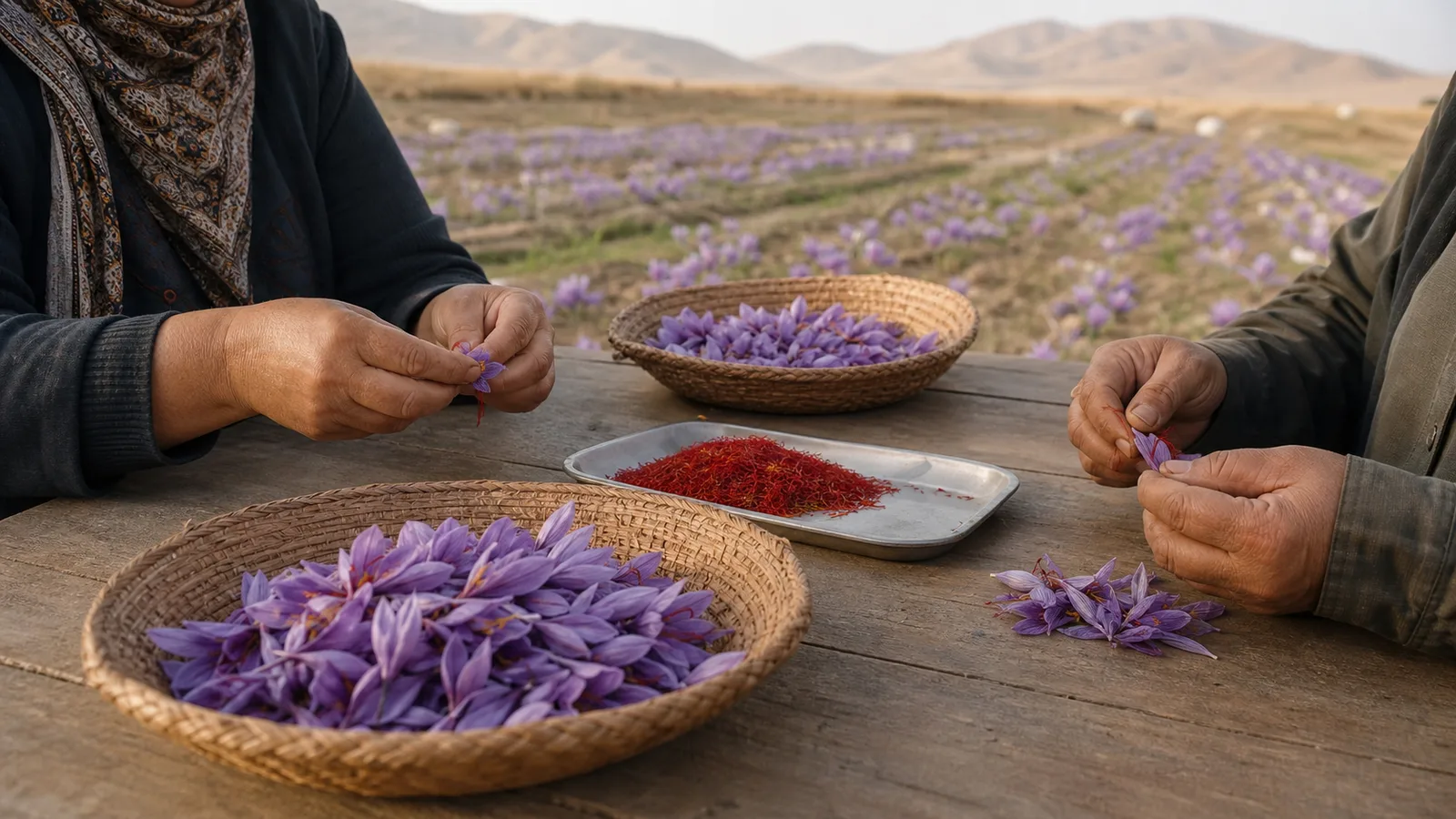
The concentration also made the harvest highly seasonal. Crocus flowers must be picked and processed promptly, and the red stigmas are traditionally separated by hand. A larger planted area therefore creates a short, intense demand for labor and clean working space. Production capacity is not only the amount a field can grow; it also includes the ability to handle flowers before quality deteriorates.
Why Farouj’s governor wanted expansion paused
In a separate report, Farouj governor Masoud Sadeghi argued that the city should not expand its saffron area until it had better processing facilities. His concern was not weak demand for the crop. It was the scale of work required immediately after picking.
Sadeghi estimated that cleaning the existing harvest would require about 28,000 people working three hours a day, compared with a city population of roughly 50,000. Harvest also coincided with the season in neighboring saffron-producing areas, so spare labor could not simply be drawn from nearby districts.
Much of the flower cleaning was being done by hand in homes. The governor called for dedicated hygienic cleaning units so the city could process its crop under better-controlled conditions. His broader point remains useful: expanding acreage before cleaning, drying, storage, and packaging capacity are ready can move the bottleneck from the field to the processing stage.
The report placed saffron at 8–10 million tomans per kilogram at the time. That is a historical price, not a present quotation. Readers looking for today’s market should use the site’s current saffron price information instead.
Hamadan shows what smaller regional production looked like
A report from Hamadan offers a useful comparison with North Khorasan’s ton-scale harvest. Rahim Bayat of the provincial horticulture department forecast 172 kilograms of saffron from 53 hectares, up from 162 kilograms on 48 hectares in the previous year.
The same historical account put Iran’s saffron area at about 79,000 hectares. It assigned 78% of production to Khorasan Razavi and 18% to South Khorasan, with the remaining 4% shared among provinces including Kerman, Isfahan, Hamadan, North Khorasan, and Fars. That distribution helps explain why production outside the two dominant Khorasan provinces was often discussed in terms of emerging local clusters.
The translated source records national output as 60 tons for that year, but this figure does not align comfortably with the stated acreage and the article’s own claim that Iran supplied 80–89% of world production. A zero may have been lost in transcription or translation. The number is therefore preserved as part of the source record but should not be treated as a verified national total.
What the agronomy says about expansion costs
Bayat’s report also explains why adding saffron acreage requires more than preparing ordinary annual crop land:
- A saffron field can remain productive for roughly five to ten years.
- The strongest yields were described as occurring between years three and seven.
- Establishing one hectare may require about three to five tons of saffron corms, making the first year comparatively expensive.
- Picking flowers and separating stigmas are labor-intensive jobs often carried out by families and local seasonal workers.
Those details connect the Hamadan and Farouj reports. The corm investment encourages growers to think in multi-year cycles, but each larger harvest also increases the need for short-window labor, clean processing, drying, and secure storage.
How to read the consolidated North Khorasan record
The four reports describe different moments and should not be forced into a single present-day statistic. Together, they support a clear historical sequence: North Khorasan expanded from a small saffron base; hundreds of hectares were added; production moved through reported totals of 12.11 and 15 tons; and officials later forecast an 18-ton harvest, with Farouj responsible for most of it.
The expansion also exposed the limit of acreage-led growth. North Khorasan’s reported yield was strong, but Farouj still needed hygienic cleaning and processing units capable of handling flowers during a short harvest period. The durable lesson is that saffron development works best when planting, skilled labor, processing, quality control, and market access grow together.

![Exporting Saffron to Turkey + Price Guide [Complete 0 to 100]](https://img.rowhanisaffron.com/20260827003933/saffron-export-turkey-quality-inspection.webp)



