


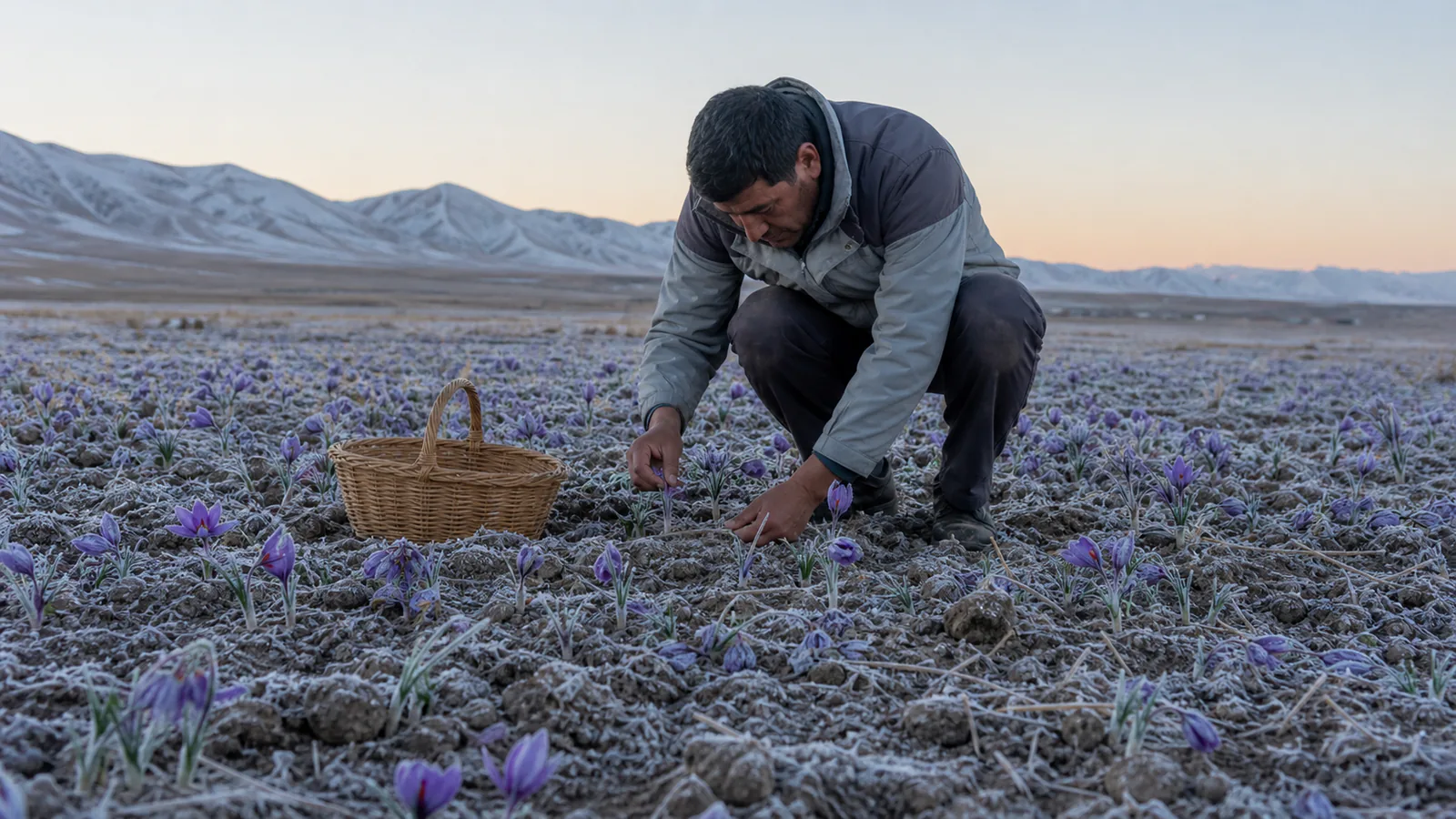
Saffron harvests in the colder parts of Khorasan Razavi were provisionally estimated to be 15–20% lower after temperatures fell to about −7°C. Snow, hail, persistent cold, and frozen surface soil were reported to have damaged flower-producing tissue or delayed flowers from emerging. The estimate was made while harvesting was still under way, so it was not a final province-wide result.
The same official later connected the difficult season with a wider argument about Khorasan’s dependence on saffron and competition from cultivation programs in other Iranian provinces. Weather evidence and market policy are different questions; this combined account keeps them separate.
Why the Khorasan Razavi saffron harvest fell
Mohammad Reza Ghodsi, horticulture director at the Khorasan Razavi Agricultural Jihad organization, based the initial 15–20% reduction estimate on field visits in colder districts. He said the temperature had remained low for long periods and reached roughly −7°C.
Saffron grows from a corm below the soil, but the flower must still develop and emerge through the surface. According to the report, severe cold affected the flower-producing organs, while snow, hail, and frozen topsoil made emergence more difficult. Fields that had flowered before the cold escaped some of the loss.
This was a report about one particular season. A temperature reading by itself cannot predict the loss on every farm: duration, soil moisture, snow cover, field elevation, flowering stage, and local exposure all influence damage.
Cold and warmer districts were at different harvest stages
Ghodsi listed Torbat-e Heydarieh, Zaveh, Neishabour, Chenaran, Mashhad, and Fariman among the colder areas where saffron fields had been affected. In contrast, harvesting had only recently begun in relatively warmer areas including Bardaskan, Khalilabad, Kashmar, Gonabad, and Mahvelat.
That timing difference is why a final provincial total was not yet available. The warmer districts had not reached peak flowering, and officials expected to report more exact production figures around mid-December, after their harvest finished.
| Reported group | Districts named | Situation at the time |
|---|---|---|
| Colder areas | Torbat-e Heydarieh, Zaveh, Neishabour, Chenaran, Mashhad, Fariman | Field losses observed after severe cold |
| Relatively warmer areas | Bardaskan, Khalilabad, Kashmar, Gonabad, Mahvelat | Harvest beginning; final total not yet available |
Why irrigation timing changed the outcome
The report noted that some growers irrigated earlier, bringing flowering and picking forward. Those fields had produced flowers before the severe cold and therefore avoided the same degree of damage.
That observation is not a universal instruction to irrigate as early as possible. Irrigation timing has to reflect local temperature, soil, corm dormancy, water availability, and the grower’s intended flowering window. Moving one field operation can also change labor demand and harvest timing. Our saffron cultivation guide explains the broader production cycle; local agronomic advice should decide the exact schedule.
Heat, cold, and reduced cultivated area
In the related market report, Ghodsi described two weather stresses in the same year: extreme heat in July and cold in November. He associated them with lower yields and said the cultivated saffron area had also declined in Torbat-e Heydarieh, Zaveh, and Rashtkhar, three major growing areas.
Neishabour and Sabzevar were described as less affected, although not untouched. The source did not provide hectare changes for these districts, so the article preserves the direction of the report without inventing a precise loss.
A decline in cultivated area and a decline in yield are not interchangeable. Area describes how much land is planted; yield describes dried saffron per unit of land. A season can suffer one, the other, or both.
Was Khorasan losing its saffron market?
Ghodsi argued that Khorasan Razavi and South Khorasan depended unusually heavily on saffron because their dry climate and water scarcity limited alternative crops. On that basis, he opposed government cultivation allocations for other provinces. His concern was that water-richer regions could enter the market and reduce Khorasan Razavi’s share.
This was a policy position, not proof that saffron can or should grow only in Khorasan. Farmers in other provinces may have suitable soils, temperatures, water constraints, and markets of their own. Nor does more production automatically remove Khorasan’s advantages in experience, processing networks, trade relationships, and regional identity.
The useful question is whether expansion reflects agronomic suitability and genuine demand rather than a short-lived price signal. If acreage grows faster than grading, processing, and sales, the result can be more supply without stronger farm income.
What the 15–20% estimate does and does not show
- It was an early estimate for cold regions based on field visits.
- It was not the final production result for all of Khorasan Razavi.
- The report tied the loss to prolonged cold near −7°C, snow, hail, and frozen surface soil.
- Earlier-flowering fields were reported to have avoided some damage.
- A related report also mentioned summer heat and reduced area in several major districts.
The lasting lesson for Khorasan growers
The cold-season report and the market debate point to the same vulnerability from different directions. Khorasan’s saffron economy is concentrated: weather can reduce production across important districts at once, while market changes affect a large group of specialized growers.
Protecting that economy does not require treating every other producing province as a threat. It requires better local weather records, field-level yield data, resilient cultivation decisions, consistent quality, and market systems that reward origin and performance. The historical 15–20% loss estimate is most useful as a reminder that acreage and reputation cannot remove seasonal risk.

![Exporting Saffron to Turkey + Price Guide [Complete 0 to 100]](https://img.rowhanisaffron.com/20260827003933/saffron-export-turkey-quality-inspection.webp)



