


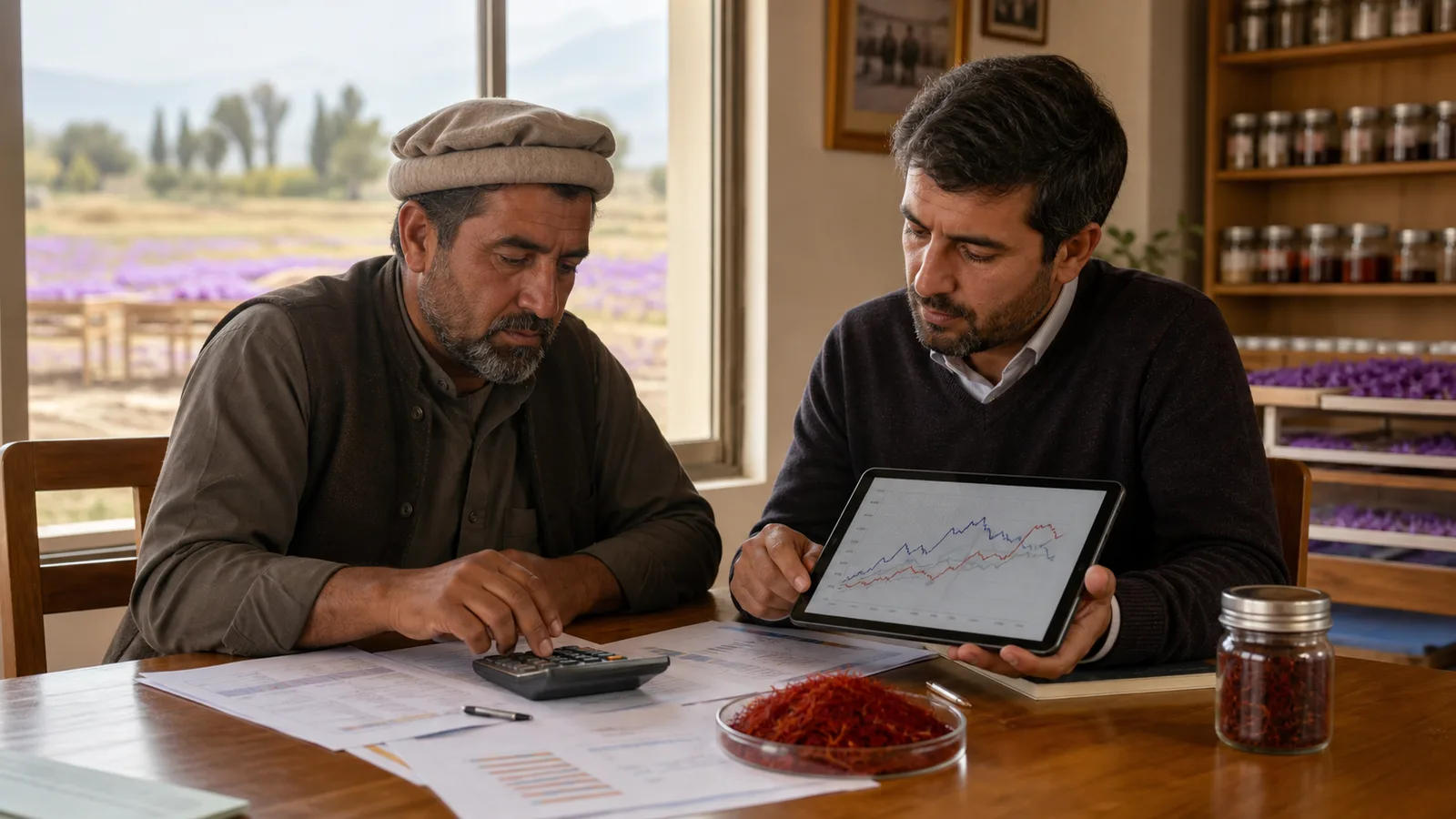
The original headline promised 10 times the export and economy of saffron by changing the exchange rate. The conference remarks preserved on this page do not demonstrate a tenfold result. They make a narrower argument: if a guaranteed saffron price is fixed in local currency while export earnings are received in euros or dollars, exchange-rate changes can leave producers behind.
That concern is real, but an exchange-rate adjustment alone does not multiply exports or farm income by ten. This article keeps the speaker’s historical figures and proposals, separates them from current data, and explains what would actually have to improve across the saffron value chain.
The Torbat Heydarieh conference argument
Ali Shariati Moghaddam, described in the old report as a member of Iran’s National Saffron Council, spoke at a saffron conference in Torbat Heydarieh. He called saffron one of the city’s defining crops and connected it with employment, household income and rural development.
The article said as many as 400,000 people took part in planting and harvesting during the growing season. That figure appears to describe seasonal work across a broad saffron economy rather than 400,000 permanent jobs in one city, but the surviving English version does not define its geography or method. It should therefore remain an attributed conference estimate.
The event covered a wide agenda: harvesting and packaging; foods, beverages and related products; medicinal and health research; saffron flowers; quality and productivity; fair trade; organic farms; Iranian saffron in global markets; employment; rural economic and cultural values; and saffron in Iranian and Islamic arts. That range matters because export value depends on more than the exchange rate.
Historical acreage and household figures
Shariati Moghaddam’s presentation gave the following snapshot:
- 108,000 hectares of saffron cultivation across Iran;
- 84,000 hectares in Khorasan Razavi, associated with 78% of production;
- 15,700 hectares in South Khorasan, associated with about 7%;
- about 8,000 hectares across other provinces;
- 21,000 hectares in Torbat Heydarieh and Zaweh together;
- 117,000 saffron-growing households in Khorasan Razavi;
- 14,000 to 15,000 of those households in Torbat Heydarieh; and
- 17,000 agricultural workers in Zaweh, 90% said to be involved with saffron.
These numbers are historically useful but internally imperfect. For example, 21,000 hectares is 25% of 84,000, not the 30% stated in the old translation. The same speech later referred to a national area of 115,000 hectares rather than 108,000. That may reflect different seasons, definitions or a transcription error. Without the underlying statistical table, the discrepancy should not be silently resolved.
Current FAO reporting places Iran at roughly 85–90% of world saffron production and continues to identify Khorasan as the core growing region. It does not turn every conference-era acreage number into a current statistic.
What the €1,200 proposal meant
The speaker proposed linking guaranteed prices for export crops, especially top-grade saffron, to the exchange rate. He used approximately €1,200 as a reasonable and globally competitive price for the best saffron. Contemporary Persian reporting identifies the proposed grade as Negin or pressed Negin and treats the number as a per-kilogram guaranteed-purchase benchmark.
It was a policy proposal, not a universal world price. The appropriate comparison would depend on grade, purity, moisture, lot size, packaging, shipment terms, destination, payment risk and date. A buyer’s retail price in Europe cannot be compared directly with an Iranian farm-gate or guaranteed-purchase price.
The proposal aimed to protect producers when foreign-currency export receipts converted into more local currency. If the domestic guaranteed price stayed fixed, exporters or intermediaries could capture more of that nominal difference while the farmer received no corresponding adjustment.
Why currency depreciation does not guarantee more exports
A weaker local currency can increase the local-currency value of a euro or dollar sale. Under a simple model, it may also let an exporter reduce the foreign-currency price while covering domestic costs. Real trade is more complicated.
International Monetary Fund research on dominant-currency pricing shows that when exporters quote in dollars or euros, depreciation does not necessarily make the product immediately cheaper to foreign buyers. Export volumes may respond only modestly in the short term. The benefit can also be reduced by:
- higher costs for imported packaging, machinery, testing or transport;
- inflation in labour and other domestic inputs;
- foreign-exchange conversion and repatriation rules;
- banking, insurance, sanctions and payment constraints;
- limited production capacity and inconsistent quality;
- buyer tariffs, standards and market access; and
- the bargaining power of intermediaries.
A nominal exchange-rate gain is not the same as a real gain after costs and inflation. Nor does a larger local-currency receipt prove that physical export volume rose.
The rural-values development project
The old article described an operational project to develop rural values through better saffron production. Its proposed scale was 20,000 farmers. At the time of the speech, about 4,000 farmers were said to be covered, at least half of them in the Torbat Heydarieh area.
The plan linked training with healthier products, better quality and higher efficiency. It also aimed to retain at least 50% of the value added between the farm and processing of organic products. That target was aspirational; the article did not provide an audited calculation showing that participants had already achieved it.
The economic logic is sound. Farmers capture more value when quality is protected after harvest, lots are traceable, buyers trust laboratory results, and packaging or processing serves a real market. An exchange rate can change the conversion of export revenue, but it cannot create those capabilities.
Yield: from 3.4 to 15 kilograms per hectare
Shariati Moghaddam put national average yield at 3.4 kg per hectare and argued that it should reach 15 kg per hectare. The second number is a target, not a forecast and not a safe promise for every farm. It is more than four times the stated average, not ten times.
Saffron yield varies with corm health and size, planting density, soil, water, field age, climate, pests, nutrition, labour timing and how flowers and stigmas are counted. A high biological yield can also be uneconomic if it requires excessive inputs or sacrifices quality.
Farm improvement should therefore measure saleable dry saffron per hectare together with colour, aroma, moisture, contamination, labour, water, input cost and net return. Our article on saffron harvesting steps explains why timing and post-harvest handling can protect value that cultivation alone cannot secure.
Organic demand and limited supply
The conference report said global buyers wanted organic saffron but limited production prevented suppliers from meeting that demand. “Organic” is not simply a synonym for natural or low-input farming. Export markets generally require a recognised production standard, documented inputs, separation from non-certified product, inspection and chain-of-custody records.
Certification can open a market segment, but it also adds transition, record-keeping, testing and audit costs. A producer should verify buyer demand and price premium before assuming that certification will increase net income.
What could genuinely strengthen the saffron economy
A durable export strategy needs several parts to move together:
- Farm productivity: improve saleable yield without degrading soil, water use or quality.
- Post-harvest quality: separate, dry and store stigmas consistently.
- Authenticity: test identity and contamination and maintain traceable lots.
- Market fit: produce grades, package sizes and documentation buyers actually request.
- Pricing: distinguish farm-gate, wholesale, export and retail values and state the currency/date.
- Finance and policy: make currency conversion, export obligations and working capital predictable.
- Producer share: use transparent contracts and organisations that let growers understand where value is added.
FAO’s current work with Iranian institutions likewise focuses on authenticity, traceability, post-harvest handling, testing, innovation and market confidence. That broader approach is more credible than expecting one exchange-rate change to transform the sector.
Was a tenfold increase established?
No. The text supplied no baseline export value, no tenfold scenario and no calculation linking a particular exchange rate to ten times more exports. It contained a €1,200 guaranteed-price proposal, historical acreage and household figures, a farmer-training programme and a yield ambition from 3.4 to 15 kg/ha.
The headline is best understood as an emphatic summary of the speaker’s growth ambition. The defensible conclusion is narrower: exchange-rate policy influences how export revenue is distributed, while long-term saffron income depends on productivity, verified quality, processing, market access and the share that reaches producers.
Sources
- The Torbat Heydarieh conference report preserved in the previous version of this page; all historical figures above are attributed to that record unless otherwise stated.
- Khorasan Razavi Saffron Exporters Union archive of the €1,200 proposal (Persian).
- IMF: dominant currencies and the limits of exchange-rate effects on trade.
- FAO: innovation and quality integrity in Iran’s saffron value chain.

![Exporting Saffron to Turkey + Price Guide [Complete 0 to 100]](https://img.rowhanisaffron.com/20260827003933/saffron-export-turkey-quality-inspection.webp)



