


Young people welcome the saffron futures contract was the headline given to a 2019 interview with economist Hamid Reza Baradaran Shoraka. He reported visible interest from traders and investors, particularly younger people in Mashhad, after saffron futures began trading in Iran. That observation should be kept in proportion: it describes what he saw around a new market, not a published demographic study of everyone who traded it.
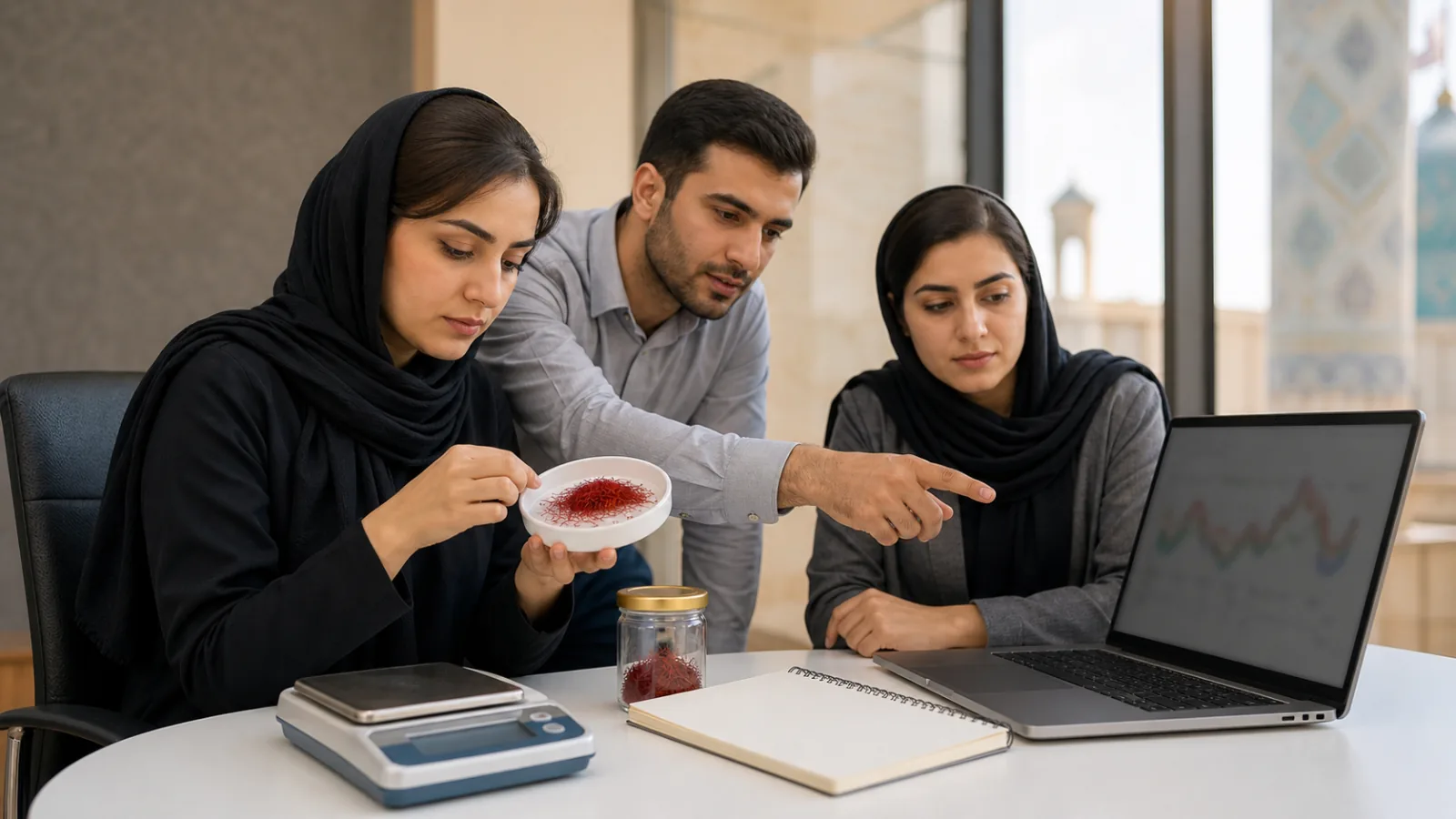
His broader point was that an exchange-based contract could make saffron prices easier to observe and give producers, processors and exporters another way to manage price fluctuations. Interest from a new generation mattered because the market would need informed participants, practical access and enough trading activity to become useful rather than merely exist on paper.
What the early welcome actually meant
Baradaran Shoraka described saffron as the second commodity admitted to the futures market he was discussing. He said traders and investors could see the market developing and that many young people, especially in Mashhad, wanted to enter it. The original interview did not provide an age breakdown, account totals or trading volumes, so it cannot tell us how large that group was or whether their interest became sustained participation.
Saffron futures had begun trading on the Iran Mercantile Exchange on 2 Khordad 1397, equivalent to 23 May 2018, according to a contemporary report of the launch. The interview looked back after roughly one year, when farmers and other participants were still learning what the contract could and could not do.
How a saffron futures contract works
A futures contract is an agreement tied to a defined quantity, quality and future date, with the price set when the contract is made. A producer concerned about a price fall near harvest may use a suitable contract to offset some of that exposure. A processor or other commercial buyer worried about a price rise can take the opposite kind of hedge.
The US Commodity Futures Trading Commission’s futures-market guidance explains that commodity producers and consumers commonly use futures to reduce the risk of financial loss from price changes. It also warns that futures are complex and volatile. They do not prevent the cash price from moving, insure a profit or guarantee that a contract will match a particular farmer’s crop.
For the tool to be useful, a participant needs to understand several practical details:
- the contract size and delivery month;
- the accepted saffron grade and testing process;
- warehouse, delivery and settlement rules;
- margin requirements and the possibility of additional payments;
- how closely the exchange contract tracks the price of the physical lot being bought or sold.
This is why enthusiasm and education have to develop together. An unfamiliar participant should not treat a futures position as a simple prediction about whether saffron will become more expensive.
Farmers wanted clearer prices, but information was uneven
According to Baradaran Shoraka, many farmers did not yet have enough information about saffron futures. Even so, he believed they welcomed the exchange’s attempt to make prices more transparent. He also argued that exchange trading had brought quoted prices closer to what he considered the product’s real value during its first year.
A public quote can reduce dependence on rumours and private offers, but there is no single “real price” for every lot. Cut style, colour strength, aroma, moisture, residues, origin documentation, package format, delivery date and destination requirements all affect value. A trustworthy reference therefore needs representative trading volume and a contract whose grade and delivery terms are clearly understood.
Farmer education is especially important. A producer who cannot deliver the specified grade, does not understand margin calls or sells a different physical product may still face losses even when the general price direction was anticipated correctly.
Can Iran become the global saffron price reference?
The interview connected price transparency with Iran’s reported share of about 90 percent of world saffron production. Baradaran Shoraka argued that the major producer should also have a stronger role in international price discovery, instead of leaving a large share of trade and market influence to countries such as Spain.
Production scale creates an opportunity, not automatic control. International buyers pay for a delivered specification in a chosen currency and market. Consistent grading, traceability, residue compliance, reliable logistics, customer service and recognisable branding all influence whether an Iranian quote becomes a reference abroad. Our article on Iran’s case for greater saffron price-discovery influence explains why an exchange price is different from unilateral pricing authority.
Baradaran Shoraka called for cooperation among producers, distributors and exporters, supported by domestic sales and export activity through the exchange. He believed that stronger participation could help Iran create more added value from saffron trading and open business opportunities around the sector.
The exchange is one part of a wider market strategy
The original interview did not present futures as the only answer. It also named market studies, research and development, advertising and attendance at international exhibitions. Those activities address a different side of the problem: learning what buyers need and turning Iranian production into dependable products and relationships.
That distinction remains useful. A futures market can publish a standard price and transfer some price risk. Marketing can introduce a product, but it cannot substitute for evidence of quality. Research can identify a customer segment, but it does not guarantee a sale. Export performance depends on these pieces working together.
What a healthy welcome would look like
The strongest sign of progress is not simply that young people open trading accounts. It is that farmers, cooperatives, processors and exporters understand the contract, use it for a clear commercial reason and can compare it with their physical saffron business. Training should cover risk as carefully as opportunity.
Seen in that light, the early interest reported in Mashhad was encouraging but preliminary. The long-term test is whether participation improves transparent price discovery, gives commercial users a workable hedge and supports reliable saffron trade without asking a new or inexperienced trader to carry risks they do not understand.

![Exporting Saffron to Turkey + Price Guide [Complete 0 to 100]](https://img.rowhanisaffron.com/20260827003933/saffron-export-turkey-quality-inspection.webp)



