


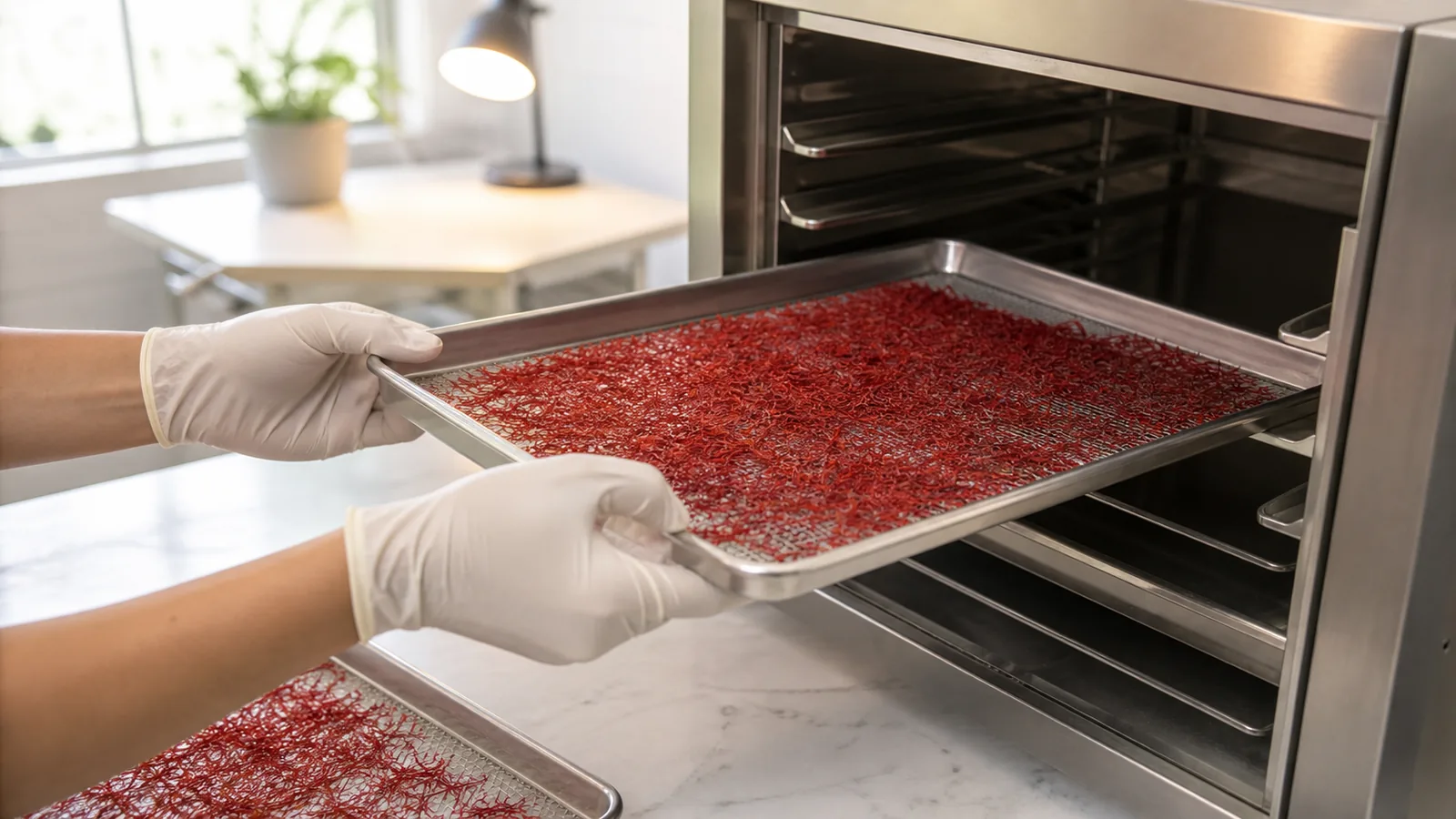
To dry saffron well, separate the red stigmas soon after picking, spread them in a thin layer on a clean food-safe screen, and use controlled heat rather than an open flame. A useful starting point is 50–60°C, checking from 30 minutes onward, then cooling the threads completely before airtight storage.
Why the drying step matters
Fresh saffron stigmas contain a great deal of water. Drying makes them stable enough to store and helps develop the colour, taste and aroma expected from the spice. The process also changes the compounds behind those qualities: crocins contribute colour, picrocrocin contributes bitterness, and safranal is central to the finished aroma.
That balance is sensitive to time and temperature. Drying saffron threads too slowly can leave them exposed to contamination and unwanted enzymatic changes. Strong, uncontrolled heat can scorch them or drive off aroma. The aim is prompt, even dehydration, not simply the highest temperature or the shortest possible time.
The University of Vermont’s saffron drying guidance notes that stigmas need to lose more than 80% of their water and that post-harvest handling strongly affects quality. Its trials also show why one setting cannot be copied blindly: the result depends on the dryer, batch and exposure time.
Prepare the threads before drying
Process the flowers as soon as practical after harvest. With clean hands or sanitised tools, separate the three red stigmas from each flower and remove obvious plant debris. Keep batches away from soil, dust, smoke, strong odours and standing water.
Spread the stigmas evenly rather than pressing them into a dense heap. A shallow layer lets heat and air reach the batch more consistently. Use clean food-contact mesh, parchment or trays intended for food processing. Do not place the threads on a rusty, reactive or unsanitary metal surface.
How to dry saffron with controlled heat
For a small batch, a thermostatically controlled dehydrator or oven is easier to manage than a hot room. The following method keeps the old Spanish-style approach while making the points that matter in practice clear:
- Preheat the equipment and confirm the temperature with a separate, reliable thermometer if possible.
- Arrange the saffron threads in one even layer on a clean fine-mesh screen or lined tray.
- Use indirect, uniform heat. At 50–60°C, begin checking the batch at about 30 minutes; some batches may need closer to 60 minutes.
- Rotate the tray if the appliance has warm and cool spots. Avoid piling or compressing the threads while they are moist.
- Stop when the threads are dry, light and brittle rather than soft or damp. They should not be blackened or smell burnt.
- Let the saffron cool in a clean, dry place before sealing it. Packing warm threads can trap condensation.
Those figures are a working range, not a universal recipe. A peer-reviewed comparison of electric-oven drying at 50, 60 and 70°C used schedules ranging from 30 to 65 minutes and found meaningful changes in crocins, picrocrocin and safranal. Tray loading, airflow, starting moisture and the way an appliance cycles all affect the real drying time.
Traditional Iranian shade drying
The traditional Iranian method described in the original article keeps saffron in shade or in a warm, dry room for roughly 8 to 12 days. It requires little equipment, but the long drying period is difficult to control. Microorganisms have more time to grow if humidity remains high, dust and handling can add contamination, and prolonged enzyme activity may reduce colouring strength.
Open-air drying is therefore a poor choice when the room, airflow and hygiene cannot be controlled. Direct sun is not a reliable shortcut: conditions vary through the day, the batch can be contaminated outdoors, and strong light and heat may damage quality.
The Spanish drying method
In the Spanish method, the stigmas are spread on a silk-mesh sieve and exposed to indirect heat of about 50–60°C for 30–60 minutes. Compared with a long period in open air, this short controlled process can produce stronger colour and limit the opportunity for fungal contamination.
Historical methods did not all use the same temperature. Research comparing room-temperature, hot-air and traditional Spanish processing recorded traditional drying at a mean of 54–83°C for 28–55 minutes, while higher-temperature, shorter treatments produced high colouring strength. These findings support controlled time-and-temperature combinations; they do not mean that every home oven should be set to the highest laboratory temperature.
Industrial saffron drying systems
Commercial processors can control larger volumes with hot-air tunnel or conveyor dryers, where conditioned air moves through a measured layer of product. Vacuum dryers reduce pressure as moisture is removed and can shorten processing under controlled conditions. Freeze drying, microwave drying and other systems have also been studied.
The name of the machine does not guarantee a good batch. Air temperature, product temperature, airflow, layer depth, residence time, sanitation and loading consistency must be recorded together. Direct contact with hot air is normal in many industrial dryers, but direct flame, combustion fumes and uneven hot spots are not.
A comparison of electric and vacuum oven drying found that excessive drying time can reduce important constituents and that high-temperature, short-time treatments can behave differently from low-temperature, long-time treatments. Commercial settings should be validated for the actual equipment and the quality specification the producer intends to meet.
How dry should the finished saffron be?
The original article advised a final moisture level no higher than 10%. That is a conservative target, but it should not be presented as the only standard for every form of saffron. A recent peer-reviewed summary of the ISO 3632 saffron quality categories reports a maximum of 12% moisture and volatile matter for filaments; other published analyses report a 10% limit for powder. The current specification applies to filaments, cut filaments and powder, and commercial producers should use the current test method and the limit for the form they sell.
A thread snapping between the fingers is a useful process observation, not a laboratory moisture measurement. Producers selling graded saffron need calibrated weighing and moisture testing, documented sampling and, where food-safety controls require it, water-activity or microbiological checks. Simply extending the oven time “to be safe” can reduce quality.
Common drying mistakes
- Leaving a thick pile: the surface can feel dry while the centre remains moist.
- Using direct flame or an unverified oven dial: saffron is easily scorched and small appliances can cycle far above their setting.
- Drying on an unclean surface: heat does not excuse poor food-handling hygiene.
- Relying on a fixed clock time: batch size, airflow and starting moisture vary.
- Sealing the threads while warm: trapped condensation can undo careful drying.
- Mixing batches without records: a problem in one harvest or dryer load then becomes hard to trace.
Cool and store the saffron correctly
After drying, let the threads return to room temperature away from steam and humidity. Transfer them promptly to a clean, airtight food-grade container. Store the container in a cool, dark and dry place, protected from light, air, heat and strong-smelling foods.
Label each batch with its harvest and drying date. For repeat production, also record the fresh weight, dry weight, layer depth, equipment, temperature, time and final test result. Those notes make the next saffron drying process more consistent and help trace a quality problem without guessing.
The correct way to dry saffron is therefore a controlled sequence: clean separation, a thin even layer, measured heat, frequent checks, full cooling and moisture-safe storage. A 50–60°C indirect-heat method is practical for many small batches, while commercial operations should validate their own time, temperature and moisture endpoint rather than treating any single number as universal.

![Exporting Saffron to Turkey + Price Guide [Complete 0 to 100]](https://img.rowhanisaffron.com/20260827003933/saffron-export-turkey-quality-inspection.webp)



