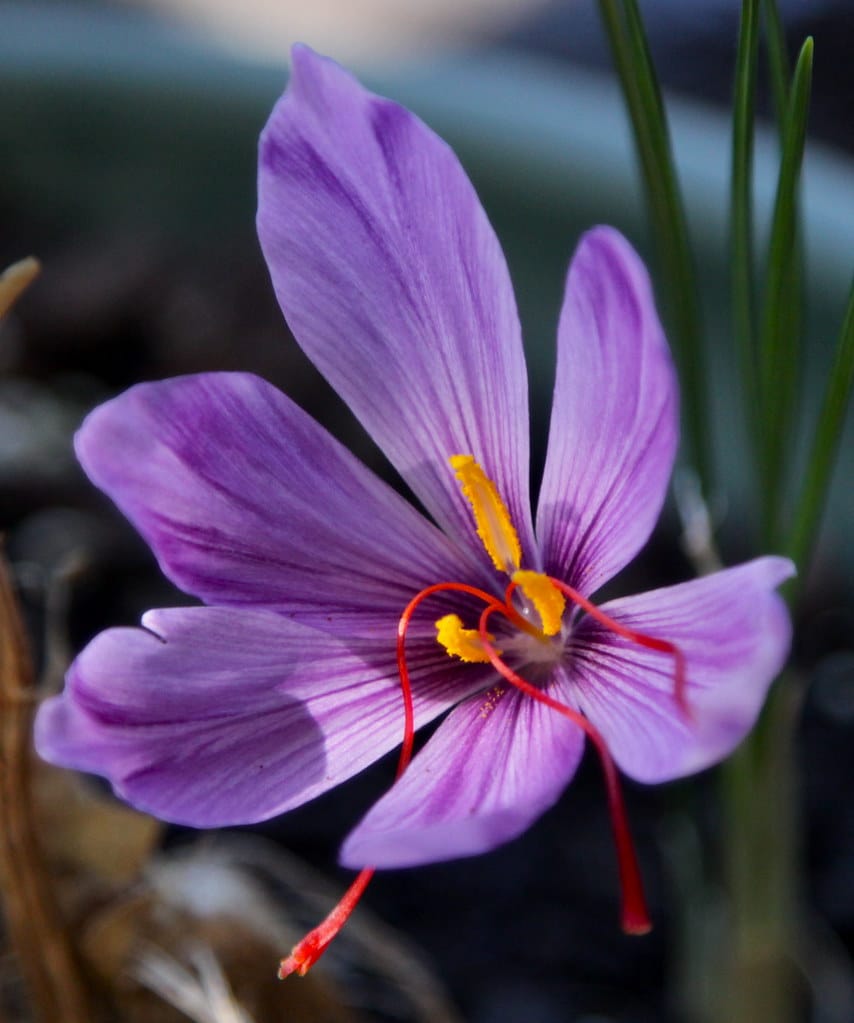
The area under saffron cultivation is increasing in Markazi province, according to an earlier provincial horticulture report that placed the crop at 113 hectares and forecast a rise to 120. Those figures are useful as a historical baseline, provided planted area is not mistaken for productive area or current output.

What the 113-hectare report recorded
Ali Asghar Zarei, identified as horticulture director of the Jihad Agricultural Organization of Markazi province, said 113 hectares were under saffron cultivation. He divided that total into 93 productive hectares and 20 hectares described in the translated report as infertile. In context, the second category is more likely to mean newly planted or not yet bearing, but the source did not define it.
Zarei predicted that the provincial total would reach 120 hectares. The report also said saffron was being cultivated across the province and identified three leading locations: Khomein with 24 hectares, Delijan with 13 hectares and Mahallat with 13 hectares. Together, those named areas accounted for 50 hectares; the source did not provide the remaining district distribution.
These figures should be read as an undated administrative snapshot. They do not establish today’s acreage, yield or farmer income. A current claim would need a reporting year, a consistent definition of cultivated area and a fresh provincial record.
Why productive and newly planted hectares must be separated
Saffron is a perennial crop. A field planted this season is not equivalent to an established field at a mature stage, and field performance can change as daughter corms multiply. Reporting all hectares in a single total can make expansion look like immediate production.
A useful provincial account should distinguish land prepared, land planted, land that emerged, productive area and land removed or replanted. It should also state the date on which each category was measured. Without that structure, two honest reports can appear to contradict one another simply because they used different cut-off dates or definitions.
How this report relates to another Markazi forecast
A separate Markazi saffron expansion report on this site recorded a different baseline: 147 hectares moving toward 170, with district allocations and corm requirements. The 113-to-120-hectare report should not be blended silently with those later-looking figures.
Because the source material does not preserve the original publication dates, the safest interpretation is that the articles describe different reporting periods or programme stages. Keeping each set of numbers with its named official and assumptions preserves their value without manufacturing a timeline. A future official dataset could then reconcile the sequence.
What “lower-water cultivation” does and does not mean
Zarei presented saffron development as a lower-water horticultural policy. The FAO’s account of Iran’s qanat-based saffron system likewise describes the crop’s role in a region facing severe water scarcity. This makes saffron relevant to water planning, but it does not make the crop water-free.
Establishment, pre-flowering irrigation, rainfall, soil moisture and daughter-corm growth still matter. A responsible comparison measures water delivered at field level and relates it to marketable dry saffron. It also includes pumping energy, conveyance losses and the opportunity cost of the water. A label such as “low water” cannot replace that calculation.
The planting window needs a date and local conditions
The original report stated that saffron planting ran from the first to the 25th of September. That is a useful record of the programme’s stated calendar, not a universal rule for every Markazi field or year. Soil temperature, corm dormancy, irrigation access, elevation and weather can alter the practical window.
A current recommendation should identify the year, district and agronomic authority behind it. Growers also need enough time to inspect and grade corms, prepare drainage and complete planting without damaging the material. Meeting a calendar date has little value if the field is wet, compacted or unfinished.
Area growth should be matched with healthy planting material
Every additional hectare requires a traceable corm supply. Lots should be checked for rot, injury, pests, size distribution and storage damage before they are spread through the province. Supplier, lot, receiving farm and planted block should remain identifiable if a problem emerges.
Corm quantity alone is not a quality measure. A peer-reviewed study of Iranian saffron farms found meaningful variation in planting density and showed that field age and crowding affect technical efficiency. The findings came from Gonabad, not Markazi, so they support monitoring rather than a single planting rate copied across districts.
More hectares do not automatically mean more saffron
Provincial expansion is valuable only if fields establish well and produce saleable quality. A report should therefore pair hectares with dry-stigma yield, number and age of productive fields, rejected area and year-to-year change. Fresh flower weight must not be presented as dry saffron output.
Weather can shift flowering into a tighter or later window. Labour then becomes part of capacity: flowers need timely picking, stigmas must be separated and drying needs to be consistent. If planted area grows faster than harvest and processing capacity, quality can fall even while the acreage number rises.
Khomein, Delijan and Mahallat need separate records
The three named locations should not be treated as identical. Soil, elevation, water source, field age and access to labour or processing can differ. Recording each district’s planted and productive area, yield range and corm losses would show whether expansion is broad-based or concentrated in a few strong fields.
That district view also helps extension teams. One location may need drainage work, another healthier corm supply, and another a shared drying facility. Province-wide totals are useful for planning, but they do not tell a farmer why a particular field succeeded.
What a current acreage update should publish
- Reporting date, data owner and method used to collect the figures
- Planted, emerged, productive, replanted and removed hectares
- Field-age distribution for each named district
- Dry-stigma production and yield range, not only a provincial average
- Corm source, quantity, health checks and establishment losses
- Measured irrigation and rainfall data for representative fields
- Harvest labour, drying capacity and quality results
- Farmer count, sale channel and dated price basis
Publishing the categories together would allow readers to see whether an increase from 113 to 120 hectares translated into durable production. It would also make the figures comparable with the separate 147-to-170-hectare plan.
The province description is historical context
The source described Markazi as an industrial province in central Iran, situated between the Alborz and Zagros ranges. It also listed 12 counties, 23 districts, 32 cities, 66 rural divisions, 1,394 inhabited villages and 46 uninhabited villages, although the English translation confused several administrative terms and ended mid-sentence.
Those counts are preserved as part of the original context, not presented as current administrative data. Boundaries and classifications can change, and the incomplete translation is not a reliable basis for a present-day geographic claim. What matters to the cultivation story is that Markazi contains varied landscapes requiring district-level evidence.
What the increase means for Markazi farmers
The early report shows a province moving from trial and establishment toward a larger productive base. Its strongest contribution is the split between 113 total hectares and 93 productive hectares, because that distinction warns against judging a perennial crop by acreage alone.
Future growth should be evaluated through establishment, water productivity, dry yield, quality and net farm return. If those measures improve alongside hectares, the expansion represents real agricultural capacity. If they do not, a larger cultivated-area number may conceal weak fields rather than progress.
![Exporting Saffron to Turkey + Price Guide [Complete 0 to 100]](https://img.rowhanisaffron.com/20260827003933/saffron-export-turkey-quality-inspection.webp)