


Successful implementation of saffron quality improvement project in Birjand records Khalil Khalili’s account of a model programme that encouraged private-sector participation in saffron quality work.
The article was published on this site in April 2021. It preserves what the official said about the project and its coordinating centre at that time; it is not a current certification announcement or proof that every participant achieved the same result.
Who described the Birjand project
Khalili was identified as secretary of the Iranian Saffron Science and Industry Coordination Center. He said the centre was among the first organisations of its type established in Iran and operated under the Vice President for Science and Technology.
Although its remit covered Iran, he explained that it was formed in Khorasan because the province was the centre of saffron production. The headline locates the quality-improvement project in Birjand, while the wider organisational comments concern the centre’s national role.
What the coordination centre was set up to do
Khalili described policy-making and monitoring for Iranian saffron as the centre’s principal goals. Its activity extended across production, distribution and export, linking work at farm level with the way saffron moved through trade.
That description was broad. The stored report did not list statutory powers, inspection procedures or enforcement responsibilities. It is therefore more accurate to present policy and monitoring as the mission Khalili stated, not as a complete legal definition of the organisation.
The Iranian saffron roadmap
Compiling a roadmap for Iranian saffron was one of the centre’s major projects. Khalili said the roadmap had been submitted to the scientific deputy and was unveiled after completing the required legal steps.
The article did not reproduce the roadmap, its milestones or an implementation timetable. Its contribution is to record the sequence Khalili described: preparation, submission, legal review and unveiling.
Connecting the saffron sector
Another part of the centre’s work was communication among the people and organisations involved in saffron. Khalili named several groups:
- Primary producers and consumers.
- Academic and research centres.
- Trade participants and exporters.
He also referred to preparing a database of saffron-sector participants, holding festivals and organising specialised saffron seminars. Together, these activities were intended to create a clearer network between production, research and commerce.
Quality improvement and saffron certification
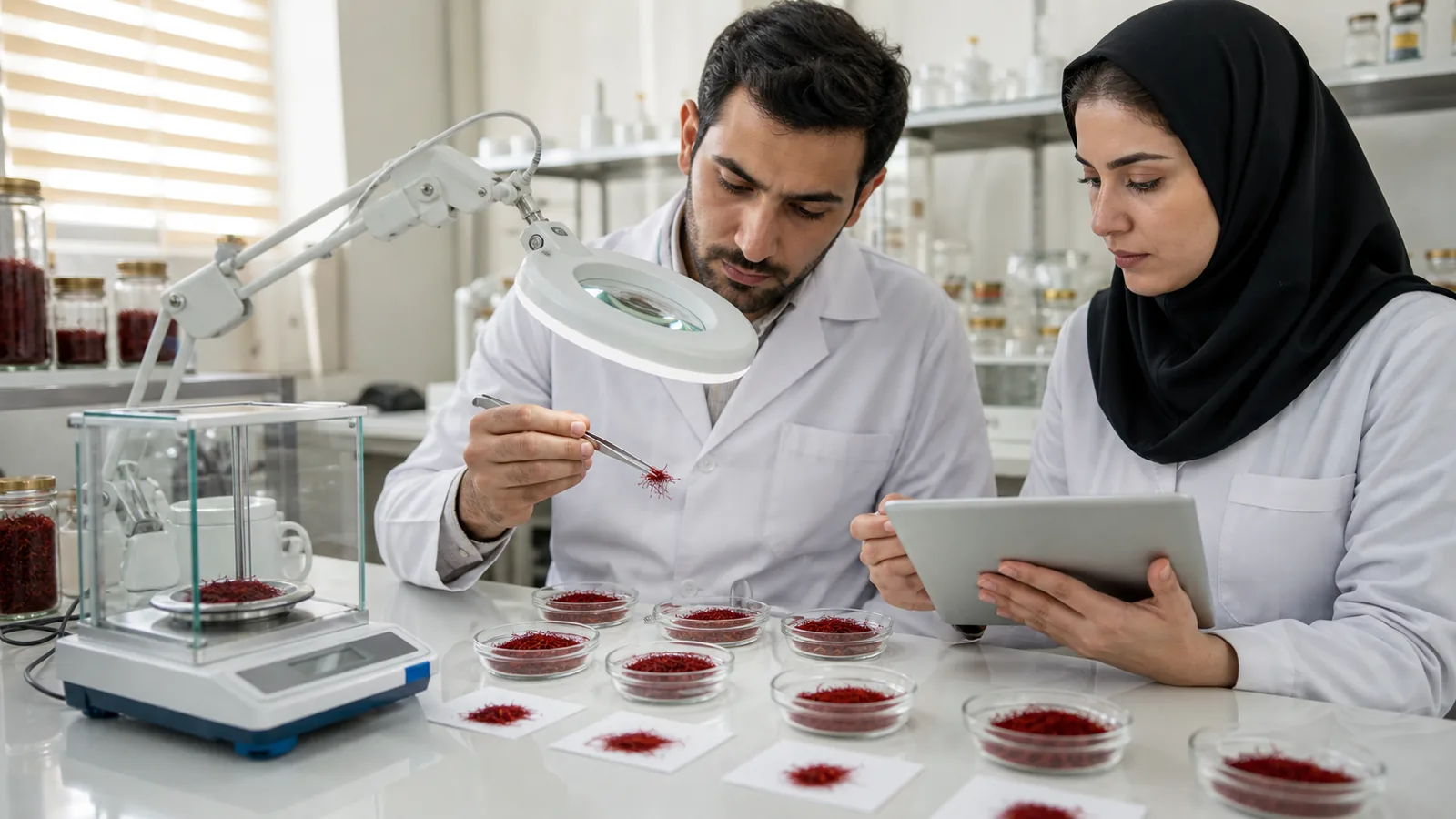
Khalili presented model projects as a practical part of the centre’s programme. He specifically named the saffron product quality-improvement plan and work to create a certificate for saffron, describing both as successfully carried out.
He said the quality plan’s implementation had encouraged the private sector to put the approach into practice. The article did not identify the certification standard, participating companies, measured quality indicators or audit results. “Successful” therefore remains Khalili’s assessment of the programme rather than an independently verified score.
The funding constraint
The report also recorded a serious limitation. Khalili said the centre had been unable to perform its duties during the preceding two years because it lacked financial support.
That statement gives important context to the list of achievements. A roadmap and model project could demonstrate an approach, but sustained monitoring, sector communication and national implementation would require continuing resources.
What the incomplete final statement tells us
The stored source ends in the middle of Khalili’s last statement. It refers to recent approaches in the new government, conditions in Iran and a greater need involving industry and agriculture, but does not preserve the rest of the sentence.
This rewrite does not invent the missing conclusion. The complete, supportable record is that Khalili linked saffron quality work with national coordination, a roadmap, sector data, model projects and private participation, while warning that two years without financial support had limited the centre’s work.

![Exporting Saffron to Turkey + Price Guide [Complete 0 to 100]](https://img.rowhanisaffron.com/20260827003933/saffron-export-turkey-quality-inspection.webp)



