


“Spain became the first exporter of this product with Iranian saffron” should not be read as a literal global ranking. In the 2018 trade data closest to the original report, Iran was the world’s largest reported saffron exporter and Spain was second. The headline reflects a different concern: Spain imported substantial saffron from Iran and had a mature packing and distribution network capable of selling saffron onward to many markets.
What the 2018 trade data actually shows
The WITS presentation of UN Comtrade data for 2018 lists Iran first among reporting saffron exporters under HS 091020, with about $351.1 million and 279,608 kg. Spain reported about $55.8 million and 78,898 kg, placing it second among individual countries in that table.
Spain was also an important importer of Iranian saffron. Partner-reported 2018 data records Spanish imports from Iran at about $33.8 million and 50,248 kg. Spain exported saffron to a wide range of destinations, including the United States, Italy, the United Arab Emirates, the United Kingdom, France and Saudi Arabia.
Those figures establish that Spain both imported Iranian saffron and exported saffron. They do not prove that every gram Spain exported was Iranian. Customs data cannot follow individual threads through inventory, blending, grading and repackaging, and Spain has its own saffron production. The defensible conclusion is that Iranian supply formed a significant part of Spain’s saffron trade during that period—not that Spain outranked Iran globally.
Growing origin, packing country and seller are different
A jar can involve several places. The saffron may be grown and harvested in one country, tested or packed in another, and sold by a company established in a third. “Packed in Spain” describes a packing operation; it does not by itself mean the saffron was grown in Spain. An accurate label and the supporting traceability record should keep those facts separate.
When assessing Spanish saffron suppliers or saffron packaging in Spain, ask for the growing origin and lot evidence rather than inferring origin from the seller’s address. The unaccented search phrase “zafran Spain” often leads to Spanish-language saffron offers; it is not a grade or a statement of where the crop was grown.
Spain also has a protected regional product, Azafrán de La Mancha PDO. That name is governed by a defined product specification and certified control system. Imported saffron does not become Azafrán de La Mancha merely because it is packed by a Spanish business. At the same time, saffron sold by a Spanish supplier is not automatically claiming that protected origin; the exact label matters.
Iranian saffron versus Spanish saffron
Country names alone are not a reliable quality grade. Iran and Spain both have legitimate saffron traditions, and the characteristics of a commercial lot depend on cultivar, field conditions, harvest timing, stigma separation, drying, storage, age and authenticity. A buyer comparing Iranian saffron vs Spanish saffron should ask for the same evidence from each supplier: traceable origin, form, grade, laboratory method, harvest or packing information and storage history.
Brand recognition can still affect price. A company that understands retail buyers, maintains distribution and provides consistent packs may earn a margin beyond the border value of the raw spice. That does not make the agricultural origin irrelevant. It shows why Iranian exporters have an interest in building customer relationships and product capability as well as producing good saffron. Our guide to developing foreign business for Iranian saffron sets out that work in practical terms.
The allegations in the original interview
Farzad Saharkhiz, identified in the 2019 report as an industry-board member, alleged that non-specialist traders moving Iranian saffron through the United Arab Emirates mixed it with impurities and misused Iranian standard marks before sales to the Persian Gulf, Africa and China. He also alleged that some Iranian saffron bought through Afghanistan was resold as Afghan saffron.
Those are serious claims, and the article did not provide inspection records, named lots or enforcement findings that would allow them to be independently verified. They should remain attributed allegations, not general descriptions of saffron traded through either country. The correct response is lot-level authenticity testing, traceability and enforcement when evidence supports a violation.
Saharkhiz also described Saudi Arabia and Qatar as important buyers of Iranian retail packs and said frequent travel had made consumers in Arab markets familiar with Iranian saffron quality. This, too, is a historical market observation rather than a current consumer survey.
Why the packaging percentages conflict
The report first says only 5% of Iranian saffron exports were in packs below 10 g, with 95% above 10 g, including commercial packs up to 1.5 kg. It later says packs below 10 g had reached 45% of export volume and were increasing. Both statements cannot describe the same measure and period.
The most likely explanation is a missing time comparison in the translation, but the source text does not identify the dates, customs basis or whether the percentages refer to shipment weight, declarations or package counts. The figures should therefore be preserved as two attributed snapshots, not combined into a growth calculation. Package size also does not determine origin accuracy or value by itself: a well-documented commercial lot can be more useful to an industrial buyer than a retail jar.
The historical export totals and concentration warning
The interview cited roughly 236 tonnes of saffron exports worth more than $326 million in the preceding year, along with export growth of about 55%. It also said approximately 77% of Iranian “red gold” exports went to China, the United Arab Emirates and Spain. These numbers depend on the Iranian reporting period and destination grouping. They are close to, but not identical with, calendar-year UN Comtrade figures, so they should not be substituted for current statistics.
The strategic point remains useful. Heavy dependence on a few gateway markets can leave exporters exposed to changes in demand, payment channels, regulation and the negotiating power of intermediaries. Diversification is not simply shipping to more country names. It means qualified buyers, compliant products, reliable payment and repeat demand in each destination.
What trustworthy saffron packaging should preserve
- Origin: the growing origin must be supported by supplier and lot records and described accurately where declared.
- Identity: each retail batch should trace back to the tested bulk lot or documented blend from which it came.
- Quality: the product should match the stated form, grade and laboratory specification throughout its shelf life.
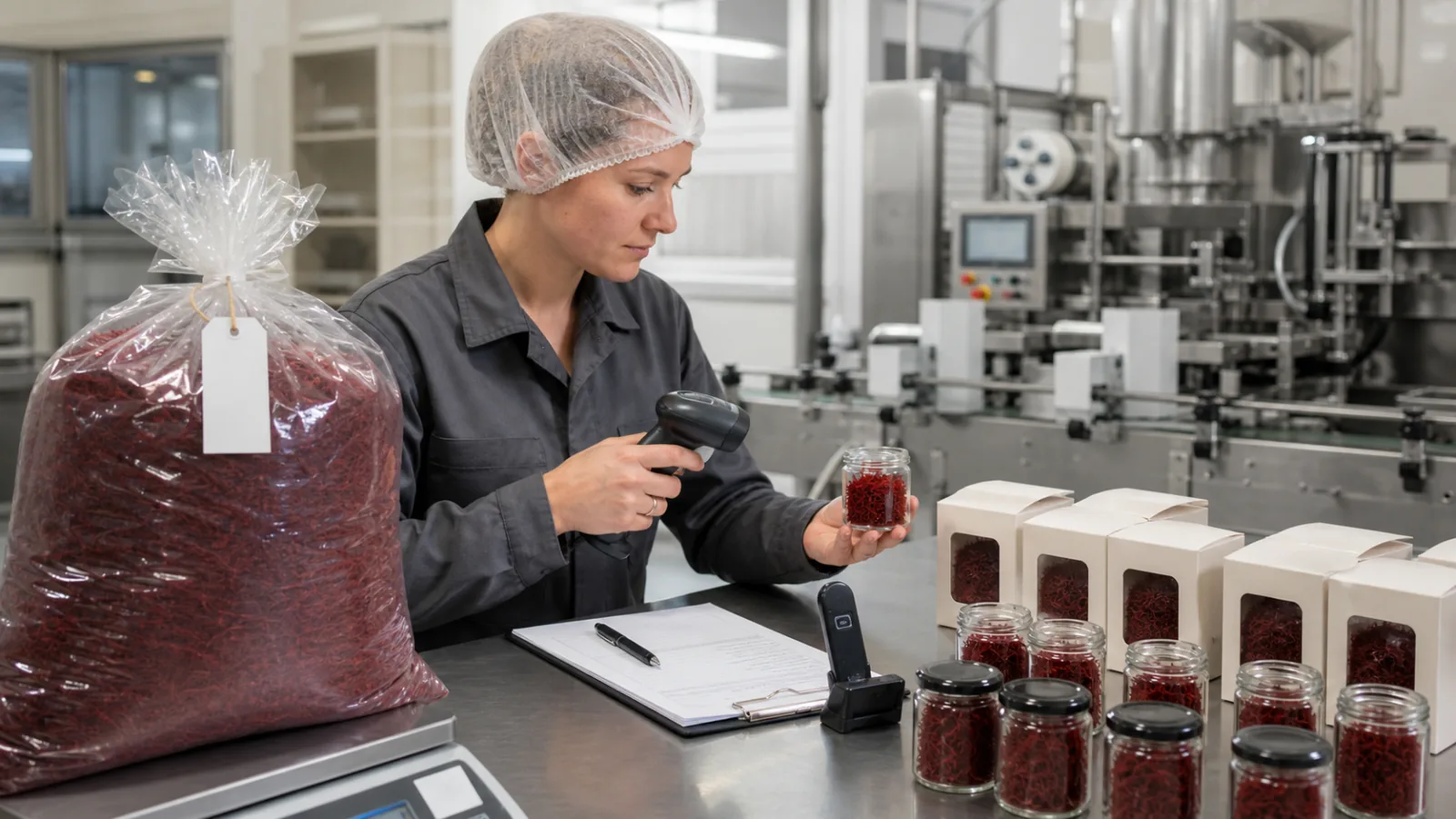
- Protection: the pack should limit moisture, light, contamination and tampering.
- Compliance: mandatory food information, language, importer and net-weight details must follow destination rules.
- Honesty: packing location, seller identity and agricultural origin should not be presented as if they were the same fact.
A more accurate reading of Spain’s role
Spain did not become the world’s first saffron exporter ahead of Iran in the 2018 data. It was a major importing, packing and re-exporting hub with established access to many buyers, and it imported a substantial volume from Iran. Spain also produced and protected its own regional saffron.
That is a stronger and more useful explanation than the headline alone. It respects Iranian saffron’s production origin, Spanish saffron’s legitimate identity and the commercial value of packing and distribution—while insisting that every claim about origin be supported by traceable evidence.

![Exporting Saffron to Turkey + Price Guide [Complete 0 to 100]](https://img.rowhanisaffron.com/20260827003933/saffron-export-turkey-quality-inspection.webp)



