


Saffron supportive shopping a way to prevent price drops describes a historical support-purchasing programme in Sarbisheh, South Khorasan. “Supportive shopping” is a literal translation: the policy was a public or cooperative purchase option intended to give growers an alternative buyer during the concentrated harvest period.
Maryam Javadi Baghei, then director of Agriculture Jihad in Sarbisheh, connected the scheme with local production, training and post-harvest guidance. A support purchase may reduce pressure on farmers to sell immediately, but it cannot guarantee a particular market price.
The Sarbisheh figures behind the announcement
Javadi Baghei reported 648 hectares under saffron, an average dry yield of 3.6 kilograms per hectare and about 1,240 growers or operators. She estimated annual production at 2.3 tonnes and its value at 175 billion rials.
The area and yield figures broadly reconcile: 648 multiplied by 3.6 kilograms equals 2,332.8 kilograms, close to the stated 2.3 tonnes after rounding. Dividing 175 billion rials by 2,300 kilograms gives an implied average value of about 76 million rials per kilogram. That is derived arithmetic, not a quoted support price or evidence that every grower received the same amount.
All of these numbers belong to the reporting period. They should not be read as current Sarbisheh area, yield, production or price data.
The water figure is missing an essential unit basis
The translated account associates the crop with 4,000 to 4,500 cubic metres of water, but it does not say whether this means per hectare, per farm, per season or the entire reported area.
If it meant the full 648 hectares, the result would be only about 6.2 to 6.9 cubic metres per hectare, which is not a credible seasonal field-water statement. The likely missing basis must not be supplied as fact without the original source record.
Javadi Baghei’s broader point was that saffron suited a regional cropping pattern constrained by limited water. That comparison still requires measured water delivered per hectare and the yield obtained, not a “low-water” label alone.
What a support purchase can change
Saffron flowers over a short period, so many growers finish drying and approach the market at roughly the same time. When cash needs are immediate and buyer options are limited, that concentration can weaken an individual seller’s position.
The historical announcement said South Khorasan’s rural cooperative organisation and its county units were prepared to make support purchases, organise domestic sales and support export channels. A later IANA report on an official saffron support-purchase instruction shows that such programmes used provincial working groups and conditional physical purchasing through rural-cooperative bodies.
For a grower, the useful details are the programme dates, eligible grades, sampling method, laboratory criteria, delivery point, quantity limit, price, payment schedule, ownership transfer and procedure for a rejected lot. Without those terms, “support” is not yet a sale a household can plan around.
Why support purchasing cannot guarantee the price
A purchase programme can create temporary demand and give eligible growers another route to market. Its effect depends on volume, timing, grade rules, funding and what happens to the stock later.
It may fail to reach small farms if delivery costs or documentation are burdensome. Delayed payment can replace price pressure with cash-flow pressure. Poorly planned release of accumulated stock can also affect the market later.
A sound assessment should publish how much was offered, accepted, rejected, paid for and ultimately sold, along with the time taken to pay farmers. The original article announced availability; it did not report those final outcomes.
Production support began before the sale
Javadi Baghei listed training classes, demonstration farms, working-capital assistance, cooperative guidance and access to high-quality “onions”—the translated term for saffron corms. These measures address risks that a buyer cannot fix after harvest.
Healthy, true-to-type corms and suitable planting density affect the field for several years. Training should also cover irrigation timing, disease, flower handling, stigma separation, drying, lot traceability and safe storage. Working capital matters because growers pay much of the labour before the dried product is sold.
The 15-to-25-day harvest window
The report placed Sarbisheh’s harvest from early November to the end of that month. It described flowering as lasting about 15 to 25 days, with flower numbers rising strongly between the seventh and tenth days. Those are planning ranges, not a fixed calendar for every season.
It recommended picking flowers in the bud stage early in the morning to reduce mechanical damage during transport. Clean wicker or food-grade plastic baskets can keep flowers shallow and ventilated; sacks or deep compressed containers encourage bruising and heating.
Once flowers arrive at the work area, stigmas should be separated promptly with clean hands and surfaces. The report suggested a sieve with indirect heat or an electric dryer. Whatever equipment is used, temperature, loading depth and time need to be controlled and recorded. Excess heat can damage aroma and colour, while incomplete drying increases storage risk.
From dried saffron to a marketable lot
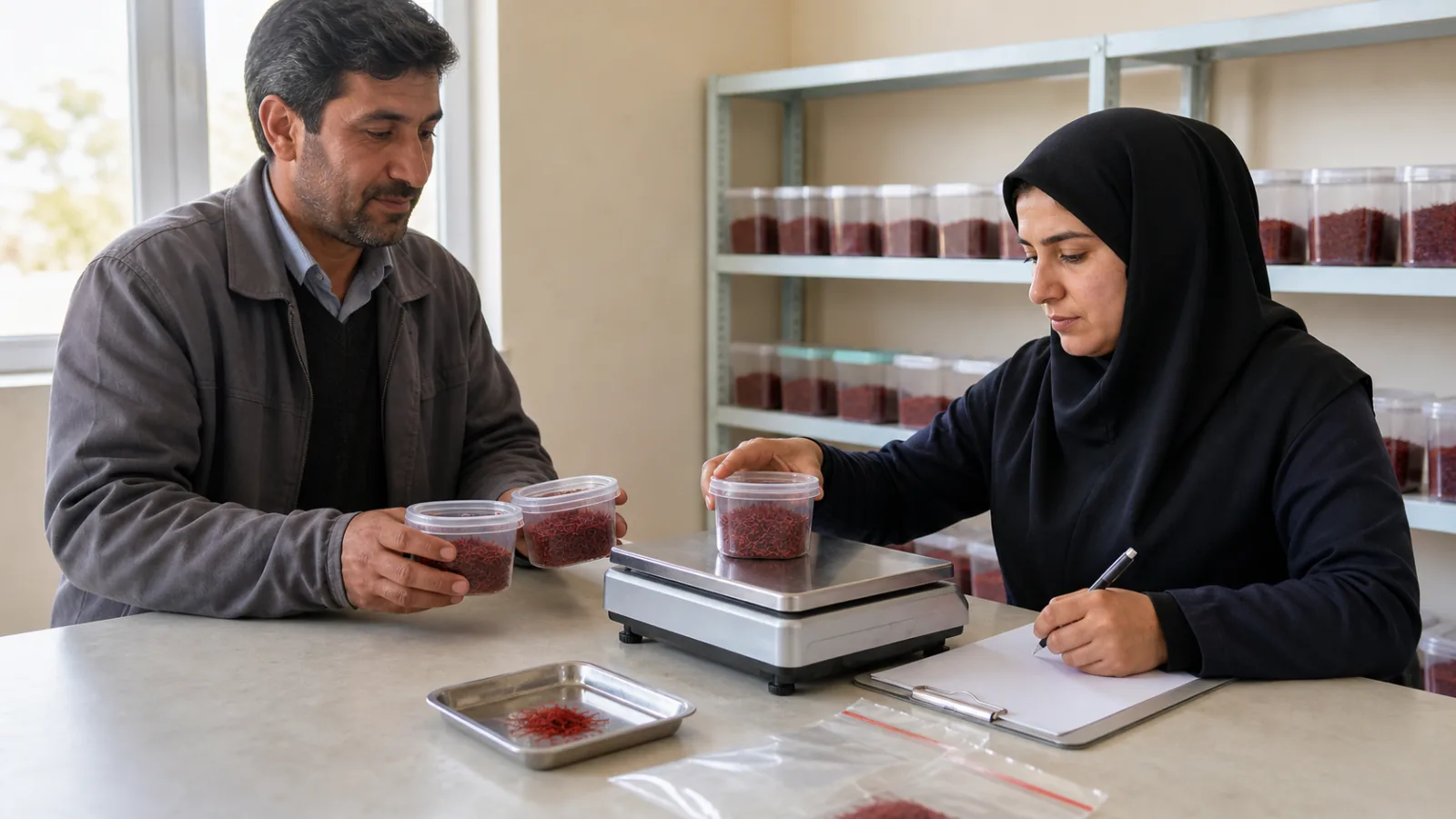
A support centre or private buyer still needs a defined lot. The grower should keep harvest date, field, drying batch, dry weight and storage-container records, then obtain representative quality testing where required.
Our guide to exporting Iranian saffron explains why traceability, testing, buyer specifications and documentation matter after the crop leaves the field.
The Sarbisheh programme joined three parts of the value chain: production support, careful harvesting and an alternative purchase channel. That combination can improve resilience. It should still be judged by measured farm outcomes rather than the stronger promise that supportive purchasing will always prevent a price drop.

![Exporting Saffron to Turkey + Price Guide [Complete 0 to 100]](https://img.rowhanisaffron.com/20260827003933/saffron-export-turkey-quality-inspection.webp)



