


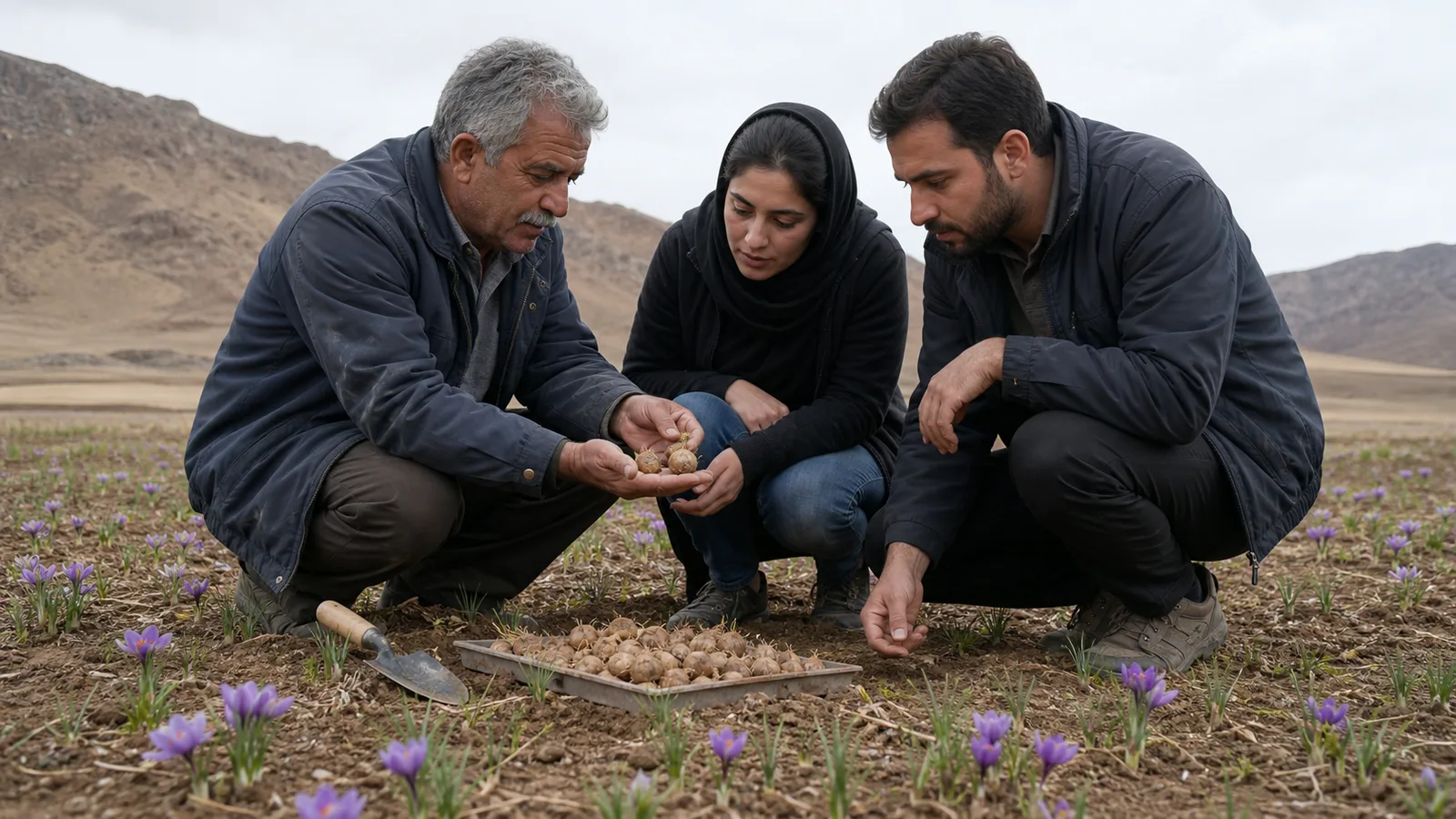
Saffron cultivation in Famenin expanded from about 1.5 hectares to more than seven hectares as local officials looked for alternatives to water-intensive crops. A separate support proposal in Nir, Ardabil Province, targeted agriculture graduates with planting material and production facilities. The two reports describe the same crop-policy goal—rural work with less pressure on water—but they concern different counties and different forms of support.
Neither report includes enough harvest, water or income data to prove the programmes succeeded. Their value is as a record of how local authorities tried to change cropping patterns: Famenin through extension and field expansion, Nir through incentives for trained entrants.
Saffron cultivation in Famenin
Jafar Kaviani Javid, identified as head of the local Agricultural Jihad office, said saffron had been promoted in Famenin in response to pressure on the county’s water resources. The reported area rose from more than 1.5 hectares in one year to more than seven hectares in the next.
The comparison gives a clear expansion—at least 5.5 additional hectares—but no exact field list, grower count or harvest total. It should therefore be read as a period programme figure, not as the current saffron area of Famenin.
Why officials compared saffron with watermelon and sugar beet
The report proposed saffron as an alternative to crops such as watermelon and sugar beet, which were described as putting heavier demands on limited irrigation water. Saffron’s annual cycle can use less water than some irrigated summer crops in the same district, but “low water” is not the same as no water. Autumn establishment, winter-spring leaf growth, soil, rainfall and field age all affect need.
A proper comparison would measure total irrigation volume per hectare, yield, saleable grade, income and labour for each crop. Counting irrigation events alone can be misleading because one application may deliver far more water than another.
Small plots, hand work and rural income
Kaviani Javid noted that saffron can be cultivated on small parcels and that flowers are traditionally picked and separated by hand. This creates a short period of intensive work that may suit household farms. It does not automatically create stable year-round employment; income depends on yield, labour availability, drying quality and the price actually received.
The report also connected crop-pattern reform to village retention. That is a reasonable policy aim, but migration is influenced by services, wages, education and reliable markets as well as the crop itself. A seven-hectare programme is a trial of local potential, not evidence that saffron alone can reverse rural migration.
Water management beyond crop substitution
Famenin’s plan was broader than replacing one field crop. The report discussed using agricultural water pools for fish farming and then applying the water to fields. Reuse can recover some nutrients and obtain more value from a water allocation, but it needs suitable water quality, disease controls and crop-specific guidance. Water should not be reused simply because it has already passed through a pond.
The criticism of sugar beet cultivation was also tied to that period’s groundwater decline. A current decision needs current aquifer, allocation and farm-budget data rather than assuming the old crop restrictions still apply unchanged.
Support for saffron in Nir, Ardabil
In a separate employment and “resistance economy” meeting, Nir governor Akbar Samadi announced incentives for agriculture graduates who wanted to cultivate saffron. He described the local climate as suitable and said the governorate was prepared to cooperate with executive agencies to provide planting material and greenhouse-related support.
The translated source calls the planting material “saffron roots.” Saffron is propagated with corms, not detached roots, so corms are the likely intended item. The greenhouse wording is also unclear: the report does not say whether applicants would receive a complete greenhouse, access to a facility, equipment or another form of assistance. The offer should be verified from the original programme before anyone treats it as an entitlement.
A graduate incentive is only the starting point
Free or subsidized corms reduce the initial cost, but they do not solve site selection, drainage, disease, labour or sales. A responsible graduate-support package would include:
- health-checked corms with known size and origin;
- soil and water assessment before planting;
- training in depth, density, irrigation and disease monitoring;
- clean flower handling, stigma separation and drying;
- records for yield, quality, labour and actual sale price;
- a market route that does not depend on an assumed future buyer.
The meeting also referred to more than eight billion in Basij-linked financing for local resistance-economy projects, including livestock, poultry, aquaculture, carpet weaving and beekeeping. The translated report does not preserve a reliable currency or show how much, if any, went to saffron. The figure therefore describes a wider rural-finance programme, not a saffron budget.
How to judge the two programmes
Famenin’s headline measure was area: growth from 1.5 to more than seven hectares. Nir’s headline measure was access: an offer aimed at agriculture graduates. Both are inputs. Outcomes should be checked after several seasons through healthy stand establishment, dried stigma yield, water used, quality, buyer acceptance, net farm income and whether support continued after the first corm distribution.
The most useful lesson is not that every dry county should plant saffron. It is that crop-pattern change needs a local trial and a complete route from corm to customer. Famenin’s expansion and Nir’s incentive proposal can be judged fairly only when the water, crop and income records are available alongside the announcements.

![Exporting Saffron to Turkey + Price Guide [Complete 0 to 100]](https://img.rowhanisaffron.com/20260827003933/saffron-export-turkey-quality-inspection.webp)



