


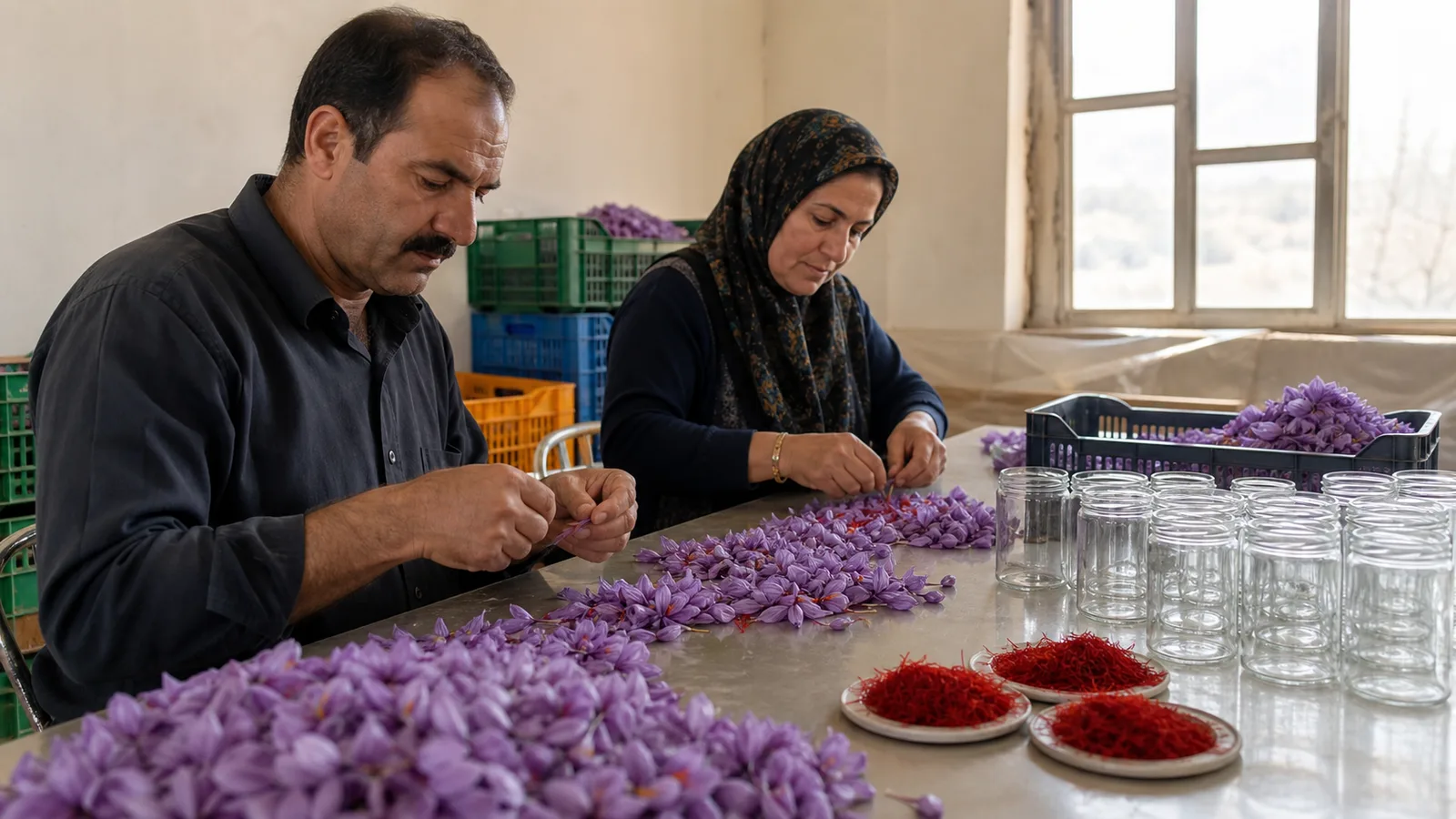
Lorestan’s saffron growers needed more than encouragement: they needed local processing, reliable markets and a reason to keep their crop in the province. That was the central argument made by Seyyed Ahmad Moradi Biranvand, then director of conversion and food industries at Lorestan’s Agricultural Jihad Organization. He warned that withdrawing support after farmers had begun cultivating saffron would discourage them and weaken a promising source of rural income.
A later report from the same official supplied the missing scale. In Iranian calendar year 1399, corresponding broadly to 2020–21, Lorestan reportedly had 420 hectares under saffron and produced 1,400 kilograms. The figures describe that reporting period, not the province’s current area or harvest.
Why saffron mattered to Lorestan
Lorestan’s agricultural economy has long depended on farming and related work. Moradi Biranvand presented saffron as one crop that could diversify rural income, particularly when cultivation was connected to cleaning, packing, branding and sales. He also described farmers as economically vulnerable and argued that government institutions should not create enthusiasm for a crop and then leave growers without a route to market.
The concern was not simply whether saffron flowers could grow in the province. A harvest sold only as loose raw material leaves much of the later value elsewhere. Local facilities can prepare a consistent product, pack it into traceable lots and make it easier for buyers to compare quality. Those steps do not guarantee a profitable business, but they give growers more options than selling immediately after harvest.
The reported 420 hectares and 1,400-kilogram harvest
The 1399 report put Lorestan saffron cultivation at 420 hectares and production at 1,400 kilograms, with output said to have increased from the previous year. Dividing those rounded totals gives an implied average of about 3.3 kilograms per hectare. That calculation is useful for understanding the scale of the report, but it should not be treated as an audited yield for every farm. Field age, corm density, weather, harvest timing and drying losses can all produce very different results.
The same report said packaged saffron was already being exported in addition to sales of unpacked product. It did not identify export volumes, destination countries, buyers or the share sold in each form, so the statement shows commercial activity rather than proving a particular level of export success.
Processing licences and proposed capacity
Moradi Biranvand said three establishment licences and three initial agreements had been issued for saffron and medicinal-plant processing. The translated report also referred to facilities with stated capacities of 93 kilograms and 70 kilograms. Those numbers appear to describe authorised or proposed operating capacity, not the province’s annual harvest and not necessarily production that had already taken place.
The report is internally cautious about progress: it says three licences had been issued but only one project had reached an operating-licence stage. That distinction matters. An establishment licence permits a project to move forward under stated conditions; it is not evidence that a plant has been built, commissioned or used at full capacity.
Private investment with public support
The official described processing investment as a private-sector responsibility, with the public organization supporting eligible applicants through licensing and facilities rather than directly building the businesses. He also acknowledged that finance could take time and involve its own assessment. In practice, a viable project still needs enough crop supply, working capital, food-safety controls, trained staff and committed customers.
What local processing can change
A coherent saffron value chain in Lorestan would connect several tasks that are often discussed separately:
- careful flower collection and prompt stigma separation;
- controlled drying and clean storage;
- lot identification and quality testing;
- food-safe packing in sizes buyers actually want;
- honest origin and product information;
- sales channels that return a workable price to growers.
Branding comes after those basics. A province name on a box is useful only when the product inside is consistent and traceable. The same applies to export: attractive packaging cannot replace compliant labels, dependable documentation or a buyer who understands the destination market.
Support should follow the crop from field to buyer
The two Lorestan reports make more sense together. The first records a warning that farmers would lose confidence if support disappeared. The second describes 420 hectares, a 1,400-kilogram harvest, licensing activity and early packaged sales. Together they show a sector moving from crop promotion toward the harder work of processing and market development.
For growers, the durable measure of success is not the number of licences announced. It is whether operating facilities buy saffron on clear terms, preserve its quality and reach customers without eroding the farmer’s share. Current decisions should therefore use current provincial production, operating-capacity and sales data; the 1399 figures are a historical baseline for that assessment.

![Exporting Saffron to Turkey + Price Guide [Complete 0 to 100]](https://img.rowhanisaffron.com/20260827003933/saffron-export-turkey-quality-inspection.webp)



