


Preventing the sale of raw saffron should be a priority when “raw” means exporting an anonymous product while testing, packaging, product development and customer ownership happen elsewhere. It should not mean that every bulk shipment is harmful or that packaging alone creates lasting value.
Where the argument came from
Sorena Sattari, then Iran’s Vice President for Science and Technology, made the argument during a visit to an agriculture-focused knowledge-based company in South Khorasan. He also visited the growth centre for technology units in Ghaen and called for stronger infrastructure there.
Sattari described the province’s educated workforce and natural resources as major assets. His wider point was regional: deprived cities could build businesses around knowledge and skills already present in the province instead of sending out a minimally differentiated crop and buying the finished value back.
The saffron sector suits that discussion because South Khorasan has production experience, skilled growers and the established name of Ghaenat. Turning those assets into durable income still requires laboratories, production discipline, market access and companies capable of selling a specification rather than a story alone.
The US$9 billion and US$500 million figures need caution
Sattari said global saffron export turnover was US$9 billion while Iran’s exports reached about US$500 million. The archived statement gives no year, source, product definition or calculation for either number.
Public customs data does not support treating US$9 billion as the value of internationally traded dried saffron under its own tariff code. World Bank WITS data based on UN Comtrade records Iran’s 2017 exports under HS 091020 at about US$325.65 million for 235,900 kilograms.
A later global exporter table for 2021 lists Iran at about US$154.32 million, Spain at US$44.26 million and other leading exporters at much smaller values. Gross export records include re-exports and can contain reporting anomalies, but the scale is still far below US$9 billion.
The larger figure may have been intended to cover retail sales, saffron-containing foods, extracts, cosmetics, supplements or several transactions along the same supply chain. Without a definition, it cannot be compared directly with Iran’s customs exports. The useful conclusion is that downstream markets can be more valuable, not that the unexplained ratio is an audited market-share calculation.
What “raw saffron” means in this debate
Saffron sold as dried stigmas has already been harvested, separated and dried. Calling it “raw” is therefore a policy shorthand for limited value added, not a precise processing term.
A large food manufacturer may quite reasonably buy saffron in bulk. It can test the lot, use it as an ingredient or pack it under contract for a specific market. A reliable bulk order can give an Iranian supplier predictable volume without the cost of building retail distribution in every country.
The problem begins when the shipment leaves without a protected identity, dependable specification or relationship with the end market. Another business then earns the margin for grading, documentation, packaging, customer service and brand trust. A ban on bulk trade would not automatically transfer those capabilities to the producer.
Packaging is only one part of value addition
A good retail pack protects saffron from moisture, light, contamination and tampering. It also carries origin, lot, net weight, storage information and the details required by the destination market. Those functions are valuable when the pack is accurate and suited to the buyer.
Packaging without demand can become an extra cost. An attractive jar does not create shelf space, regulatory acceptance or repeat purchases. Exporters need the right portion size, language, materials and price for each market, plus a distributor or direct sales route that can keep the product moving.
An industry working group discussed the same challenge in 2020. The Iranian Agricultural News Agency report records the National Saffron Council president’s estimate that about 80 percent was exported without consumer-ready value addition and 20 percent in packages. This was an industry estimate, not a customs category, but it shows why branding and packaging remained policy concerns.
Where knowledge-based companies can add substance
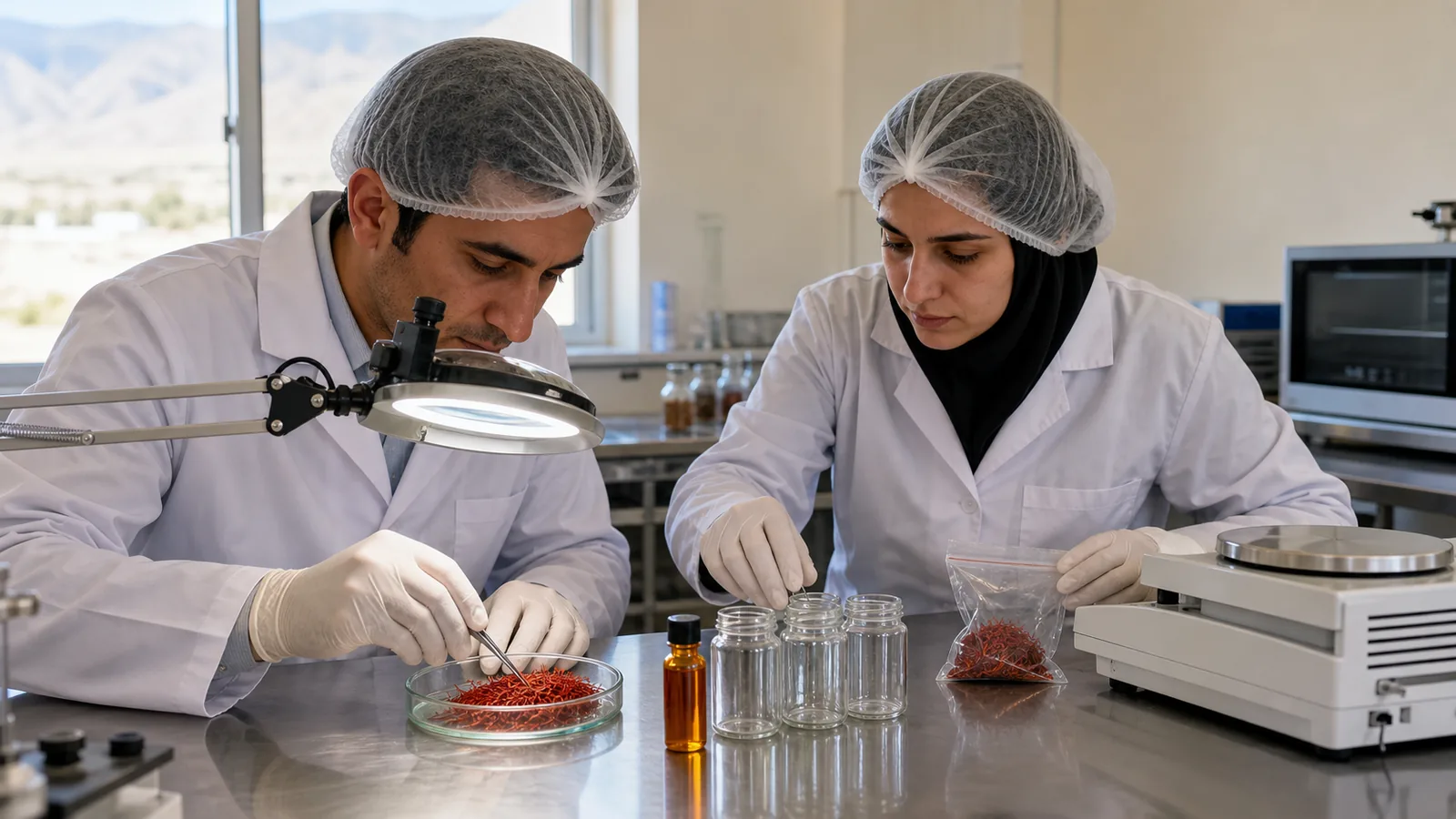
Sattari’s emphasis on knowledge-based products is stronger when it starts with problems buyers will pay to solve. In saffron, that can include repeatable drying, cleaning, grading, representative sampling, laboratory methods, traceability software, tamper-evident packs and stable ingredient specifications.
Product development may go further into standardized extracts or saffron-containing foods, provided the company can control composition, safety and shelf life. A new formulation needs technical validation and the approvals required in its target market. Traditional reputation is not a substitute for evidence.
Technology can also reduce losses before export. Better harvest scheduling, hygienic stigma separation, controlled drying and moisture-resistant storage protect the value already created in the field. These improvements may be less visible than a new consumer product, but they help every lot meet a consistent specification.
Why Ghaen’s growth centre mattered
The Ghaen technology-unit growth centre could connect local founders with workspace, equipment, technical advice and commercial support. Sattari said its infrastructure should be strengthened, and he pointed to knowledge-based companies already active in South Khorasan.
Infrastructure is useful when it closes a defined gap. A shared laboratory can reduce the cost of testing for small firms. A pilot line can let a team prove a drying or packing process before buying industrial equipment. Export and regulatory advice can stop a promising product from being designed for a market it cannot legally enter.
The province’s educated population is part of that system. Food scientists, agricultural specialists, engineers, designers and sales staff each solve a different part of the value-chain problem. Retaining them requires viable companies and customers, not only training programmes.
A practical value-retention plan
For a saffron business, “stop selling raw” is too broad to guide an investment. A better plan begins with the buyer and works backward.
- Identify whether the customer needs a bulk ingredient, private-label pack or the exporter’s own retail brand.
- Set a measurable specification for identity, grade, moisture, cleanliness and any required contaminant limits.
- Build lot-level records from supplier and harvest through drying, testing, packing and shipment.
- Choose processing or packaging that solves the customer’s problem and complies with the destination market.
- Calculate the added margin after equipment, rejected lots, materials, certification, freight, distributor fees and marketing.
- Expand only after repeat orders show that the added step creates value rather than inventory.
This approach leaves room for high-quality bulk exports. A traceable, tested lot sold under a clear supply agreement may be more profitable than a retail product with no route to consumers. The objective is to keep valuable capabilities and commercial relationships in the province, not to force every kilogram into the same package.
What should be the priority
The headline remains directionally sound: South Khorasan should capture more of the value created after harvest. Its strongest route is a connected system of skilled people, sound processing, credible tests, market-specific packaging, product development and direct customer knowledge.
The US$9 billion comparison should not be repeated as a verified saffron-export statistic. Available customs records describe a much smaller trade in saffron itself, and the original statement never defines the wider market it may have intended.
Preventing low-value, anonymous sales is a useful goal. Preventing all bulk sales is not. The durable measure of success is how much verified quality, intellectual property, brand equity and buyer trust South Khorasan’s businesses retain with each shipment.

![Exporting Saffron to Turkey + Price Guide [Complete 0 to 100]](https://img.rowhanisaffron.com/20260827003933/saffron-export-turkey-quality-inspection.webp)



