


No subsidies will be paid to Lorestan production saffron was the policy message delivered by Hossein Zeynli, then director of medicinal-plants programmes at Iran’s Ministry of Agriculture Jihad. He did not announce a ban on growing saffron in Lorestan. He warned that publicly funded expansion could add production faster than the market could absorb it.
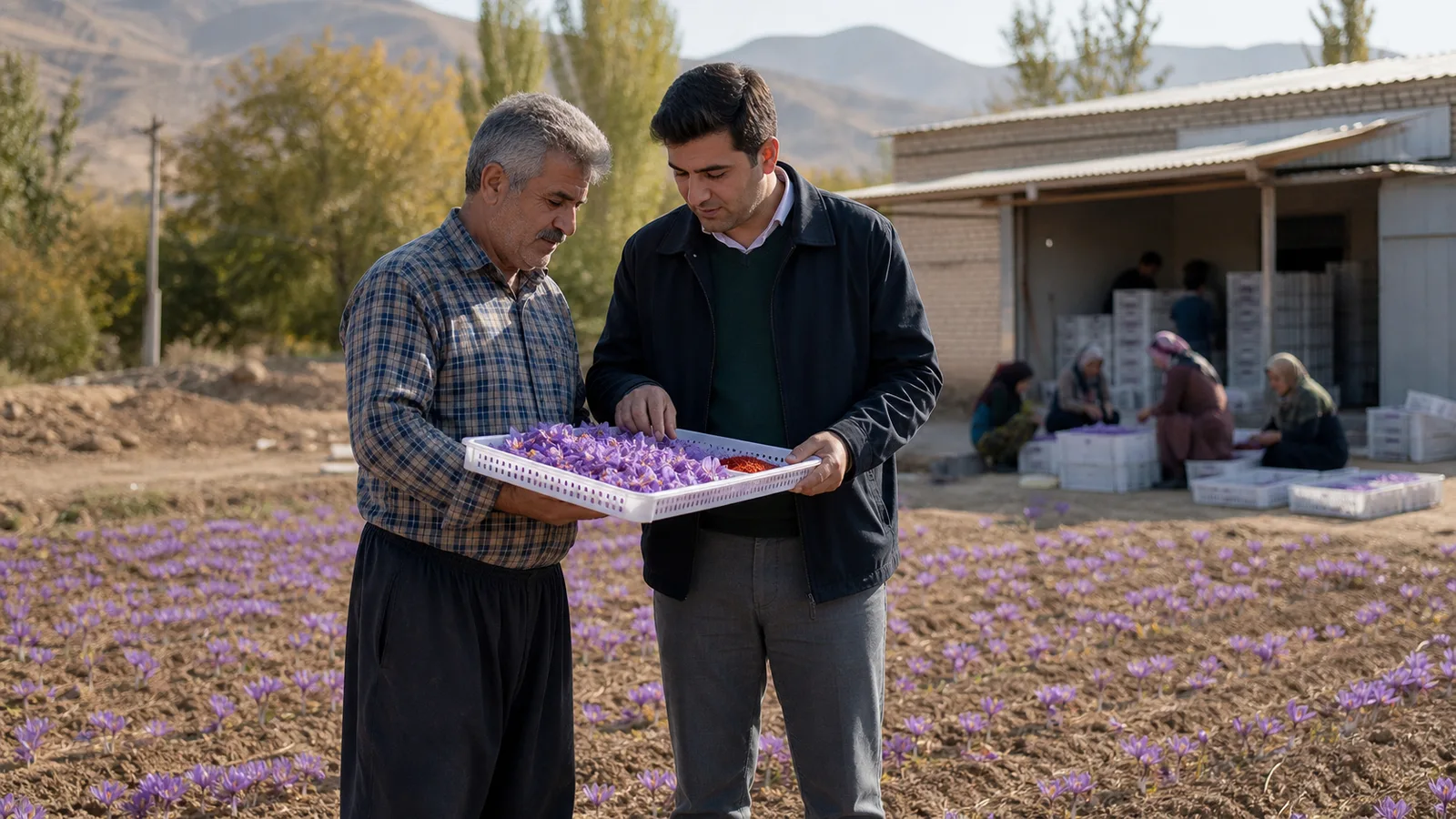
The statement was reported in early 2020 and should not be treated as a current entitlement or funding notice. Its central question remains relevant: should support pay simply for more hectares, or should it strengthen processing, packaging, quality and routes to market first?
What “no subsidies” meant in this announcement
Zeynli said the ministry did not intend to subsidise the expansion of saffron cultivation in Lorestan. His concern was future market pressure: if many applicants entered the crop because public money reduced the initial cost, growers could later face excess supply or weak sales.
He also said this did not prohibit farmers from planting saffron. An operator could proceed with their own resources and judgment, subject to the normal agricultural rules. The distinction was between permission to cultivate and a specific national decision to finance more production.
The wording should not be extended beyond its date and programme. Agricultural support can take different forms, including low-interest finance, training, equipment assistance, crop-specific grants or help for processing. Applicants need a current written programme notice from the responsible authority; this historical article cannot establish what is available today.
Why the ministry was cautious about expansion
Saffron has a high price per kilogram, but that headline number can hide the limits of the market. A new field requires corms and preparation, then careful flower picking, stigma separation, drying, testing, storage and sale. The crop may remain in the ground for several years, so a decision to expand creates a continuing exposure rather than a one-season experiment.
Zeynli wanted balance across medicinal crops instead of directing all support toward whichever product appeared most profitable. The old English version contains an unclear crop name rendered as “Mozar.” Because the underlying term cannot be verified confidently from the available text, we do not turn it into a specific crop recommendation. The defensible point is that he preferred support based on each region’s comparative advantage.
If production rises without enough buyers, processing capacity or brand recognition, growers can be forced to sell in bulk at weak prices. A subsidy can lower the cost of planting, but it cannot by itself create sustained demand.
Processing and packaging were the preferred support targets
Zeynli argued that support should go toward processing agricultural products. For Lorestan saffron, that means protecting quality after harvest and presenting a product that can enter larger domestic or export markets.
The practical chain includes rapid flower handling, hygienic stigma separation, controlled drying, moisture-safe storage, laboratory verification, traceable lots and packaging suited to the buyer. Weakness at any point can erase some of the value created in the field.
An Iran Agricultural News Agency report from the same period described 381 hectares of Lorestan saffron and approximately 1,047 kilograms of production. It also reported traditional packaging and limited local market recognition as constraints. Those are 2019–2020 figures, not current statistics, but they explain why officials discussed downstream investment rather than hectares alone.
Was Lorestan saffron “the best in Iran”?
The earlier article called Lorestan’s product the best saffron in Iran and said it had held that position for years. That is a promotional claim, not a quality grade supported by the page’s evidence.
Officials and growers have reported favourable laboratory results and strong aroma, flavour and colour. Quality, however, must be demonstrated lot by lot. Origin alone does not determine crocin, picrocrocin, safranal, moisture, foreign matter, microbial condition or authenticity.
A stronger market statement is that Lorestan can produce high-quality saffron when cultivation and post-harvest handling are sound. Accredited test results, transparent grading and traceability give a buyer evidence. A regional superlative without the test method does not.
Why packaging matters without becoming the whole strategy
Suitable packaging protects saffron from moisture, light, contamination and aroma loss. It also provides space for the required identity, net weight, lot and traceability information. For export, the pack and documentation must meet the rules of the destination market.
Packaging alone cannot rescue inconsistent material or guarantee access to “world markets.” A useful development plan connects verified quality with a defined customer, appropriate pack size, realistic pricing and reliable fulfilment. Processing equipment that sits idle or premium boxes without distribution only add cost.
The agronomic advantages behind the interest
The 2020 discussion identified several reasons farmers were interested in saffron:
- its irrigation demand can be lower than many competing crops when the site and schedule are suitable;
- one planting can remain productive for multiple seasons;
- small plots can produce a high-value crop;
- the basic field crop does not require highly specialised heavy machinery; and
- the dried spice is compact and can retain value after harvest when processed and stored correctly.
Each advantage has a qualification. Saffron still needs correctly timed water, healthy corms, labour during a compressed harvest, careful drying and a buyer. “Low-water” does not mean no-water, and “high-value” does not mean every field will have a high net margin.
Employment potential and its limits
Saffron can create seasonal work because flowers must be picked and separated quickly. Processing, testing, packaging and sales can add work beyond the field. That makes the crop attractive for small enterprises and regional value chains.
Employment claims should still be tied to actual production and sales. Labour concentrated into a few harvest weeks is not automatically a full-time job, and an enterprise is not sustainable if it depends on continuously recruiting new growers rather than selling saffron to end buyers.
A safer decision framework for Lorestan growers
Before expanding a field, a grower or cooperative should confirm:
- soil, drainage, climate and water suitability at the specific site;
- the health, size, source and true cost of planting corms;
- realistic multi-year yield and labour assumptions;
- where flowers will be cleaned and stigmas dried during the peak period;
- which quality tests and pack specifications the intended buyer requires;
- a sales channel and price based on comparable wholesale lots; and
- current support terms confirmed by the competent agricultural office.
This is the balance Zeynli’s warning was trying to protect. More production can be useful when quality and demand grow with it. Expanding because a subsidy or a high retail price makes the crop look effortless transfers too much risk to the farmer.
What changed after the statement?
Later official reporting showed that Lorestan cultivation continued and that provincial programmes discussed support for medicinal plants, packaging licences and parts of establishment costs. That does not make the earlier quotation false. It shows why the title must remain attached to its moment: it described one official’s policy on subsidising saffron expansion, not a permanent ban on every form of assistance.
For readers making a decision now, the historical lesson is more dependable than the old administrative detail. Protect the farmer by confirming the market, quality system and full cost before paying to increase supply.
Sources
The policy position is attributed to Zeynli’s statement preserved in the original report. The contemporary Lorestan production, packaging and employment context comes from the Iran Agricultural News Agency’s February 2020 report. A later IANA account of provincial agricultural programmes documents cultivation and processing support in a different period. Current eligibility must be checked with the relevant authority.

![Exporting Saffron to Turkey + Price Guide [Complete 0 to 100]](https://img.rowhanisaffron.com/20260827003933/saffron-export-turkey-quality-inspection.webp)



