


Najafabad saffron was reported at roughly twice the national-average yield in Dehaq and the surrounding Mehrdasht villages. Two Red Gold Festival reports describe a local industry growing from about 120 to 140 hectares, producing around 800 kilograms in one period, and trying to keep grading, packaging, branding, and sales within the region.
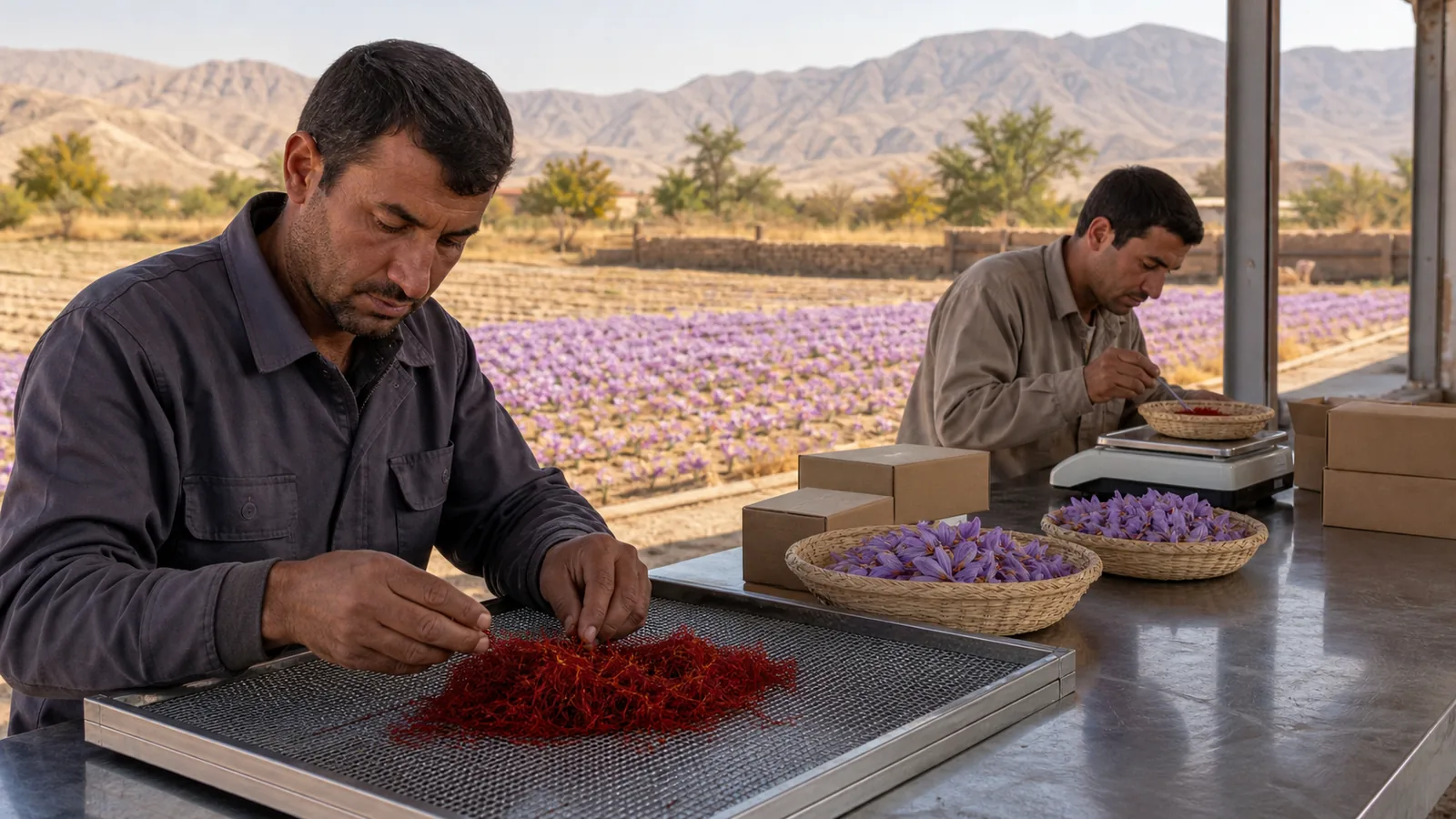
The figures come from different festival years and speakers, so they should be read as historical snapshots rather than a single current dataset. They nevertheless tell one coherent story: Mehrdasht had strong reported field performance but needed a shared commercial identity and local post-harvest infrastructure.
Where Najafabad saffron is grown
The reports center on Dehaq—also written Dehagh or Dehqah—in Mehrdasht District of Najafabad County, Isfahan Province. The first Red Gold gathering was organized to introduce saffron from Dehaq and nearby villages whose names were translated as Damav or Domab, Aliabad, Ashin, Kheyrabad, and Hosseinabad.
This local geography matters. “Najafabad saffron” in the articles is not a claim that every field across the county has identical soil, age, density, or yield. It refers to a production cluster within Mehrdasht whose villages were promoted together through the festival.
The third Red Gold Festival production snapshot
At the opening of the third Red Gold Festival, Najafabad governor Mojtaba Raei described saffron output in Dehaq and its neighboring villages as twice the national average. The account placed total cropland and orchards in Najafabad at about 9,000 hectares, including 120 hectares of saffron.
It also described Najafabad’s wider agricultural economy:
- first in Isfahan Province for honey production, with a stated capacity of 1,200 tonnes;
- first nationally in turkey-meat production, with a stated capacity of 230,000 birds;
- first in production of beekeeping equipment;
- second in ornamental-fish production and reproduction; and
- third in saffron production within Isfahan Province.
Those rank and capacity statements were part of the governor’s festival remarks. The article did not provide the underlying statistical tables, reporting year, or definitions of capacity, so they should not be reused as present-day rankings without a new official dataset.
What the first Red Gold conference added
An earlier report from the first conference gave a larger regional area: about 140 hectares delivering approximately 800 kilograms of dried saffron. Dividing those figures produces a simple average near 5.7 kilograms per hectare, although the organizer also described individual local yields as reaching substantially higher levels.
The translated source contains an ambiguity in that yield range. Its lower value has been rendered as both 4.7 and 7.4 kilograms per hectare, while the upper value is 8.9 kilograms. Rather than silently choosing one translation, the defensible conclusion is that organizers claimed some Mehrdasht fields exceeded a comparison figure of about 4.5 kilograms per hectare. Field-level records would be needed to confirm the exact range.
Why the reports use both 120 and 140 hectares
The difference does not necessarily mean one figure is wrong. The reports refer to different editions of the festival and may use different dates, geographic boundaries, or definitions of producing versus planted area. A 120-hectare figure for one period can coexist with a 140-hectare regional figure from another.
What should not be done is combine the largest acreage, largest yield, and best quality statement as if they were measured in one controlled survey. Each number stays attached to the report that supplied it.
What did “grade 22” mean?
First-conference organizer Ahmad Damabi said laboratory grading placed local saffron at 22 compared with an average of 18. The translation alternately describes that comparison as national or global, and it does not name the analytical scale, units, laboratory, sampling method, or report. “Grade 22” is therefore preserved as an attributed festival statement, not converted into a recognized international grade.
Modern saffron quality is normally described through defined tests and specifications. ISO 3632-2 specifies test methods for dried saffron in filaments, cut filaments, and powder. Testing commonly examines characteristics connected with color, taste, and aroma, while authenticity work may use additional methods.
A numeric result is meaningful only when the parameter, units, sample preparation, and method are named. Without those details, “22 versus 18” cannot be compared reliably with an ISO category or a buyer’s specification.
High yield does not prove high quality
Yield measures dried saffron mass per unit of land. Quality measures a different set of properties. A field can produce more material while drying, storage, contamination, or adulteration damages the finished product; conversely, a small harvest can meet a demanding specification.
Corm size and health, planting density, field age, irrigation timing, soil, nutrition, flower-picking speed, stigma separation, drying temperature, moisture control, and storage all affect the commercial result. That is why a serious regional claim needs both field records and representative laboratory testing.
The plan for one regional brand and a packing facility
The first-conference report said saffron from the named villages had been sent to Khorasan Razavi for packing and sale. Festival organizers wanted a single Mehrdasht brand and a local packaging factory so cultivation, processing, packing, and supply could remain closer to the producing villages.
The goal was not merely to put a different name on a box. Local value retention depends on clean separation and drying, batch traceability, moisture-safe storage, verified grade, food-safe packing, honest origin claims, and access to buyers. A shared brand can fail if lots of different quality are mixed without rules; it can succeed when participants agree on specifications and independent checks.
This remains a current national priority. A 2025 FAO and Mashhad University initiative noted that international trade commonly references ISO 3632 while also emphasizing the need for stronger authenticity testing and better post-harvest guidance. The initiative is national, not evidence that the Dehaq facility was built, but it supports the quality-control logic behind the local plan.
Production strength and export weakness
The third-festival account contrasted Iran’s leading saffron production with a claimed 17th-place export rank. That rank was not accompanied by a year, product code, value-versus-volume definition, or trade table, so it cannot be treated as a current verified position.
The underlying concern is sound: producing a large share of a crop does not guarantee the same share of branded export value. Bulk sale, re-export through other markets, inconsistent documentation, weak traceability, and insufficient marketing can separate farm production from the identity a final buyer sees.
Tourism and the Red Gold Festival
Governor Raei also presented the festival as a way to introduce Mehrdasht’s agricultural and tourism capacity. A saffron festival can bring visitors close to the short autumn flowering season, village landscapes, harvest work, local food, and direct sales. That opportunity must be managed without disrupting farms or turning unsupported superlatives into the main attraction.
Good interpretation explains why each flower supplies only three stigmas, how quickly flowers must be handled, why drying matters, and how buyers can understand origin and quality. It gives the region a story grounded in real work rather than a slogan.
What the merged record establishes
The festival reports support a historically strong saffron cluster in Dehaq and the Mehrdasht villages: about 120–140 hectares in the reported periods, roughly 800 kilograms in the first-conference account, and claims of above-average field yield. They also identify the central commercial gap—product was leaving for packing elsewhere instead of building a verified regional identity.
The most useful next step is not to repeat “twice the national average” indefinitely. It is to publish dated acreage and harvest data, define the laboratory method behind quality claims, resolve geographic scope, record batch origin, and show whether the proposed common brand and packaging capacity now exist. That would turn a festival claim into durable market evidence.

![Exporting Saffron to Turkey + Price Guide [Complete 0 to 100]](https://img.rowhanisaffron.com/20260827003933/saffron-export-turkey-quality-inspection.webp)



