


The saffron flower market in Gonabad was presented as a practical way to organize a brief, demanding harvest trade. An earlier report from Sano village described a local market intended to bring growers and buyers together, reduce disorder during the season and keep more of the crop’s value connected to the area.
The plan announced for Sano village
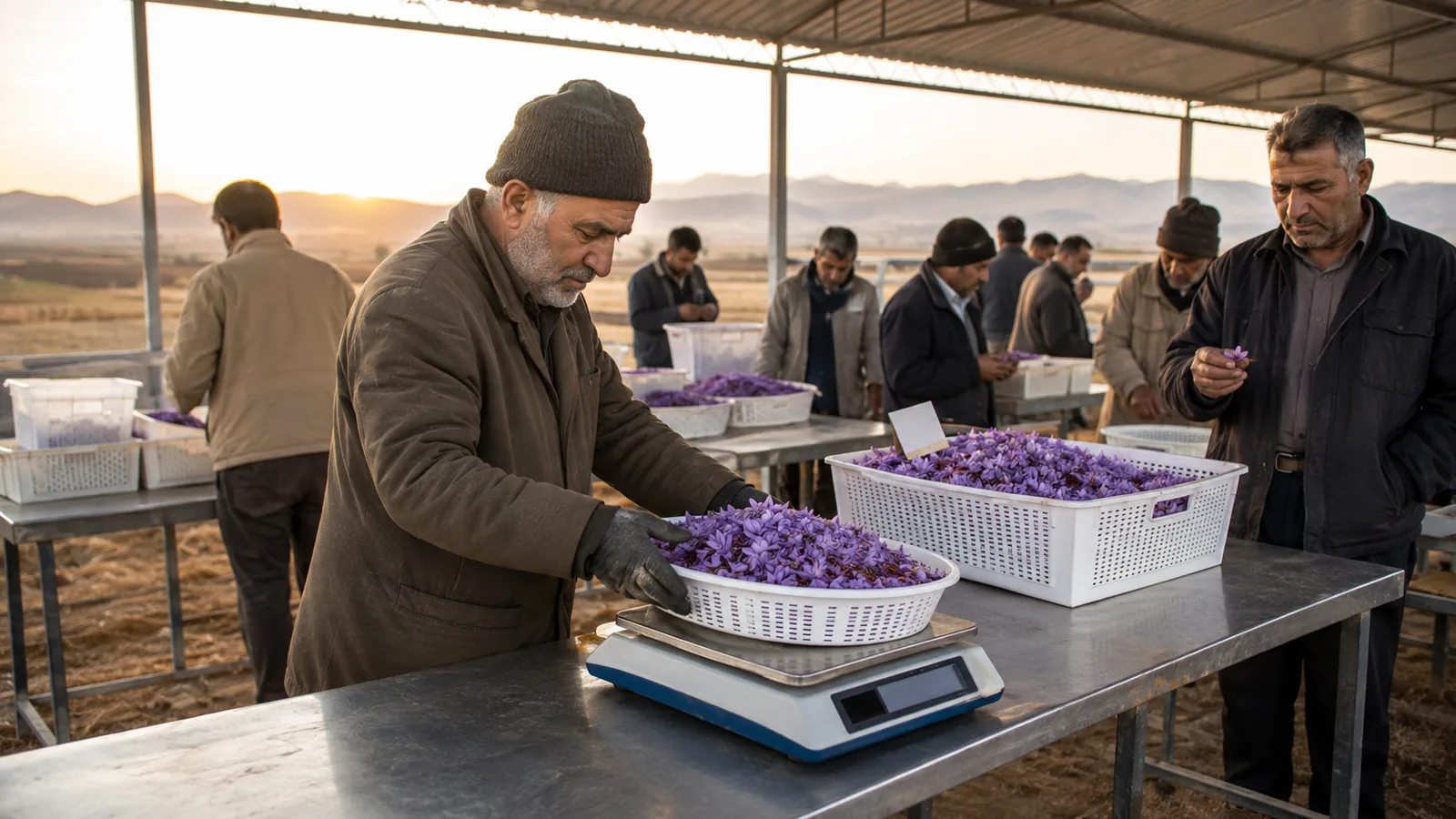
A member of Sano’s Islamic Council announced what the report called the village’s first dedicated market for buying and selling saffron flowers. The stated aim was straightforward: create an orderly place where the fresh flowers could be traded during their short season instead of relying entirely on scattered, informal transactions.
The proposal was linked to three expected benefits. Its supporters hoped for more stable trading conditions, a smaller gap between prices in Gonabad and those seen in other cities, and a central place where sales could be observed and coordinated. Those were expectations attached to the launch, not proof that every price problem had already been solved.
Why a flower market is different from a dried-saffron market
A fresh saffron flower is highly time-sensitive. The red stigmas still have to be separated, dried, protected from contamination and prepared for storage or sale. That leaves much less room for delay than a trade in properly dried threads.
For a local flower market to work well, it therefore needs more than a physical location. Delivery times, weighing, handling, buyer capacity and payment terms all have to be clear. If too many flowers arrive without enough labour or processing space, a central market can simply concentrate the bottleneck rather than remove it.
Asghar Sadeghian’s case for the market
Asghar Sadeghian, identified in the original report as secretary of the Young Farmers Club in Sano, said about 1,000 hectares of the village’s farmland were under saffron cultivation. The figure is preserved as his statement; the report did not provide a survey year or current land record with which to update it.
He connected the market to support from the Islamic Council and participation by the private sector. In his account, a recognized trading point could direct financial activity toward local agriculture and help complete the village’s saffron production chain.
What “completing the production chain” means in practice
The phrase can sound abstract, but the work is concrete. Flowers have to move quickly from the field to clean separation areas. Stigmas must be handled consistently, dried under controlled conditions and kept in packaging that protects them from moisture, light and foreign material. Lots also need enough identity to trace a quality problem back to its source.
A flower market can support that chain by matching growers with capable processors. It cannot replace the chain. Buyers still need trained workers, clean equipment, realistic daily capacity and records that follow each lot from purchase through drying.
How centralized trading can help price discovery
When several buyers and sellers meet under known rules, growers can compare offers more easily. A visible weight, a stated quality basis and a written price reduce the uncertainty that comes with a hurried verbal deal. The result may be better price discovery, although no market can guarantee a particular price.
The original report specifically hoped to reduce the difference between local prices and those in other cities. A fair comparison would need to account for timing, flower condition, stigma yield, transport and payment terms. Two headline prices are not necessarily for the same product or the same risk.
Weighing and payment need simple, visible rules
Small details determine whether growers trust a seasonal market. Scales should be checked, deductions should be explained before a sale, and both parties should receive a record of the weight and agreed price. Payment timing matters too. A slightly higher offer is not necessarily better if its conditions are unclear or payment is delayed.
Lots should remain identifiable while they wait for acceptance. Mixing flowers from several growers too early makes it difficult to settle a dispute or learn which field and handling practice produced the best result.
Quality starts before the flowers reach the market
A trading centre cannot restore freshness lost in the field. Harvest timing, clean containers, protection from heat and crushing, and prompt delivery all influence what processors receive. Flowers should not be compacted into deep, warm piles or placed in containers carrying soil, fuel, chemicals or strong odours.
At intake, buyers can separate visibly damaged or contaminated material and record arrival time. These basic controls give a quality-based offer more meaning than a price based on weight alone.
Surplus flowers from neighbouring villages
Sadeghian also said the market could receive surplus flowers from nearby villages. That could give growers another outlet when local processing capacity is full. It would also increase the market’s responsibility to manage arrival schedules and avoid accepting more perishable material than buyers can process.
For visiting growers, the useful questions are practical: who may sell, when intake opens, how quality is assessed, whether transport time affects acceptance, when payment is made and what happens to a rejected lot. Publishing those rules before harvest would prevent confusion on the busiest mornings.
Gonabad’s wider saffron setting
The report described Sano as the largest village in Kakhk District by area and population, situated north of Ferdows, with agriculture and horticulture central to village work. These location and size descriptions come from that report and are not presented as a new census finding.
The regional context is better established. The FAO recognizes Gonabad’s qanat-based saffron farming system as a Globally Important Agricultural Heritage System. Its description connects saffron with water management, local knowledge, livelihoods and biodiversity in an arid landscape. A flower market sits within that living system; it should serve the people and practices that make the crop possible.
What growers should be able to expect
A dependable market should make its operation easy to understand. Growers should know the opening period, intake hours, accepted containers, weighing method, grading approach and payment schedule before they travel. They should also know who handles complaints and how a disputed weight or rejected lot will be reviewed.
Clear rules do not favour only large farms. They are especially valuable to small growers who have little time to compare buyers while fresh flowers are waiting to be processed.
What buyers and processors should prepare
Buyers need to match purchases to real separation and drying capacity. They should plan staffing, clean work surfaces, food-safe containers, lot labels and transport before the first deliveries arrive. Buying more flowers than can be handled promptly risks lowering the quality of the very product the market is meant to support.
Processors can also explain how their offers relate to flower condition and expected stigma yield. A transparent method helps growers understand why two lots of the same gross weight may not receive the same offer.
How success should be judged after the season
The launch itself is only a starting point. A useful review would record how many growers participated, how much flower was traded, how quickly sellers were paid, how often lots were rejected and whether processors handled purchases without damaging delays. Price comparisons should use like-for-like transactions rather than isolated high or low figures.
Grower complaints and buyer feedback matter alongside volume. If the market shortened travel, made weights clearer and connected surplus flowers to responsible processors, those are meaningful gains. If congestion, unclear deductions or delayed payments appeared, they provide a specific agenda for the next harvest.
A local market has to earn lasting trust
The idea behind launching a saffron flower market in Gonabad was not simply to create another place of sale. It was to organize a narrow seasonal window in which growers need quick, fair decisions and processors need fresh, carefully handled flowers.
Sano’s reported 1,000 hectares, its agricultural livelihood and its position among neighbouring villages explain the logic of a local hub. Its long-term value, however, depends on transparent trade, realistic processing capacity and quality controls that protect both the grower and the final saffron.

![Exporting Saffron to Turkey + Price Guide [Complete 0 to 100]](https://img.rowhanisaffron.com/20260827003933/saffron-export-turkey-quality-inspection.webp)



