


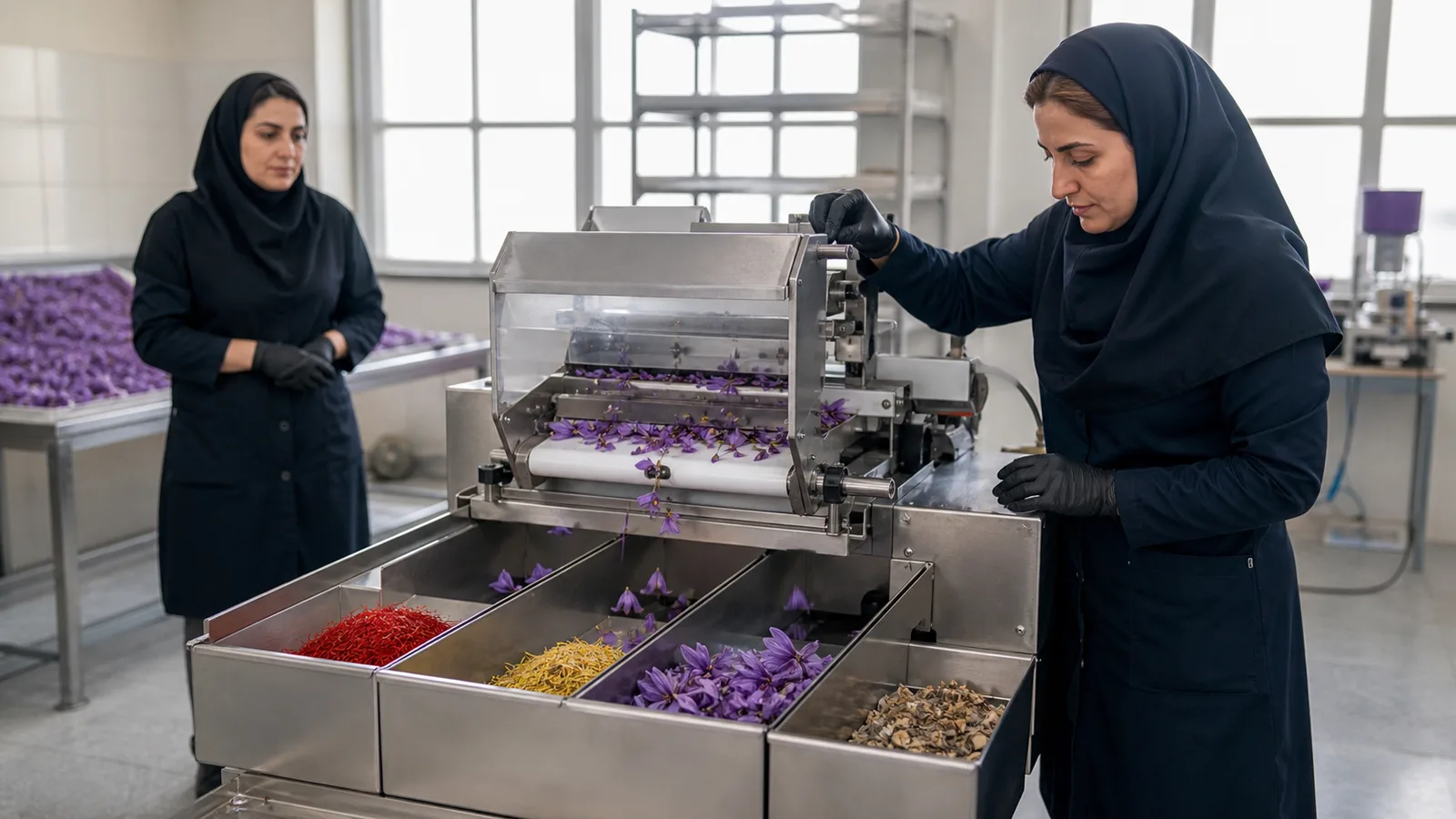
The launch of the first saffron sorting plant in Iran in Mashhad was reported as the result of a decade-long effort led by Khorasan inventor Malihe Pakcheshm Moeini. Her team described a machine designed to separate freshly picked saffron flowers into red, orange-yellow and other plant fractions instead of performing only a basic removal of waste.
This was an invention announcement, not a published independent performance test. The distinction matters: the project illustrates an important attempt to mechanise one of saffron production’s most labour-intensive stages, but the available report does not establish commercial throughput, sorting accuracy or a later patent outcome.
What the Mashhad saffron machine was designed to do
Pakcheshm Moeini said her workgroup had begun the project about ten years before the announcement and had succeeded in launching the machine roughly three years earlier. It was unveiled publicly at the closing ceremony of a women’s empowerment exhibition in Mashhad.
According to her description, the device could sort saffron flowers into several visible components: the valuable red stigmas, yellow and orange portions, and the remaining flower material. She contrasted that multi-part separation with equipment she had seen used in Spain, which she said separated saffron from waste without making the same colour-based divisions.
That comparison belongs to the inventor’s account. Without model details, test data or an independent inspection, it should not be read as a general statement about every Spanish sorting system or proof that the Mashhad machine outperformed them.
Sorting is different from grading dried saffron
“Saffron sorting plant” can describe more than one operation. This machine concerned the parts of a newly harvested flower. It was not simply grading finished dried threads by colour, length or foreign matter, and it was not a packaging line.
Each Crocus sativus flower contains three red stigmas, yellow stamens and purple tepals. The stigmas become the culinary spice after careful separation and drying. Keeping other flower material out of that fraction supports purity, while collecting the remaining parts separately can make research or other uses easier.
Finished saffron still requires its own quality controls. Drying conditions, moisture, storage, handling and laboratory measurements all affect the final product. A flower-separation machine can improve consistency at one stage, but it cannot by itself certify quality or replace testing against an appropriate saffron standard.
Why mechanising flower separation is difficult
Saffron flowers are soft, irregular and easily damaged. They arrive during a short harvest period, and their orientation, size and degree of opening vary. The stigmas are slender and valuable, so a fast mechanism that cuts or pulls in the wrong place can trade labour savings for lost product or unwanted yellow style.
Engineering studies have approached the problem in several ways. A Spanish research prototype used computer vision to locate a cutting point on each flower and reported a faster cutting rate than manual work under its test conditions. Other researchers have tested airflow because petals, stamens and stigmas respond differently to moving air. Those systems show why a practical line may need several stages rather than one simple separator.
For any commercial machine, useful evaluation would need to report more than speed:
- kilograms or flowers processed per hour under normal harvest conditions;
- the proportion of red stigmas recovered without damage;
- the amount of yellow style, stamens, petals and debris left in the saffron fraction;
- cleaning time, food-contact materials and sanitation procedures;
- energy use, operator requirements and maintenance;
- performance with flowers of different sizes, ages and moisture levels.
The old announcement supplied none of those measurements. That absence does not invalidate the prototype, but it limits what can responsibly be claimed about its readiness or economics.
The inventor’s self-funded development
Pakcheshm Moeini emphasised that her group paid for the project from beginning to end. She described the financial pressure as substantial, while also saying the result made the effort worthwhile and gave the team a sense of pride.
At the time of the exhibition, she said a patent application was under way. Her next aim was to give the device an official name and add more convenient features and attachments. These were plans reported at that moment; the accessible source record does not confirm whether the patent was later granted or whether the machine entered serial production.
What happens to saffron flower fractions?
The red stigma is the part sold as the familiar spice. Its principal colouring compound is crocin, while picrocrocin contributes bitterness and safranal is strongly associated with aroma, especially as processing and drying transform the material. Other flower parts have different chemical profiles and should not be marketed as though they were equivalent to the stigma.
The inventor referred to early laboratory research into compounds from the differently coloured fractions and possible antioxidant, mood-related and anti-tumour activity. That research context must be kept within its limits. Cell or animal findings do not demonstrate that a separated flower part treats cancer or depression in people, and neither this machine nor the compounds it sorts are a substitute for medical care.
Separate recovery can still be useful without making a health promise. It gives researchers cleaner starting material, reduces mixed waste and may support investigation of pigments or other compounds. Any food, cosmetic or pharmaceutical use would require suitable safety, quality and regulatory evidence for the specific product.
Why the project mattered in Mashhad
Mashhad is the commercial centre of Razavi Khorasan, a major saffron-growing region. Harvesting and stigma separation create a concentrated demand for careful labour, so local processing technology addresses a real production problem. It can also retain more technical knowledge and manufacturing value close to growers.
The women’s empowerment exhibition gave the project another dimension. It placed a woman-led engineering effort in public view and connected invention, agricultural work and regional industry. The strongest legacy of the announcement is therefore not an unverified “first” alone, but a concrete example of local engineers trying to solve a difficult saffron-processing task.
How to read the “first” claim
The original headline called this the first saffron sorting plant in Iran. We retain that historical wording because it identifies the specific Mashhad announcement and is strongly associated with how readers find the page. It is best understood as the claim made at the unveiling, not a complete patent search or a judgment covering every earlier Iranian prototype.
Earlier and international research into mechanised stigma separation already existed, including an Iranian airflow-based separator study and a Spanish vision-guided cutting system. The Mashhad project may still have been first in the precise configuration or exhibition context its inventor described, but the surviving report does not define that category closely enough to prove a broader priority claim.
Sources and evidence limits
The invention details and quotations come from the 2019 report republished by Carton Iran, which attributes the account to Young Journalists Club. Technical context comes from the peer-reviewed automated saffron-flower cutting study and the Politecnico di Torino record for a computer-vision separation system. Where no independent test or later status record is available, this article says so rather than filling the gap.

![Exporting Saffron to Turkey + Price Guide [Complete 0 to 100]](https://img.rowhanisaffron.com/20260827003933/saffron-export-turkey-quality-inspection.webp)



