


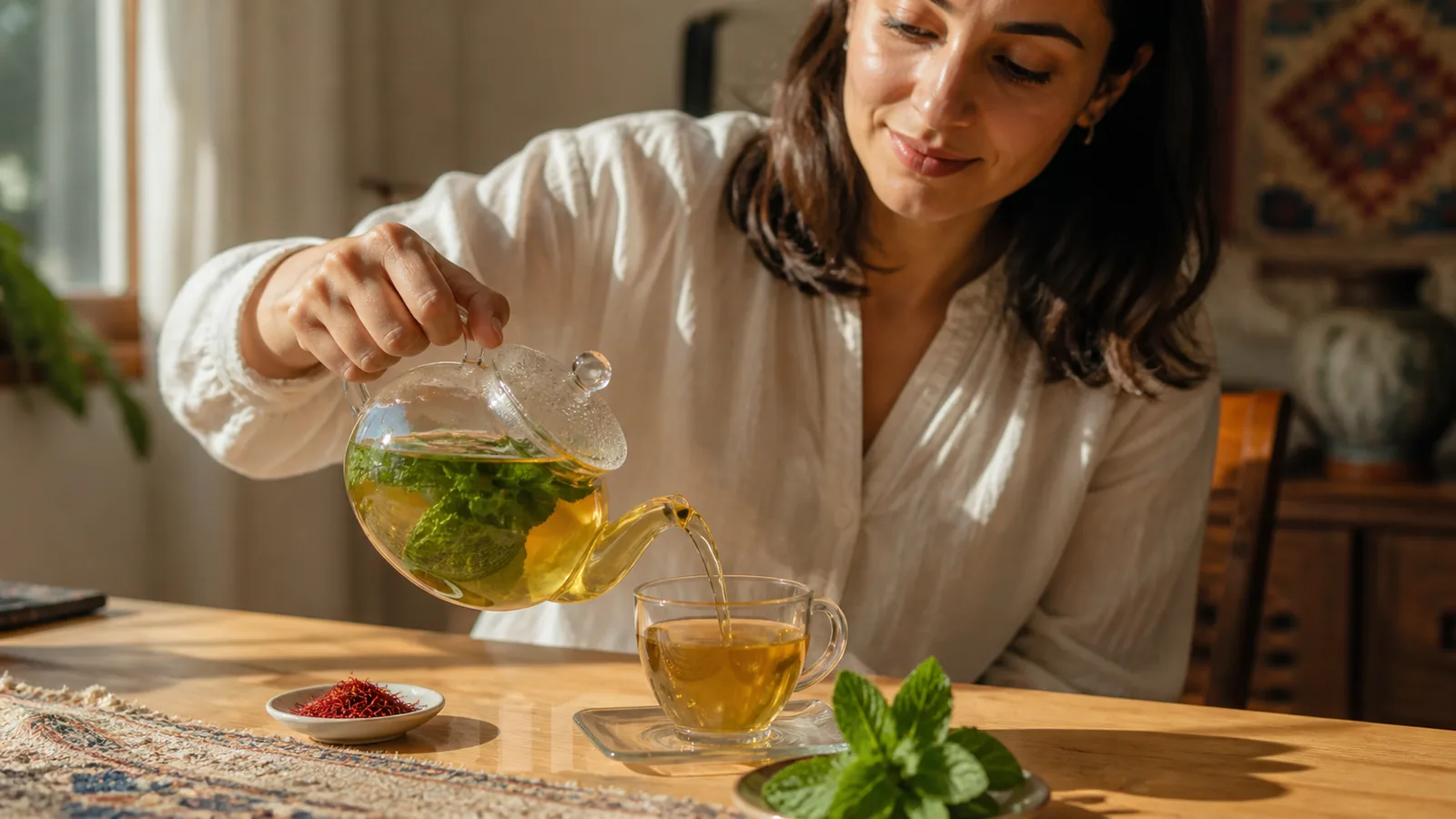
Saffron can make an ordinary drink or meal feel special, but “happy” should be understood carefully. Its aroma, colour, and place in Iranian hospitality can add pleasure to a daily ritual. Research also suggests that standardised saffron supplements may improve some mood scores. Neither a cup of saffron tea nor a sweet syrup, however, is a treatment for depression or heart disease.
For anyone searching for how to be happy with saffron Iran, the useful answer begins with enjoyment: choose genuine threads, bloom them gently, and use the resulting infusion for aroma and colour. Health questions require a different standard of evidence.
A simple way to enjoy Iranian saffron
Crush a small pinch of threads between clean fingers or in a mortar. Add two or three tablespoons of warm water and let the saffron bloom for about ten minutes. The water should turn a clear golden colour and release a hay-like, floral aroma.
Add the infusion to a pot of tea, warm milk, rice, soup, or dessert. For a simple saffron tea, pour hot water over a small pinch of bloomed saffron and steep it with a little mint or a slice of lemon. Sweeten only if you want to, and keep the amount modest. Saffron’s flavour is delicate; a very large dose can become bitter rather than more enjoyable.
Why saffron feels celebratory
In Iranian cooking, saffron often appears in dishes made for guests and special occasions. The experience is sensory before it is medical: vivid colour, a distinctive aroma, and the small ritual of grinding and blooming the threads.
Three familiar compounds help explain those characteristics. Crocin contributes much of the colour, picrocrocin is associated with bitterness, and safranal is an important part of the aroma. Their presence does not mean that every saffron food or drink delivers a pharmaceutical effect. Taste, tradition, and treatment are different claims.
What studies say about saffron and mood
The clinical evidence is more promising than the old claim that saffron simply “causes happiness,” but it still needs context. A 2026 GRADE-assessed systematic review and meta-analysis included 34 randomised controlled trials with 1,769 adults. Saffron supplementation improved several depression and anxiety scores, but results varied substantially between studies. The interventions lasted at least four weeks and used controlled preparations; they did not test an occasional cup of saffron tea.
A 12-week placebo-controlled trial in 202 adults with subclinical low mood also reported a modest improvement with a standardised extract, while noting a large placebo response. The trial’s design and results cannot be translated into a dose of culinary threads because an identified extract and a household infusion are not interchangeable.
The fair conclusion is that saffron is being studied as a possible adjunct for mood, not that any saffron recipe is an antidepressant.
Saffron does not replace mental-health care
Depression is not ordinary sadness, and it should not be managed by changing a spice routine alone. Do not stop an antidepressant, alter its dose, or replace counselling with saffron unless the clinician responsible for your care agrees.
If low mood persists, affects sleep or daily function, or comes with hopelessness, speak with a qualified healthcare professional. Thoughts of self-harm or suicide require immediate local emergency or crisis support. A pleasurable cup of tea can be part of a day; it is not emergency care.
Can saffron treat heart disease?
No clinical evidence shows that culinary saffron strengthens a heart ventricle, nourishes heart muscle, or treats established heart disease. Crocin and picrocrocin are real saffron constituents, but naming them does not prove those older claims.
Research has measured cardiovascular risk markers rather than showing that saffron cures disease. A meta-analysis of eight randomised trials found average reductions of 0.65 mmHg in systolic pressure and 1.23 mmHg in diastolic pressure. The authors explicitly described the effects as small and potentially not clinically important.
A newer review of 25 trials in people with metabolic syndrome and related conditions reported small average changes in blood pressure, glucose, and total cholesterol, but called for more high-quality research in diverse populations. Risk-factor changes are not evidence that saffron repairs the heart or prevents a heart attack.
Someone with high or low blood pressure, heart disease, or prescribed cardiovascular medication should not add a concentrated saffron supplement without discussing it with a clinician or pharmacist.
The old one-kilogram sugar syrup is not heart medicine
The source article described a traditional mint-and-saffron syrup made by heating one kilogram of sugar with three litres of water, adding brewed saffron, and diluting the concentrate before drinking. That explains the intended recipe, but the claim that it improves heart disease is unsupported.
The American Heart Association’s dietary guidance recommends minimising added sugars in foods and drinks. A heavily sweetened concentrate therefore should not be presented as a heart-health intervention.
For the same flavour idea, steep fresh mint in hot water, add a small saffron infusion, and serve it warm or chilled. Lemon can add brightness. Leave it unsweetened or add only enough sweetener for taste. This preserves the refreshing mint-and-saffron character without turning a traditional drink into a treatment claim.
What about cancer, Alzheimer’s disease, eyesight, and athletic performance?
The earlier page grouped liver cancer, Alzheimer’s disease, vision, depression, heart disease, and athletic enthusiasm together as conditions saffron treats. These are different diseases with different evidence. Laboratory findings, animal studies, and small condition-specific trials cannot support a universal treatment list.
Saffron tea should not replace cancer treatment, dementia assessment, eye care, or a sports nutrition plan. Athletes may enjoy it as food, but “continuous exhilaration” is not an established performance effect. Claims must stay tied to the exact preparation, population, outcome, and duration studied.
Ghaenat saffron and the Iranian growing tradition
Ghaenat, often written Qaenat, is in South Khorasan, one of Iran’s best-known saffron-producing regions. The dry climate and skilled, labour-intensive harvest are part of the spice’s identity. Flowers are collected in a short autumn season, and the three red stigmas in each flower are separated and dried.
Regional reputation is valuable, but it does not replace lot-level quality. Look for dry red threads with a clean aroma, minimal yellow style, protective packaging, and clear traceability. Store saffron tightly closed, away from heat, light, moisture, and strong odours.
Food use and supplements are not the same
A culinary pinch shared across a dish is not equivalent to a capsule or concentrated extract used daily. Clinical study results belong to the tested preparation and dose. More is not automatically better.
The U.S. Food and Drug Administration’s supplement guidance advises people to discuss supplements with a healthcare professional, not use them instead of prescription medicine, and check for interactions. This is especially important during pregnancy, before surgery, when taking medicines, or when managing a diagnosed condition.
How to be happy with saffron Iran: the honest answer
Enjoy saffron for what it reliably offers: colour, aroma, flavour, and a connection to Iranian food culture. Bloom a small pinch, make a lightly flavoured tea, or share a saffron dish with other people. Those are real pleasures that do not need a medical promise.
Mood research on standardised preparations is encouraging but not conclusive enough to turn culinary saffron into self-treatment. Heart-disease claims are weaker still, and the traditional high-sugar syrup should be treated as a sweet drink rather than medicine. Our saffron collection is for culinary use; medical decisions belong with a qualified professional who knows your health and medicines.

![Exporting Saffron to Turkey + Price Guide [Complete 0 to 100]](https://img.rowhanisaffron.com/20260827003933/saffron-export-turkey-quality-inspection.webp)



