


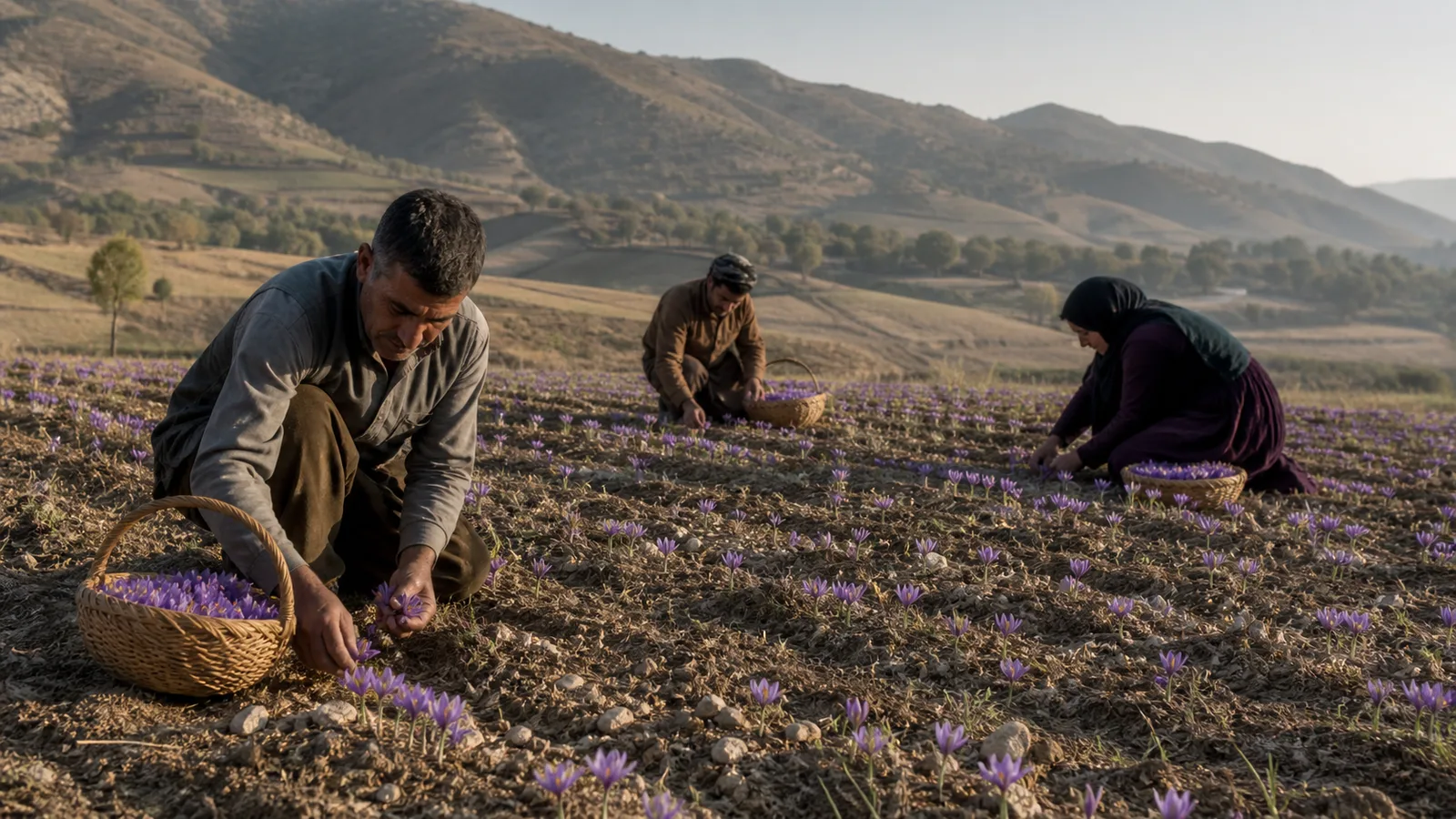
Harvest of red gold from Izeh Farms in Iran was reported as a small but expanding local crop project. The historical announcement said roughly 8.2 hectares were planted across Izeh County and that growers expected more than 3 kilograms of dried saffron per hectare. Those figures describe that season; they are not a current production forecast.
What the Izeh report recorded
Mostafa Harmandian, identified in the original report as the head of Izeh’s Agriculture Jihad office, announced the start of the county’s saffron harvest. He put the cultivated area at 2.5 hectares in one part of the county and 5.7 hectares elsewhere, for a reported total of about 8.2 hectares.
The translated source gives the first locality as “Dezz” and the harvest village as “Qala-e-Dandz.” Because those English spellings could not be verified independently, they are retained here as historical transliterations rather than silently replaced with a different place name.
The official expected a yield above 3 kilograms per hectare. If all 8.2 hectares had reached that level, the arithmetic would imply more than 24.6 kilograms of dried saffron. That is a calculation from the announcement, not a measured county total. Actual output depends on field age, corm health, weather, irrigation, flower density and how efficiently the stigmas are handled after picking.
When saffron was planted and harvested in Izeh
The announcement said saffron corm planting began in early October and flowers were ready during Azar, the Iranian calendar month that falls mainly across late November and early December. Harvest had started in the named village and was expected to continue through the first half of Azar.
Saffron does not wait for a convenient timetable. Flowers are usually collected promptly after opening, commonly in the cool morning, to limit exposure and keep the stigmas clean. The valuable red threads must then be separated from the flower and dried under controlled conditions. Delays, rough handling or poor drying can reduce colour, aroma and storage quality even when the field yield is good.
Why Izeh growers were trying saffron
The local official linked expansion to Izeh’s climate and saffron’s seasonal water pattern. Saffron is often described as a lower-water crop because its active growing period falls in the cooler part of the year and it does not require summer irrigation in the same way as many warm-season crops. That does not mean it needs no water. Establishment, pre-flowering irrigation, rainfall, drainage and soil moisture still affect flowering and corm development.
The wider goal was to introduce medicinal and industrial crops that could diversify rural income while placing less pressure on limited water supplies. Whether saffron is a sensible choice still has to be tested field by field. Soil drainage, salinity, frost exposure, labour availability and access to clean drying and packaging all matter.
Was the crop really organic?
The report said the saffron land had received neither chemical fertiliser nor chemical treatment for more than six years and described the crop as organic. That history may be useful, but it does not by itself prove certified-organic status. An organic claim normally depends on a defined production standard, records, inspection and certification by an authorised body.
Growers should also avoid treating “no fertiliser” as a quality target. Saffron removes nutrients from the soil, and a field may need compost or other permitted inputs based on analysis. The safer approach is to test the soil, document every input and follow the certification rules of the intended market before using an organic label.
The old price statement needs context
Harmandian said the high-quality product had overseas customers and quoted a market range of 80 million to 150 million rials. The translated report does not clearly state the unit, grade, date or point in the supply chain. It should therefore be read as an old market statement, not as today’s Izeh saffron price and not as a guaranteed return to a farmer.
A meaningful farm calculation needs the saleable dry weight, laboratory or sensory grade, packaging, rejected material, labour, irrigation, corm, drying and marketing costs. Revenue is not profit, and a high retail price does not show what a producer received at the farm gate.
How the saffron flower can create more local value
The announcement referred to economic uses for several parts of the plant, including the saffron stigmas and flower material. The red stigmas are the food spice. Petals and other by-products may have research or processing uses, but they are not interchangeable with saffron and should not be sold as the spice. Any food, cosmetic or industrial use needs suitable safety, quality and legal checks.
For a small production area, the most practical value may come from disciplined post-harvest work: hygienic separation, controlled drying, moisture-proof storage, honest grading and traceable packaging. Those steps can protect the quality already produced in the field without making unsupported claims about every part of the flower.
What the reported 50 jobs meant
The local official attributed 50 direct and indirect jobs to planting and harvest. That number should be treated as the report’s estimate for the project, not as a permanent full-time employment count. Saffron creates a sharp seasonal need for picking and stigma separation, while field care, processing, packaging and sales can support work over a longer period.
Future reporting would be more useful if it separated workdays from permanent jobs and recorded how many growers, pickers and processors participated. It should also publish harvested area and actual dry yield rather than only an expected yield.
What would show whether Izeh saffron succeeded?
The harvest announcement showed that commercial saffron cultivation had begun to spread in Izeh, but one season cannot establish long-term success. A sound follow-up would compare:
- planted area with the area actually harvested;
- dry saffron yield per hectare over several seasons;
- water use, soil test results and corm health;
- quality grade after drying and storage;
- farm-gate revenue against all production and labour costs; and
- seasonal workdays and lasting processing or sales jobs.
Those measures would turn a promising harvest story into evidence that farmers can use. The original account remains valuable as a snapshot: about 8.2 hectares, an expected yield above 3 kilograms per hectare, an Azar harvest and a local effort to build income around a crop with a different water calendar.
Sources
The Izeh areas, yield, calendar, price and employment figures come from the local official’s historical statement preserved in the original article. The distinction between a production history and certified-organic status follows the USDA Agricultural Marketing Service’s organic certification overview. General agronomic cautions were checked against the Iranian Agricultural News Agency’s review of elevation, temperature and nutrition in saffron cultivation.

![Exporting Saffron to Turkey + Price Guide [Complete 0 to 100]](https://img.rowhanisaffron.com/20260827003933/saffron-export-turkey-quality-inspection.webp)



