


Golbaf city is the pole of saffron in southeastern Iran was a development goal announced at the opening of a local saffron research farm in 2019. The event linked training, organic production and youth employment, but “pole” is best read as an ambition to make Golbaf a regional saffron hub—not proof that it had already become the southeast’s largest producer.
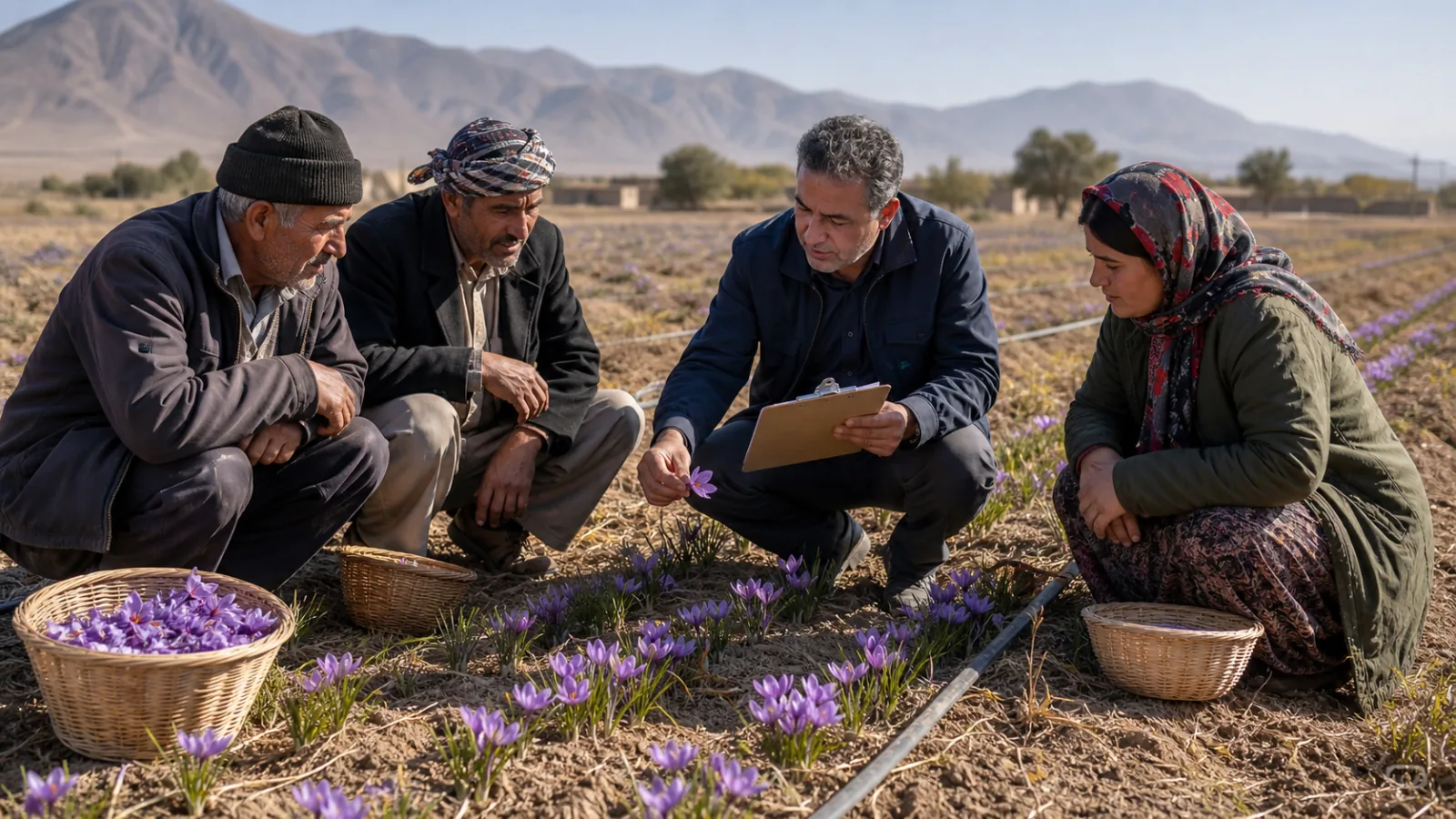
The 2019 opening in Golbaf
The original report quoted Dr Mohammad Mahdi Zahedi, then a representative for Kerman and Ravar in Iran’s Islamic Consultative Assembly. He welcomed the launch of a research farm associated with the Golbaf Saffron Research Institute at the Faculty of Agriculture.
The project was described as the result of an earlier cooperation memorandum between Golbaf’s Islamic Council and the National Saffron Institute at the University of Torbat Heydarieh. The article reported funding of 2.5 billion rials for specialist instruction in saffron cultivation and referred twice to “organic and organic” production. That repetition appears to be a translation error; it does not establish two separate cultivation systems.
Zahedi said experts would use the farm for theoretical and practical education. He expected the work to support employment for young people and improve business activity in Golbaf. Residents interested in training or investment were directed to the city’s Islamic Council, with problems to be raised through its public-relations office.
What it means to call Golbaf a saffron pole
In translated Iranian development reporting, “pole” usually means a recognized production centre or industry hub. It can refer to concentrated farms, specialist knowledge, services, processing and trade—not a pole in the geographic sense.
Zahedi said the goal was for Golbaf to become the saffron pole of southeastern Iran with support from responsible authorities. The wording was forward-looking. The 2019 source does not provide a regional ranking, cultivated-area comparison or output table, so it should not be turned into a current statistical claim.
A genuine hub would be visible in evidence: stable production records, trained growers, clean planting material, dependable laboratories, local drying and packaging capacity, traceable lots and buyers who return because quality is consistent.
Why Golbaf was interested in saffron
Saffron can fit dry-region diversification because the crop’s active growth and flowering cycle differs from many summer crops. That does not make it a no-water or universally profitable plant. Establishment, irrigation timing, soil drainage, labour during the short flower season and careful post-harvest handling still matter.
A local research farm is useful precisely because advice from another province cannot simply be copied. Trials can compare corm size, planting depth and density, irrigation schedules, nutrition, weed pressure and field age under Golbaf conditions. The results should include both yield and the quality of dried saffron.
Records also need to distinguish a demonstration plot from a commercial farm. A well-supported research field may receive closer management than a grower can afford across several hectares.
What a saffron research farm should teach
The strongest training combines a short explanation with work in the field and processing room. For Golbaf growers, a practical programme can cover:
- selecting sound saffron corms and recording their source and size;
- preparing well-drained soil and choosing an appropriate planting layout;
- scheduling irrigation from local soil and weather observations;
- monitoring weeds, pests, rot and declining field performance;
- picking flowers into clean containers and avoiding crushing or long delays;
- separating stigmas hygienically and drying them consistently; and
- assigning a lot code that connects field, harvest, drying and sale.
ISO 21983:2019, reviewed and confirmed in 2025, gives current guidelines for harvesting, transporting flowers, separating stigmas, drying and storing saffron before packing. Local teaching can adapt equipment and schedules while keeping those quality-control stages clear.
“Organic saffron” requires more than a planting method
The opening report repeatedly described the intended saffron as organic. Avoiding a particular input during one season is not enough to support an organic label in trade. A recognized programme normally covers farm conversion, permitted inputs, records, inspections, separation from non-organic product, processing, storage and labelling.
Requirements depend on the destination market. For example, the European Commission’s rules for imported organic products require an appropriate electronic certificate of inspection for entry into the EU. Its organic-logo guidance says the logo may be used only for products certified by an authorized control body and sets additional labelling conditions.
A Golbaf research programme should therefore separate three statements: grown with selected low-input practices, in conversion under a named scheme, or certified organic for a specified market. Clear wording protects both growers and buyers.
Can saffron begin with little capital and high profit?
Zahedi described saffron as a product that could be started on a small scale and deliver a high profit margin. Small plots can make entry possible, but high profit is not automatic. Corms are a substantial establishment cost, while harvest and stigma separation require concentrated labour. Yield changes with corm quality, field age, water, management and weather.
Revenue also depends on the product sold. Fresh flowers, dried stigmas in bulk and a tested consumer pack have different costs and buyers. A grower should budget for land preparation, planting material, irrigation, labour, drying, testing, packaging and sales, then model more than one yield and price outcome.
A research farm can make that planning more credible by publishing input quantities, hours of labour, measured dry yield and the method used to grade the result. A headline return without those details is not a business plan.
Turning training into youth employment
Farm employment lasts beyond planting and picking when the local value chain is developed carefully. Skilled work can include corm selection, crop monitoring, harvest coordination, hygienic separation, controlled drying, lot management, laboratory sampling, packaging and buyer support.
Training should match those real roles. A certificate of attendance has limited value if participants do not practise the task or if no local business needs it. Partnerships among growers, the council, university specialists, laboratories and buyers can define the skills and create supervised experience.
Young businesses also need honest market information. Producing more saffron before confirming quality requirements, pack sizes and buyers can depress local returns rather than create prosperity.
How to judge whether the Golbaf plan succeeds
The research farm’s value should be measured over several seasons. Useful indicators include the number of growers who adopt a tested practice, productive area rather than area merely planted, dried yield by field age, rejected or downgraded lots, water used, cost per gram and the share sold with traceable quality evidence.
Organic work needs its own record: farms in conversion, farms certified under a named scheme, audit findings and markets able to accept the certification. Employment claims should distinguish short harvest labour from continuing technical and commercial roles.
Golbaf has a credible route toward becoming a southeastern Iranian saffron centre when training produces repeatable field results and those results connect to reliable processing and demand. The 2019 opening supplied the institution and ambition. Transparent season-by-season evidence is what can turn that ambition into a durable local industry.

![Exporting Saffron to Turkey + Price Guide [Complete 0 to 100]](https://img.rowhanisaffron.com/20260827003933/saffron-export-turkey-quality-inspection.webp)



