


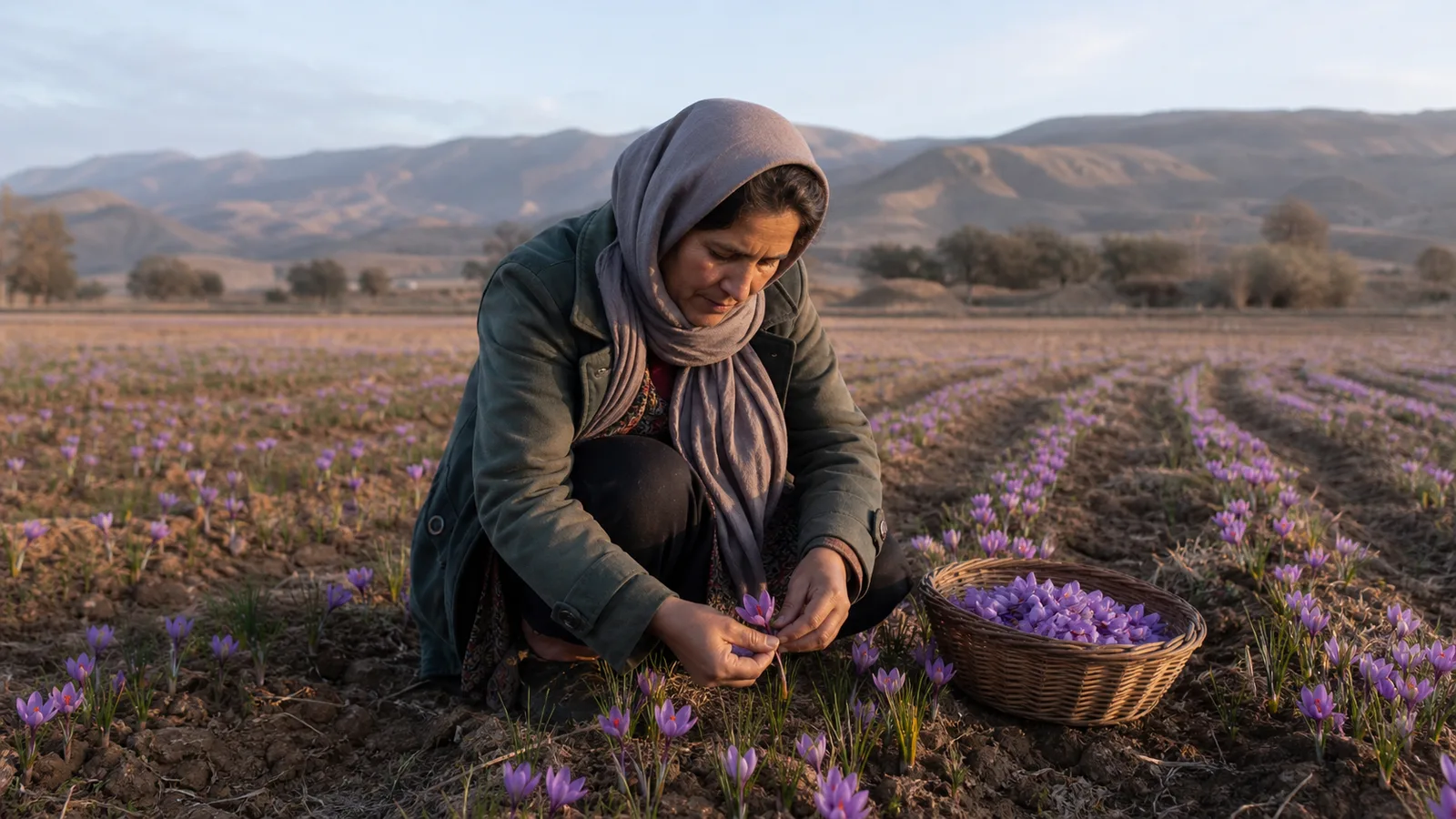
A rural entrepreneur’s decision to try saffron in Kermanshah became a project that reached far beyond her own plot. In the interview preserved in this article, Ms Mohammadi describes learning the crop, facing local doubt, establishing a small field and then helping families in villages with few income opportunities begin cultivating it themselves.
A note about the original report
This page was first published in English in July 2020 under the translated title “Effort at the price of saffron in Kermanshah province.” Its body, however, did not provide a dated market price. It told the story of one grower’s work to revive saffron cultivation and encourage other rural households. We have kept that account while removing unsupported claims that Kermanshah saffron was universally “the best” or necessarily sold above every other origin. Saffron prices change by grade, harvest, testing, supply, currency and market, so an undated price claim would mislead readers.
The first step: an entrepreneurship class
According to Ms Mohammadi’s account, the turning point came in 2010. An entrepreneurship-promotion class was held in her village for a women’s welfare fund, and she attended because she was interested in finding a workable agricultural opportunity. During the class she was introduced to saffron cultivation and heard about the crop’s potential advantages.
The idea was not immediately accepted around her. Although saffron cultivation was not entirely unknown in Kermanshah, she recalled that some people were unfamiliar with it and doubted that it would succeed locally. She decided to test the idea rather than settle the argument in theory.
Learning from established growers
Ms Mohammadi said that she travelled to Mashhad three times in a year to learn how the crop was grown. Mashhad is a major centre for Iran’s saffron trade and sits close to long-established production areas in Khorasan. Speaking with experienced growers and entrepreneurs gave her practical knowledge she could take back to Kermanshah.
Training matters because saffron is not simply planted and forgotten. A grower must choose sound corms, prepare free-draining soil, time irrigation for local conditions, manage weeds and lift the flowers quickly during a short harvest. The red stigmas must then be separated and dried with care. Small mistakes at any stage can reduce usable yield or quality.
A 1,000-square-metre trial in Shahin village
In 2011, she established saffron on a 1,000-square-metre plot in the village identified in the original interview as Shahin, Kermanshah. That is one tenth of a hectare: large enough to learn from real field conditions, but still a measured trial rather than an immediate leap into extensive cultivation.
She described expanding the crop gradually as her experience grew. One detail stood out to her as a sign of acceptance: buyers associated with Mashhad, where saffron knowledge and trade were already well established, bought Kermanshah-grown saffron. That is an attributed recollection from the interview, not a laboratory comparison or a claim that one province’s product is always superior.
Taking cultivation beyond one farm
For Ms Mohammadi, success on her own land was not the finish. She wanted cultivation to spread beyond Shahin village, so she began teaching farmers elsewhere in the province. The work meant returning throughout the production cycle rather than offering a single classroom lesson.
Her account says she helped start saffron cultivation for 72 rural families in villages with very limited facilities and income. She also described visiting those communities each year and assisting from the beginning of cultivation until the farmers could earn from the crop. The figure of 72 families comes from her interview and should be read in that context; the original post did not include an independent programme record.
Why saffron can interest small farms
Saffron’s high value relative to its dried weight can make it interesting where cultivable land is limited. The harvested product is compact and can be dried, graded and transported without the bulk of many field crops. Those advantages do not make it effortless or guarantee a particular income. Flower picking and stigma separation are labour-intensive, output varies, and the price depends on quality and the market available to the grower.
A viable project therefore needs more than suitable soil. Farmers need realistic production costs, healthy planting material, agronomic advice, enough labour for the harvest window, careful drying and storage, quality testing where available, and a credible route to buyers. Training is strongest when it covers that whole chain rather than focusing only on planting.
Quality determines value—not a province name alone
The old article connected Kermanshah saffron with a pleasant taste and a higher price, but it did not identify the tests, grades, dates or markets behind those statements. Origin can be meaningful, yet buyers assess the actual batch. Aroma, colour strength, flavour compounds, moisture, cleanliness, adulteration risk, thread condition, processing and packaging all affect how saffron is judged.
That distinction protects the central point of Ms Mohammadi’s story. Her achievement was not a slogan about one region being better than all others. It was the patient work of acquiring knowledge, proving a crop on a modest plot, and sharing the process with people who could adapt it to their own farms.
A family view of the work
The original interview closed with a comment from one of Ms Mohammadi’s children, who said their mother responded whenever she heard that someone needed help with saffron. Even while dealing with a lumbar-disc problem, the family member said, she continued working to develop saffron cultivation and support farmers.
It is a personal ending to a practical agricultural story. The important lesson is not that saffron automatically solves rural economic problems. It is that a small experiment, backed by training and sustained support, can give farmers evidence on which to make a better decision.

![Exporting Saffron to Turkey + Price Guide [Complete 0 to 100]](https://img.rowhanisaffron.com/20260827003933/saffron-export-turkey-quality-inspection.webp)



