


Announcing the latest coordinates of saffron futures on commodity exchanges was the headline used for an early update on Iran’s developing saffron derivative market. Alireza Naserpour, then deputy director of market development and economic studies at the Iran Mercantile Exchange, discussed contract maturities, margin requirements, certified quality, warehouses and plans for additional market instruments.
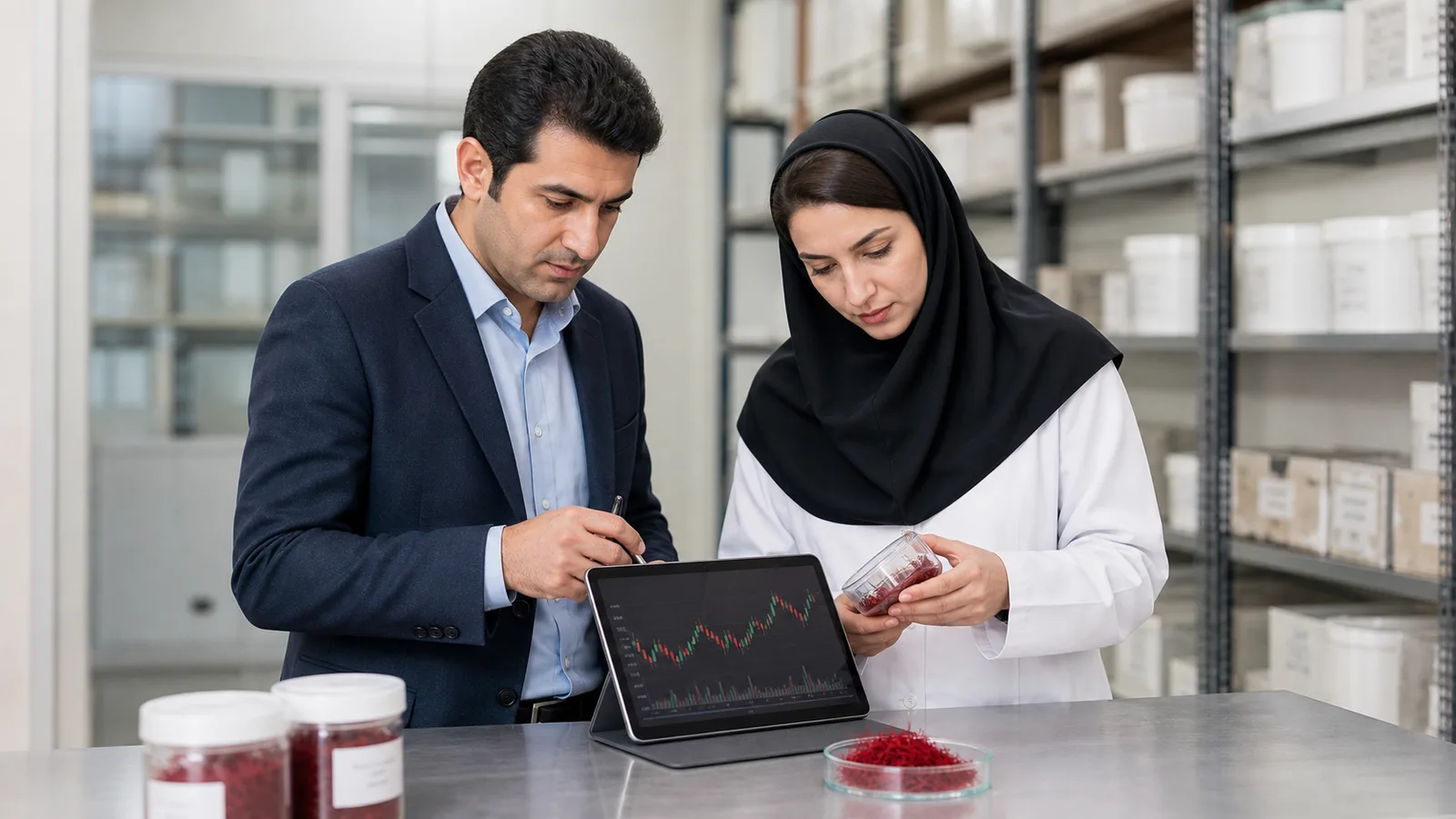
The figures were a snapshot from the 1397 Iranian calendar year, which ended in March 2019. They are not current contract specifications or investment guidance. Their lasting value is that they show how the exchange was trying to turn a traditionally negotiated agricultural trade into a standardised market.
What is a saffron futures contract?
A futures contract is an agreement to buy or sell a defined quantity and quality of a commodity at an agreed price for a specified future date. The contract is standardised by the exchange. Traders can close a position before maturity by taking an offsetting position, while contracts held into the delivery process must follow the exchange’s settlement rules.
For growers, exporters and other commercial users, futures can provide a way to manage exposure to changing prices. They also attract speculators who accept price risk in pursuit of a return. These are leveraged instruments: the trader posts margin rather than paying the full contract value, so losses can exceed the initial amount deposited.
This article explains the historical Iranian market update. Anyone considering a live contract must obtain the current specification, margin notice, warehouse list and delivery calendar directly from the relevant exchange and an authorised broker.
Why contract maturities were initially short
Naserpour said saffron futures had previously been listed with no more than about 45 days to maturity. By the time of his comments, the horizon had reached approximately three months, with longer-dated contracts planned as the market developed.
He linked those shorter maturities to volatility and the need to manage an unfamiliar market cautiously. A nearer delivery date reduces the period over which large price changes, crop uncertainty and changes in export conditions can accumulate. If trading becomes deeper and more stable, an exchange can consider additional maturities, giving producers and buyers more dates against which to hedge.
The old references to “next year” are tied to that 1397–1398 calendar transition. They should not be read as present announcements of a new contract.
How margin balances access and risk
The “guarantee” in the earlier translation refers to margin or performance security. Naserpour said it was calibrated from previous contract-price fluctuations so that the market and brokers had protection when prices moved sharply.
A higher margin requirement can reduce leverage and provide a larger buffer against default, but it also ties up more capital and may reduce trading volume. A lower requirement can make participation easier while leaving less room for adverse movement. Naserpour described this as a trade-off between liquidity and risk, and said the required amount could be reconsidered if the saffron futures market stabilised.
Margin is not a purchase instalment. Futures positions are revalued as prices change, and a trader may have to provide more funds when an account falls below the required level. That is why a busy market or a smaller initial payment should never be confused with low risk.
Certified quality and warehouse receipts
Saffron names can be used differently in traditional trade. Two merchants may attach different expectations to the same commercial label, which makes an informal name a weak basis for an exchange delivery obligation.
Naserpour said accepted saffron therefore had to meet a published specification aligned with Iran’s national standard. The relevant quality was disclosed in the contract, and a buyer taking delivery would receive saffron conforming to that specification. His expectation was that objective exchange requirements would gradually become more influential than customary descriptions.
The physical link was a certified warehouse. Eligible saffron could be deposited, checked and represented by a commodity deposit certificate or warehouse receipt. That record allowed standardised units to trade without moving the same package between participants after every transaction, while the approved warehouse remained responsible for custody under its rules.
Why exchange volume can exceed annual production
The historical update placed Iran’s annual saffron harvest at approximately 300–350 tonnes for that period. It also said about 100 tonnes had traded in the exchange’s cash market and that saffron futures turnover had exceeded the physical production figure.
Those numbers are not necessarily contradictory. Futures volume counts contracts traded. The same position can change hands, be closed and reopened, so turnover can represent the equivalent of a physical quantity more than once. It does not mean that the exchange created additional saffron or that a greater quantity was delivered.
Production and exchange-trading figures must also be compared on the same dates and definitions. The values above are retained because they were part of Naserpour’s market assessment, not because they describe today’s crop or current open interest.
What actually moves the saffron market?
Naserpour cautioned against treating saffron like gold or a currency pair. Exchange rates matter because Iran is a major exporter and foreign-currency revenue affects local pricing, but saffron has its own agricultural and commercial cycle.
Important influences include the size and quality of the crop, the timing of harvest, stock held by growers and merchants, export demand, conditions in destination markets, warehouse availability and the cost of finance. A futures price reflects market expectations about these influences for a particular contract month; it is not a guaranteed forecast of the future cash price.
This is the core purpose of a saffron derivative market: different participants can transfer price risk through a transparent contract. It cannot remove harvest risk, export restrictions, basis risk or the possibility that a trader’s position moves sharply against them.
Warehouse expansion in Khorasan
At the time of the statement, Naserpour said the number of approved saffron warehouses had risen from one to two. He expected at least four to be available early in Iranian year 1398, which began in March 2019.
More approved capacity in Khorasan could make delivery and deposit more accessible to growers, reduce concentration at a single facility and support larger certificate volumes. The benefit depends on where the warehouses are located, their admission and storage costs, testing consistency and whether farmers can use them conveniently.
The earlier English text incorrectly rendered 1398 as “1998.” This was a calendar-translation error, not a claim that the warehouse expansion occurred two decades earlier.
Options and commodity-fund plans
The update also referred to plans for options and other instruments tied to saffron, with the aim of attracting users with different risk profiles. Naserpour said futures on units of saffron-based commodity funds were being considered, subject to permission from the Securities and Exchange Organization.
These statements recorded a development programme, not confirmation that every proposed product launched on the expected schedule. Options, futures and commodity funds have different payoff structures and obligations; they should not be grouped together as interchangeable ways to own physical saffron.
He separately said there was no plan at that time to restart coin futures and that any such restart depended on other conditions. That point concerned the broader derivatives market and did not change the saffron contract itself.
What this historical update tells us
The early saffron futures market was being built around three connected controls: standard contracts, margin-based risk management and certified physical delivery. The exchange was lengthening maturities carefully, widening warehouse capacity and exploring more instruments while acknowledging that high margin could restrict liquidity.
That architecture is more important than treating any old tonnage, warehouse count or maturity as current. A sound market needs both sides: enough access for growers, buyers and traders to participate, and enough quality, custody and financial control for a contract to remain credible.
Sources and risk note
The historical figures and plans are attributed to Naserpour’s exchange-market comments preserved in the original report. General explanations of futures, margin, hedging and risk follow the US Commodity Futures Trading Commission’s official Futures Market Basics and economic-purpose guide. Those sources explain market mechanics; they do not set Iranian contract rules. This page is educational and does not recommend a trade.

![Exporting Saffron to Turkey + Price Guide [Complete 0 to 100]](https://img.rowhanisaffron.com/20260827003933/saffron-export-turkey-quality-inspection.webp)



