


“600 hectares of saffron farms in Bardaskan region in thirst for water” was the stark warning in a local report about shrinking water sources. The story also connected the farm crisis with village planning, jobs, safer housing and emergency readiness.
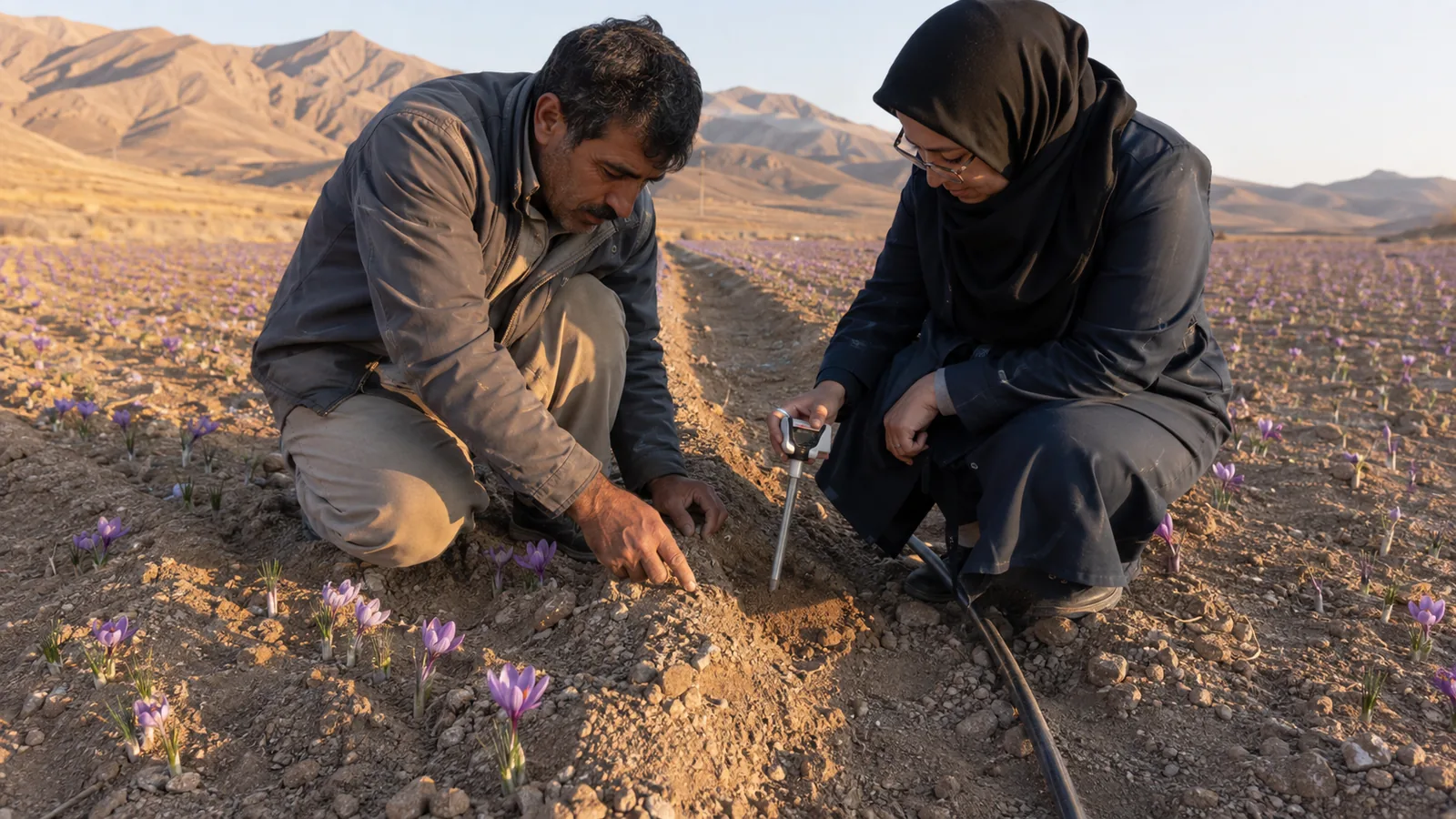
Why 600 hectares of Bardaskan saffron were at risk
Mohammad Abbaspour, then governor of Bardaskan, said more than 600 hectares of saffron farms in the county’s foothills were suffering from severe water shortage. Reduced supplies and the drying of most local water channels meant that some fields might not produce even one flower without urgent help.
The English source used “canals,” but the regional context points to qanats and related local water sources rather than a modern open-canal network alone. Because the original report supplied no inventory of the affected systems, it is safest to retain its broader meaning: established sources serving mountain and foothill farms had diminished or dried.
Saffron uses less water, but it cannot grow without water
Saffron is often chosen in dry regions because its seasonal pattern can require less irrigation than many summer crops. That relative advantage is easy to misunderstand. Corms still need suitable moisture at important stages, and a severe shortage can reduce flowering or weaken the field over time.
The Food and Agriculture Organization’s description of the qanat-based saffron system in Gonabad explains why saffron and traditional underground water systems are closely connected in this part of Iran. Gonabad is not Bardaskan, so its figures do not measure these 600 hectares. It provides sound regional context: in an arid and semi-arid environment, dependable qanat water can support both saffron production and rural livelihoods.
What “not even one flower” meant
Abbaspour’s warning was plainly urgent, not a measured botanical forecast for every hectare. Fields differ in age, corm condition, soil, elevation and the amount of water still available. Some might fail before others.
Read in context, the remark conveyed the risk of leaving affected growers without timely support. It should not be turned into a precise yield prediction or used to claim that all 600 hectares failed. The surviving report does not provide the eventual harvested area or final dry-saffron total.
The meeting was about more than one crop
The governor made the comments during a consultative meeting with village representatives. He called for rural “think tanks” and village development plans built around local capacities. He also urged communities to identify knowledgeable residents who could contribute to development and job creation.
That framing matters. Emergency water can protect a season, but rural resilience depends on more than a tanker or subsidy. Villages need a realistic view of their water balance, viable crops and businesses, local skills, infrastructure and routes to market. A useful plan should distinguish immediate relief from investments that can be maintained.
Crop planning should begin with the water budget
Abbaspour asked for new employment prospects and farming patterns that could help people remain in rural areas. The goal was economic continuity, not simply expanding every crop.
For saffron, responsible planning would identify how much land is actually productive, which fields have secure water, and whether ageing or damaged qanats can be restored. It would also consider the cost of corms, labour, drying and marketing. A high-value crop can still become uneconomic when emergency water and harvest labour outweigh the return.
The proposal for pressurized irrigation
The historical report said the government offered 37 million rials per hectare to applicants who installed pressurized irrigation on more than three hectares. It also described a group route involving ten people and a free water-storage facility. The translation does not identify the programme name, application year, technical specification or authority responsible for approval.
Those details should therefore be treated as terms announced at that meeting, not as a current grant. Growers looking for assistance now would need to confirm present eligibility, costs, ownership rules and engineering requirements with the relevant local agricultural and water authorities.
Pressurization is a system, not a promise
Pressurized delivery can improve control and uniformity when it is correctly designed, operated and maintained. It does not create new water, repair a depleted aquifer or guarantee that a particular field has a sustainable allocation.
FAO describes irrigation modernisation as a technical and managerial process rather than the simple replacement of old equipment. Its irrigation-management guidance emphasises assessment and planning, including water resources, agronomic demand, distribution performance and farm service. That is a better way to read Bardaskan’s pressurization proposal: it might be one useful component, but only after the local system and crop need are understood.
Water storage requires the same caution
A storage facility can help match an intermittent supply to irrigation timing, particularly when several farmers cooperate. Its value depends on where the water comes from, how losses are controlled and how access is shared.
The old article does not state the storage volume, construction standard or operating agreement for the ten-person groups. “Free” appears to describe the proposed public support, not the absence of future maintenance, pumping or management costs. Those practical obligations would need to be clear before farmers relied on the scheme.
Earthquake preparedness was another rural concern
Abbaspour also referred to a recent earthquake and Bardaskan’s position near the Daruneh fault. He said the city lacked a Red Crescent presence and asked village representatives to arrange relief training through Red Crescent instructors.
He also encouraged the rehabilitation of rural homes through available housing facilities. The article does not identify the earthquake’s date, magnitude or a structural assessment, so it cannot tell readers which buildings were unsafe. It does preserve the governor’s broader message: village development should include preparedness and safer housing, not agriculture alone.
How the concerns fit together
Water shortage, employment, housing and disaster readiness can look like separate topics. For a rural household, they are closely connected. A failed harvest reduces income; weak income makes home repairs harder; an unsafe home increases earthquake risk; and repeated losses can push families away from the village.
This explains the call for development plans based on each village’s capacity. A plan centred only on hectares planted can miss the systems that make farming possible: water governance, technical advice, storage, transport, processing, housing and trained local people.
What the historical report leaves unanswered
A complete record would identify the date of the meeting, the villages and number of farmers within the 600 hectares, the water sources that had failed and the irrigation volume needed. It would also state how much of the threatened area received assistance and what harvest followed.
For the funding proposal, readers would need the programme rules, approved applicants, installation type and later performance. For earthquake preparedness, the missing information includes the event details, training schedule, building assessments and whether a permanent relief capacity was established.
The lasting lesson from Bardaskan’s thirsty farms
The 600-hectare figure should remain attached to its historical warning, not be presented as Bardaskan’s current saffron area. Its importance lies in what it revealed: a high-value crop was still vulnerable when the local water system weakened.
The most durable response combines immediate support with honest water accounting, field-level advice, well-designed irrigation and village planning that includes people as well as crops. Saffron may suit a dry climate, but Bardaskan’s experience shows that “low water” never means “no water.”

![Exporting Saffron to Turkey + Price Guide [Complete 0 to 100]](https://img.rowhanisaffron.com/20260827003933/saffron-export-turkey-quality-inspection.webp)



